Begin of page section:
Page sections:

  • Go to contents (Accesskey 1)
  • Go to position marker (Accesskey 2)
  • Go to main navigation (Accesskey 3)
  • Go to sub navigation (Accesskey 4)
  • Go to additional information (Accesskey 5)
  • Go to page settings (user/language) (Accesskey 8)
  • Go to search (Accesskey 9)

End of this page section. Go to overview of page sections

Begin of page section:
Page settings:

English en
Deutsch de
Search
Login

End of this page section. Go to overview of page sections

Begin of page section:
Search:

Search for details about Uni Graz
Close

End of this page section. Go to overview of page sections


Search

Begin of page section:
Main navigation:

Page navigation:

  • University

    University
    • About the University
    • Organisation
    • Faculties
    • Library
    • Working at University of Graz
    • Campus
    Developing solutions for the world of tomorrow - that is our mission. Our students and our researchers take on the great challenges of society and carry the knowledge out.
  • Research Profile

    Research Profile
    • Our Expertise
    • Research Questions
    • Research Portal
    • Promoting Research
    • Research Transfer
    • Ethics in Research
    Scientific excellence and the courage to break new ground. Research at the University of Graz creates the foundations for making the future worth living.
  • Studies

    Studies
    • Prospective Students
    • Students
  • Community

    Community
    • International
    • Location
    • Research and Business
    • Alumni
    The University of Graz is a hub for international research and brings together scientists and business experts. Moreover, it fosters the exchange and cooperation in study and teaching.
  • Spotlight
Topics
  • Sustainable University
  • Researchers answer
  • Work for us
Close menu

End of this page section. Go to overview of page sections

Begin of page section:
You are here:

University of Graz News Simon Benal completes a voluntary environmental year at the University of Graz

End of this page section. Go to overview of page sections

Friday, 09 January 2026

Simon Benal completes a voluntary environmental year at the University of Graz

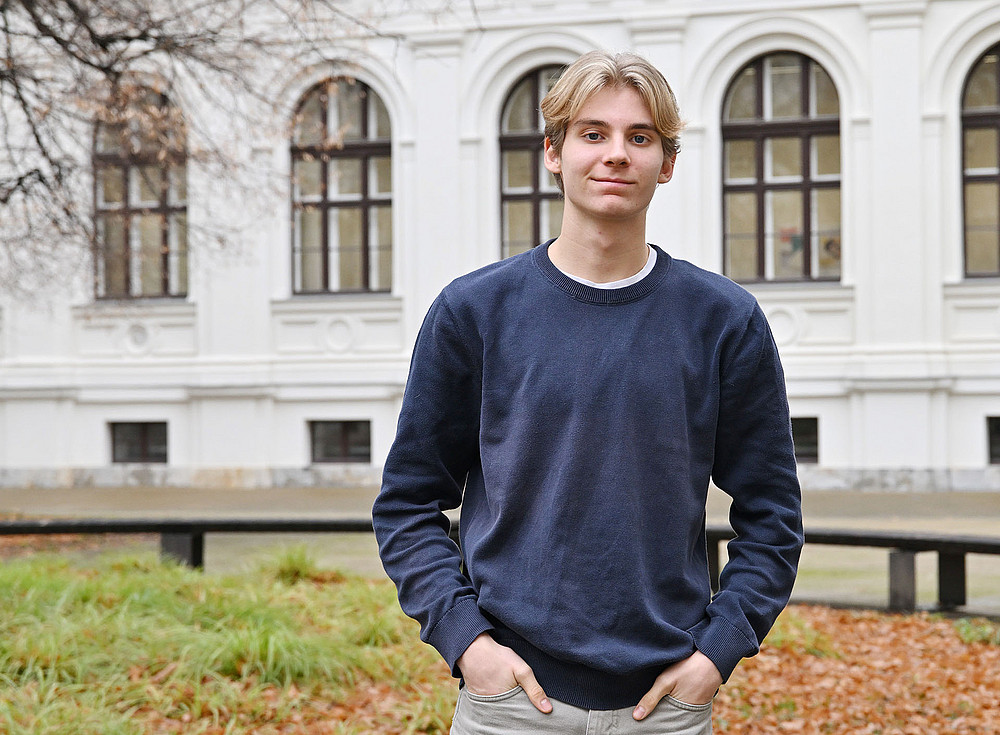
Simon Benal in the courtyard of the main university building ©University of Graz / Pichler

Simon Benal supports the Environmental Management team at the University of Graz.

Committing to the planet, getting to know exciting fields of activity and discovering possible paths for your own future – these are the opportunities offered by the Freiwilliges Umweltjahr (FUJ), a voluntary environmental year. One person who has chosen this option is Simon Benal. He has been working in the environmental management team at the University of Graz since September 2025.


“Environmental and climate protection are very important to me,” says Simon Benal. And that makes him a perfect fit as a “FUJler” at the University of Graz. When it comes to sustainability, the university has been setting an example for many years – in research and teaching as well as in its overall operation. Since 2016, it has been pursuing a consistent environmental management system certified according to EMAS and ISO 14001. In addition, the University of Graz has set itself the goal of becoming one of the first climate-neutral universities in Austria by 2040 through consistent measures to reduce emissions.

Benal's activities are quite varied. “I proofread the texts for the University of Graz's environmental statement 2024, maintain our department's website, take photos, create graphics and am currently programming a tool for issuing certificates to university employees who complete internal training courses on sustainability topics,” he reports. In the process, he is also discovering how a university functions as a business. What surprised him was that “it is far more complex than I had imagined, with so many different tasks in different departments.” And these departments must also be integrated into environmental management and work together to make the university as a whole even more sustainable and climate-friendly. “Consistently pursuing this path while guaranteeing the best conditions for science and study is a major challenge,” Benal realised after just a few months. In addition to his work at the university, he also appreciates the seminars, workshops and excursions offered as part of the FUJ course. They provide environmental education, promote personal development and are designed to help with career orientation.

However, Simon Benal has already decided that he wants to study computer science in autumn 2026. He has already acquired the basic skills for this at school, BORG Feldbach, where he chose this branch of study. “Computer science can be used in many areas. I could imagine adding a bachelor's degree in Environmental Systems Sciences afterwards,” he muses. But he still has some time until then. In any case, he will gain valuable experience at the University of Graz over the next six months.

Information about the FUJ at the University of Graz

The FUJ can be completed as an alternative to community service. There are more than 90 organisations throughout Austria to choose from.

created by Gudrun Pichler

Related news

Cosmetics in the environment: University of Graz proves danger to ants

Titanium dioxide, which is found in cosmetics, for example, is increasingly entering the environment in the form of nanoparticles. This could also put insects at risk. If ants ingest the substance in combination with the pesticide glyphosate, it disturbs the development of their offspring. Scientists at the University of Graz are drawing attention to the negative consequences of this toxic cocktail.

Varied and healthy: studies move

Exercise is the ideal way to balance out everyday stress, prevent illness and keep fit. Why this is the case, how to do it properly and what role human bodily functions and psychology play can be studied at the University of Graz.

Religious scholar Theresia Heimerl: Fasting as a spiritual boost

Fasting is not just a strategy for losing weight – it is a ritual dating back thousands of years with spiritual and evolutionary roots that has positive effects on the body. At the University of Graz, religious scholar Theresia Heimerl is investigating why fasting is a "spiritual boost".

Does fasting make us younger, Tobias Eisenberg?

Not eating is currently on everyone's lips. It's Lent, and the next swimming season is just around the corner. This phase is equated with weight and calorie reduction. Biochemist and molecular biologist Tobias Eisenberg is investigating how short-term food deprivation – a very common occurrence for our ancestors – affects the organism.

Begin of page section:
Additional information:

University of Graz
Universitaetsplatz 3
8010 Graz
Austria
  • Contact
  • Web Editors
  • Moodle
  • UNIGRAZonline
  • Imprint
  • Data Protection Declaration
  • Accessibility Declaration
Weatherstation
Uni Graz

End of this page section. Go to overview of page sections

End of this page section. Go to overview of page sections

Begin of page section:

End of this page section. Go to overview of page sections