



Begin of page section:
Page sections:

  • Go to contents (Accesskey 1)
  • Go to position marker (Accesskey 2)
  • Go to main navigation (Accesskey 3)
  • Go to sub navigation (Accesskey 4)
  • Go to additional information (Accesskey 5)
  • Go to page settings (user/language) (Accesskey 8)
  • Go to search (Accesskey 9)

End of this page section. Go to overview of page sections

Begin of page section:
Page settings:

English en
Deutsch de
Search
Login

End of this page section. Go to overview of page sections

Begin of page section:
Search:

Search for details about Uni Graz
Close

End of this page section. Go to overview of page sections


Search

Begin of page section:
Main navigation:

Page navigation:

  • University

    University
    • About the University
    • Organisation
    • Faculties
    • Library
    • Working at University of Graz
    • Campus
    Developing solutions for the world of tomorrow - that is our mission. Our students and our researchers take on the great challenges of society and carry the knowledge out.
  • Research Profile

    Research Profile
    • Our Expertise
    • Research Questions
    • Research Portal
    • Promoting Research
    • Research Transfer
    • Ethics in Research
    • Commission for Scientific Integrity
    Scientific excellence and the courage to break new ground. Research at the University of Graz creates the foundations for making the future worth living.
  • Studies

    Studies
    • Prospective Students
    • Students
    • Registration for Study Programme (Winter semester 2026/27)
  • Community

    Community
    • International
    • Location
    • Research and Business
    • Alumni
    The University of Graz is a hub for international research and brings together scientists and business experts. Moreover, it fosters the exchange and cooperation in study and teaching.
Topics
  • Sustainable University
  • Researchers answer
  • Work for us
Close menu

End of this page section. Go to overview of page sections

Begin of page section:
You are here:

University of Graz News Semesterauftakt

End of this page section. Go to overview of page sections

Wednesday, 15 March 2017

Semesterauftakt

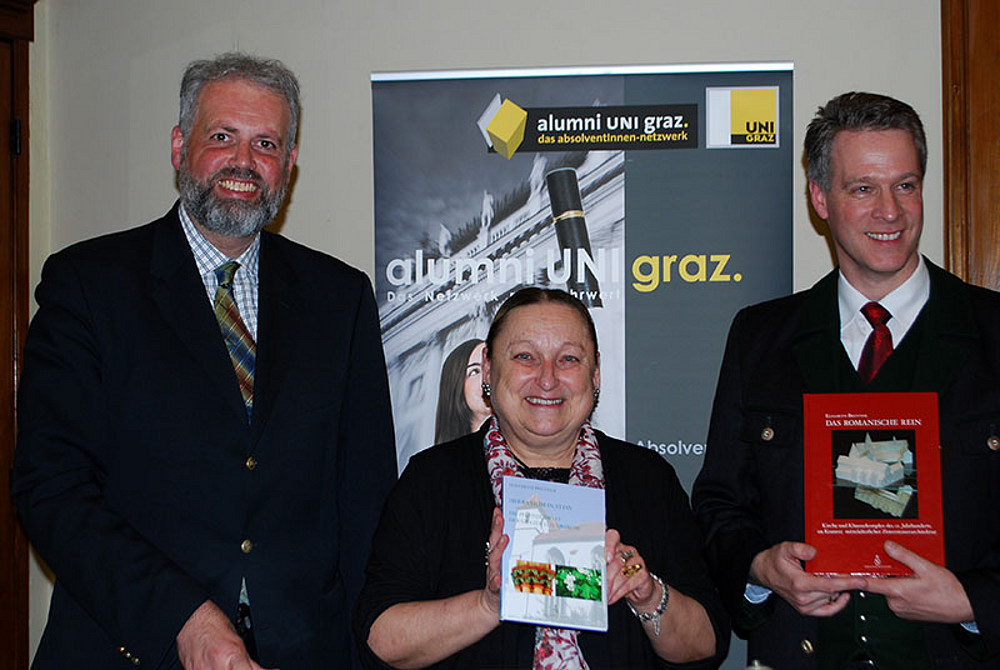
Grußredner Hansjörg Weidenhoffer vom Bundesdenkmalamt, Autorin Elisabeth Brenner und Christopher Schaffer vom Sublilium Schaffer-Verlag (v.l.). Foto: Margit Stadlober.

Grußredner Hansjörg Weidenhoffer vom Bundesdenkmalamt, Autorin Elisabeth Brenner und Christopher Schaffer vom Sublilium Schaffer-Verlag (v.l.). Foto: Margit Stadlober.

Forschungsstelle Kunstgeschichte Steiermark präsentierte Publikationen zu Stift Rein und der Grazer Leechkirche

Ein authentisches Bild des Klosters Stift Rein bei Graz im 12. Jahrhundert sowie eine Analyse der dreidimensionalen Darstellungen von Pflanzenblüten, -blättern und Früchten in den Säulenkapitellen der Grazer Leechkirche: Zwei Publikationen, eine Autorin. Dr. Elisabeth Brenner, 2015 sub auspiciis Promovendin der Kunstgeschichte an der Uni Graz, trug für ihre beiden Werke bekannte kunsthistorische Fakten und neue Forschungsergebnisse zusammen.

Die Leechkirche in Universitätsnähe ist ein seltenes „Herbarium in Stein“. Der aus der Botanik stammende Begriff meint eine Sammlung getrockneter und gepresster Pflanzen – tatsächlich dienten Blüten, Blätter und Früchte als Vorbilder für die zwölf Säulenkapitelle der Kirche. Geschaffen im 13. Jahrhundert, gehören diese Denkmäler zu den ältesten ihrer Art in Österreich. Brenner untersucht diese jedoch nicht nur aus kunsthistorischem Blickwinkel. Welche Rolle die dargestellten Pflanzen im christlichen Glauben des Mittelalters spielten und welche Attribute ihnen in der damaligen Heilkunde zugeschrieben wurden, erläutert die Wissenschafterin in ihrem Buch ebenfalls.

Ihre Dissertation, die nun in Buchform vorliegt, hatte Brenner der Rekonstruktion des ursprünglichen Baus des weltältesten Zisterzienser-Klosters, Stift Rein bei Graz, gewidmet. Das Kloster, gegründet im Jahr 1129, wurde in den folgenden Jahrhunderten mehrmals verändert, sodass von der originalen Bausubstanz heute nur mehr wenig zu sehen ist. Wie das Stift außen und innen eigentlich aussah, verdeutlichte Brenner in einem 3 D-Modell – und ließ so das ursprüngliche, romanische Rein nicht nur in Wort und Bild wiederauferstehen, sondern auch auf plastische Weise.

Beide Publikationen sind bei Sublilium Schaffer erschienen, einem jungen Fachverlag, der sich auf den Bereich kunst- und kulturhistorischer Themen spezialisiert hat. Neben Inhaber Mag. Christopher Schaffer konnten Elisabeth Brenner und Ao.-Univ. Prof. Dr. Margit Stadlober, Leiterin der Forschungsstelle Kunstgeschichte Steiermark, bei der Buchpräsentation Mitte März im Bundesdenkmalamt, Abteilung für Steiermark, auch MitarbeiterInnen des Universitätsverlags sowie des Böhlau Verlags begrüßen. Geistliche Vertreter des Stiftes Rein, Angehörige der Karl-Franzens-Universität sowie Grazer Größen der Kulturszene waren ebenfalls gekommen, um sich am Büchertisch der Verlage zu informieren und Netzwerk-Gespräche zu führen. Zu einem seltenen Zusammentreffen am Rande kam es, da mit dem Grußredner Dr. Hansjörg Weidenhoffer vom Bundesdenkmalamt ein zweiter sub auspiciis-Promovend der Kunstgeschichte anwesend war.


Gefördert wurde die Veranstaltung vom AbsolventInnenverein alumni UNI graz mit seiner Sektion „Freunde des Kunsthistorischen Instituts“ und dem Dekanat der Geisteswissenschaftlichen Fakultät.


Publikationen:


Dr. Elisabeth Brenner: „Das romanische Rein. Kirche und Klausurkomplex des 12. Jahrhunderts im Kontext mittelalterlicher Zisterzienserarchitektur“. Sublilium Schaffer, Mai 2016.
Dr. Elisabeth Brenner: „Herbarium in Stein: Die Pflanzenwelt der Grazer Leechkirche“. Sublilium Schaffer, November 2016.

created by Gerhild Kastrun

Related news

Baby health: University of Graz is seeking study participants to investigate early risk factors

Why does the body composition of babies vary so much? Some children gain a significant amount of fat mass within a few weeks, whilst others show hardly any change over the same period. “At the same time, initial observations suggest that fat distribution in all babies may follow a similar pattern, regardless of their total body fat,” explains Marco Höfler from the Institute of Movement Sciences, Sport and Health at the University of Graz. He is coordinating the research project ‘Small Bodies – Big Questions’, for which participants are currently still being sought: pregnant women and babies up to four weeks old.

In hot water: New Report reveals record losses in glaciers, permafrost and snow cover

Climate change is driving up temperatures not only in summer. Winters are also getting warmer – with dramatic consequences for glaciers, permafrost, snow cover and the freezing of lakes. The recently published cryosphere report provides specific figures for Austria. “Our monitoring shows a clear trend with record losses of ice and snow,” says project leader Wolfgang Schöner from the University of Graz.

Theologian at the University of Graz: What the excommunication of the Society of St Pius X

Following the schism involving the Society of St Pius X, there is a need for discussion. Bernd Hillebrand from the University of Graz explains why the Vatican took this step, what role anti-democratic tendencies play, and why the Society’s sacraments are no longer recognised as valid under canon law for Catholics with immediate effect.

“HeinrichBiCool”: University of Graz demonstrates the effects of green facades and roofs

The University of Graz has launched a pioneering project at the University Centre for Theology. Its name, “HeinrichBiCool”, says it all: a comprehensive system of green facades and roof will cool the building at Heinrichstraße 80 during the summer. At the same time, this will create a new habitat for plants and animals, helping to increase biodiversity. The accompanying monitoring programme will provide detailed data on the impact of the measures on indoor climate, energy consumption and biodiversity. The findings will lay a scientifically sound foundation for further projects aimed at making cities sustainable, climate-resilient and liveable. The partners in this project, funded by the Austrian Research Promotion Agency (FFG), are AEE INTEC – Institute for Sustainable Technologies, Technisches Büro Siegfried Stark, the landscape architecture and urban planning firm “studio boden”, and Ökoteam Graz.

Begin of page section:
Additional information:

University of Graz
Universitaetsplatz 3
8010 Graz
Austria
  • Contact
  • Web Editors
  • Moodle
  • UNIGRAZonline
  • Imprint
  • Data Protection Declaration
  • Accessibility Declaration
Weatherstation
Uni Graz

End of this page section. Go to overview of page sections

End of this page section. Go to overview of page sections

Begin of page section:

End of this page section. Go to overview of page sections