Begin of page section:
Page sections:

  • Go to contents (Accesskey 1)
  • Go to position marker (Accesskey 2)
  • Go to main navigation (Accesskey 3)
  • Go to sub navigation (Accesskey 4)
  • Go to additional information (Accesskey 5)
  • Go to page settings (user/language) (Accesskey 8)
  • Go to search (Accesskey 9)

End of this page section. Go to overview of page sections

Begin of page section:
Page settings:

English en
Deutsch de
Search
Login

End of this page section. Go to overview of page sections

Begin of page section:
Search:

Search for details about Uni Graz
Close

End of this page section. Go to overview of page sections


Search

Begin of page section:
Main navigation:

Page navigation:

  • University

    University
    • About the University
    • Organisation
    • Faculties
    • Library
    • Working at University of Graz
    • Campus
    Developing solutions for the world of tomorrow - that is our mission. Our students and our researchers take on the great challenges of society and carry the knowledge out.
  • Research Profile

    Research Profile
    • Our Expertise
    • Research Questions
    • Research Portal
    • Promoting Research
    • Research Transfer
    • Ethics in Research
    Scientific excellence and the courage to break new ground. Research at the University of Graz creates the foundations for making the future worth living.
  • Studies

    Studies
    • Prospective Students
    • Students
  • Community

    Community
    • International
    • Location
    • Research and Business
    • Alumni
    The University of Graz is a hub for international research and brings together scientists and business experts. Moreover, it fosters the exchange and cooperation in study and teaching.
  • Spotlight
Topics
  • Our digital Advent calendar
  • Sustainable University
  • Researchers answer
  • Work for us
Close menu

End of this page section. Go to overview of page sections

Begin of page section:
You are here:

University of Graz News Science & Society

End of this page section. Go to overview of page sections

Tuesday, 31 July 2018

Science & Society

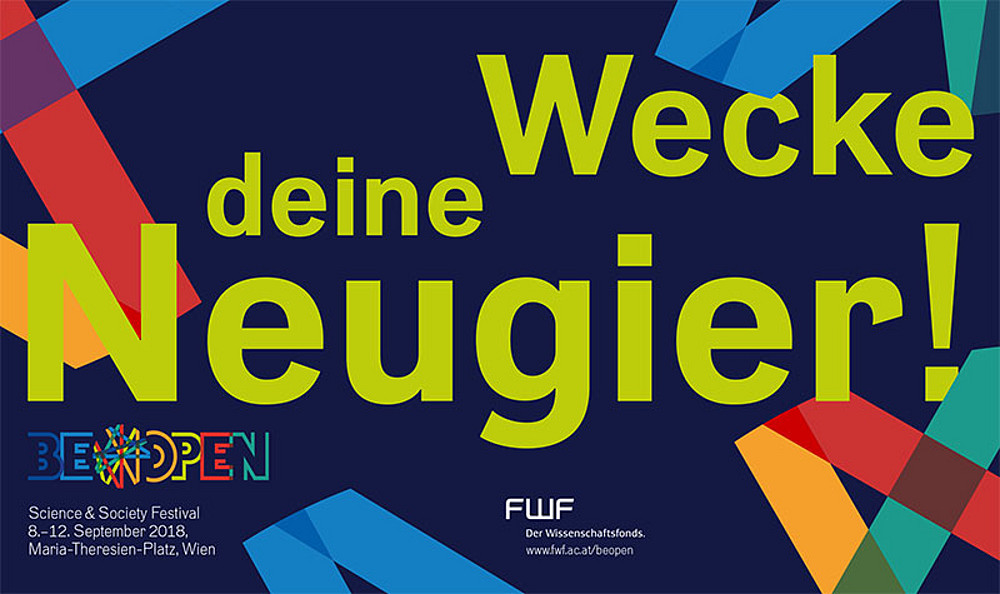
Wie lassen sich einzelne Moleküle bewegen? Und wie sieht es auf der Sonne aus? Das zeigen ForscherInnen der Universität Graz beim Science & Society Festival des FWF im September in Wien. Grafik: FWF

Wie lassen sich einzelne Moleküle bewegen? Und wie sieht es auf der Sonne aus? Das zeigen ForscherInnen der Universität Graz beim Science & Society Festival des FWF im September in Wien. Grafik: FWF

WissenschafterInnen der Universität Graz präsentieren spannende Forschung beim FWF-Festival in Wien

Mit einem mehrtätigen Science & Society Festival feiert der Österreichische Wissenschaftsfonds FWF von 8. bis 12. September 2018 sein 50-jähriges Bestehen. Unter dem Motto „BE OPEN“ wird der Maria-Theresien-Platz in Wien – zwischen Naturhistorischem und Kunsthistorischem Museum – zur Bühne für Spitzenforschung. Das Festival für alle Neugierigen lädt zum Entdecken, Mitmachen und Mitreden ein. Auch WissenschafterInnen der Universität Graz präsentieren vor großem Publikum ausgewählte Projekte.

Molekülrennen und Weltraumwetter
In einem interaktiven Pop-up-Pavillon zum Thema Materialforschung demonstriert Leonhard Grill mit seinem Team vom Institut für Chemie, wie sich einzelne Moleküle manipulieren lassen. Darin sind die Grazer ForscherInnen top, wie ihr Sieg beim ersten Molekülrennen der Welt, dem Nanocar Race im April 2017, beweist. Die BesucherInnen in Wien erfahren, was es mit diesem „Autorennen“ auf sich hat und können außerdem via Live-Schaltung in ein Labor an der Universität Graz in Echtzeit Moleküle und Atome in Bewegung bringen.

Im Pavillon zum Thema Astronomie zeigen Forscher vom Institutsbereich Geophysik, Astronomie und Meteorologie sowie vom Observatorium Kanzelhöhe Live-Bilder von der Sonne. Bei Werner Pötzi und Desmond Helmut Grossmann können sich die BesucherInnen aus erster Hand über neueste Erkenntnisse zu Sonnenaktivität und Weltraumwetter informieren.

Deutsch in Österreich
Auch SprachwissenschafterInnen sind beim Festival vertreten: Das unter der Leitung von Arne Ziegler forschende Team der Grazer Stadtsprachenforschung wird zusammen mit KollegInnen aus ganz Österreich Einblicke in den Spezialforschungsbereich „Deutsch in Österreich“ geben. Dieser beschäftigt sich mit Aspekten wie regionalen Besonderheiten, Wahrnehmung von Sprache, Sprachkontakt, Veränderungen in der Zeit oder sozialen und situationsbezogenen Zusammenhängen. Im Pavillon zum Thema Sprachforschung können die BesucherInnen mehr zur Vielfalt, zur Variation und zum Wandel der deutschen Sprache in Österreich erfahren, mit den ExpertInnen über ihre Forschungsarbeit sprechen und sich bei interaktiven Stationen selbst einbringen.

BE OPEN – Science & Society Festival
8. bis 12. September 2018
Maria-Theresien-Platz, 1010 Wien
>> mehr Informationen

created by Gudrun Pichler

Related news

Chemical Christmas show at the University of Graz: An explosive evening at the Schauspielh

At the beginning of December, the University of Graz transformed the theater into a laboratory: as part of “Chemical Life,” teacher training students staged a chemical Christmas show for Styrian school classes—complete with ethanol rockets, nitrogen snow, and glowing effects. An evening designed to inspire interest in studying chemistry.

Train by train: Koralm railway accelerates exchange between the Universities

Lectures at the University of Klagenfurt in the morning, seminars at the University of Graz in the afternoon: Austria's longest tunnel and a journey time of around 45 minutes make it easy. The Koralm railway increases the speed of networking between the two university locations. The collaboration builds on existing cooperation - for example in the areas of teacher training, Slavic studies and as employers, the universities are well coordinated.

On the trail of the Big Bang: University of Graz receives 1.5 million euros for doctoral programmes

The Austrian Science Fund FWF has selected the Doctoral Programme in Theoretical Particle Physics at the University of Graz for funding from the Doc.funds. Six young scientists will be funded for 3.5 years. They will gain fundamentally new insights into the origins of the world.

From trans women and knee prostheses: sports science prizes awarded

Walking better with a prosthesis, successfully getting rid of excess weight, training more effectively, more fairness for trans people in sport: these were the topics addressed by the students at the University of Graz who were awarded the sports science prizes for their Master's theses on 3 December 2025.

Begin of page section:
Additional information:

University of Graz
Universitaetsplatz 3
8010 Graz
Austria
  • Contact
  • Web Editors
  • Moodle
  • UNIGRAZonline
  • Imprint
  • Data Protection Declaration
  • Accessibility Declaration
Weatherstation
Uni Graz

End of this page section. Go to overview of page sections

End of this page section. Go to overview of page sections

Begin of page section:

End of this page section. Go to overview of page sections