Begin of page section:
Page sections:

  • Go to contents (Accesskey 1)
  • Go to position marker (Accesskey 2)
  • Go to main navigation (Accesskey 3)
  • Go to sub navigation (Accesskey 4)
  • Go to additional information (Accesskey 5)
  • Go to page settings (user/language) (Accesskey 8)
  • Go to search (Accesskey 9)

End of this page section. Go to overview of page sections

Begin of page section:
Page settings:

English en
Deutsch de
Search
Login

End of this page section. Go to overview of page sections

Begin of page section:
Search:

Search for details about Uni Graz
Close

End of this page section. Go to overview of page sections


Search

Begin of page section:
Main navigation:

Page navigation:

  • University

    University
    • About the University
    • Organisation
    • Faculties
    • Library
    • Working at University of Graz
    • Campus
    Developing solutions for the world of tomorrow - that is our mission. Our students and our researchers take on the great challenges of society and carry the knowledge out.
  • Research Profile

    Research Profile
    • Our Expertise
    • Research Questions
    • Research Portal
    • Promoting Research
    • Research Transfer
    • Ethics in Research
    • Commission for Scientific Integrity
    Scientific excellence and the courage to break new ground. Research at the University of Graz creates the foundations for making the future worth living.
  • Studies

    Studies
    • Prospective Students
    • Students
    • Registration for Study Programme (Winter semester 2026/27)
    • Welcome Weeks for First Year Students
  • Community

    Community
    • International
    • Location
    • Research and Business
    • Alumni
    The University of Graz is a hub for international research and brings together scientists and business experts. Moreover, it fosters the exchange and cooperation in study and teaching.
Topics
  • Sustainable University
  • Researchers answer
  • Work for us
Close menu

End of this page section. Go to overview of page sections

Begin of page section:
You are here:

University of Graz News SchülerInnen schreiben Wissenschaft

End of this page section. Go to overview of page sections

Wednesday, 10 October 2012

SchülerInnen schreiben Wissenschaft

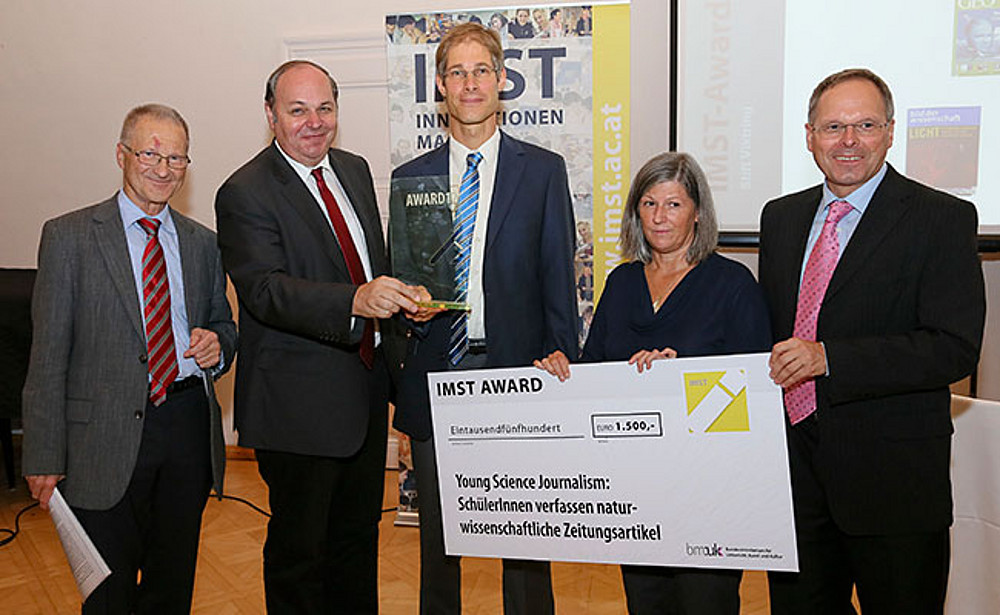
Univ.-Prof. Dr. Peter Posch, Ministerialrat DI Christian Dorninger und Univ.-Prof. Dr. Konrad Krainer überreichen Helga Kulac vom BRG Kepler und Dr. Uwe Simon (3.v.l.) vom Fachdidaktikzentrum für Biologie und Umweltkunde der Uni Graz den IMST-Award 2012

Univ.-Prof. Dr. Peter Posch, Ministerialrat DI Christian Dorninger und Univ.-Prof. Dr. Konrad Krainer überreichen Helga Kulac vom BRG Kepler und Dr. Uwe Simon (3.v.l.) vom Fachdidaktikzentrum für Biologie und Umweltkunde der Uni Graz den IMST-Award 2012 in der Kategorie „institutionsübergreifende Projekte“. Foto: IMST

Ein Grazer Schulprojekt für die Jugendzeitung „Young Science“ wurde mit dem IMST Award 2012 prämiert

Artikel schreiben im Unterricht, wissenschaftliche Inhalte in spannende Texte verpacken, mit einem Journalisten einen Titel diskutieren: SchülerInnen des BRG Kepler in Graz haben im letzten Schuljahr zu selbst gewählten Themen Beiträge für die neue naturwissenschaftliche Jugendzeitung „Young Science“ verfasst. Die Chefredaktion lag beim Initiator des Projekts, Dr. Uwe Simon vom Fachdidaktikzentrum für Biologie und Umweltkunde der Karl-Franzens-Universität Graz. Für seinen fächerübergreifenden und innovativen Ansatz wurde „Young Science Journalism“ mit dem IMST Award 2012 des Bundesministeriums für Unterricht, Kunst und Kultur in der Kategorie „institutionsübergreifende Projekte“ ausgezeichnet. Die feierliche Verleihung fand im Rahmen der IMST-Tagung am 26. September 2012 im Stift Viktring/Kärnten statt.


Das Besondere an „Young Science Journalism“: Die Artikel entstanden unter gemeinsamer Betreuung von Biologie- und Deutschlehrerin, eines Journalisten und eines Fachdidaktikers. SchülerInnen und Lehrerinnen profitierten von dem fächerübergreifenden Ansatz, bei dem die Jugendlichen ausgesprochen anregende und informative Texte von Magersucht bis Ölschieferabbau schrieben.


Die Konzeption und wissenschaftliche Begleitforschung übernahm Dr. Uwe Simon vom Fachdidaktikzentrum für Biologie und Umweltkunde der Karl-Franzens-Universität Graz. „Es zeigte sich, dass die Mädchen dem Lesen und Schreiben gegenüber viel positiver eingestellt waren als die Buben. Doch empfanden beide Geschlechter das Projekt als überaus hilfreich in der Stärkung ihrer Schreibkompetenz – was von der Deutschlehrerin bestätigt wurde“, berichtet Simon. Besonders erfreulich sei, dass sowohl Buben als auch Mädchen nach dem Projekt ein deutlich größeres Interesse an Naturwissenschaften zeigten. „Schreiben sollte somit einen festen Platz in den Fächern Biologie, Chemie und Physik haben“, ist Uwe Simon überzeugt, „gerade auch im Hinblick auf die bald verpflichtende Vorwissenschaftliche Arbeit.“


IMST ist ein flexibles Unterstützungssystem des Bundesministeriums für Unterricht, Kunst und Kultur mit dem Ziel, eine Innovationskultur zur Stärkung des MINDT-Unterrichts (Mathematik, Informatik, Naturwissenschaften, Deutsch, Technik) an österreichischen Schulen zu etablieren und strukturell zu verankern.

created by Uwe Simon & Gudrun Pichler

Related news

What is ‘Dr AI’ supposed to decide, Giovanni Rubeis?

Analysing X-rays, documenting diagnoses, searching through databases: artificial intelligence is already providing significant support with administrative and routine tasks in the healthcare sector. To what extent should it be involved in clinical matters – that is, in treatment recommendations or treatment decisions? How do we prevent built-in biases that could be detrimental to certain individuals?

Commissioned by NATO: University of Graz tests high-tech textiles

As part of an international project, antimicrobial and fire-resistant fabrics with UV protection are being developed in Zagreb. Pharmacists from the University of Graz are ensuring that these fabrics are skin-friendly.

The Arctic up close: ORF special feature on the University of Graz’s research station in S

Students from the University of Graz are spending two weeks conducting research at the Univerisity of Graz research station at the Sermilik Fjord in Greenland, which has been operational for three years. They are measuring glacial runoff, tracking ice melt in real time and installing weather stations. ORF is following the expedition and will be reporting on the special feature ‘Arctic Adventure’ across its various channels from 20 July.

Medicine for ants: Caffeine prolongs the life of infected insects

Black coffee stimulates us and acts against bacteria. So, can caffeine also be good for insects? Yes, confirm biologists of the University of Graz. When ants suffer from a fungal disease, they consume more caffeine and remain active for longer.

Begin of page section:
Additional information:

University of Graz
Universitaetsplatz 3
8010 Graz
Austria
  • Contact
  • Web Editors
  • Moodle
  • UNIGRAZonline
  • Imprint
  • Data Protection Declaration
  • Accessibility Declaration
Weatherstation
Uni Graz

End of this page section. Go to overview of page sections

End of this page section. Go to overview of page sections

Begin of page section:

End of this page section. Go to overview of page sections