Begin of page section:
Page sections:

  • Go to contents (Accesskey 1)
  • Go to position marker (Accesskey 2)
  • Go to main navigation (Accesskey 3)
  • Go to sub navigation (Accesskey 4)
  • Go to additional information (Accesskey 5)
  • Go to page settings (user/language) (Accesskey 8)
  • Go to search (Accesskey 9)

End of this page section. Go to overview of page sections

Begin of page section:
Page settings:

English en
Deutsch de
Search
Login

End of this page section. Go to overview of page sections

Begin of page section:
Search:

Search for details about Uni Graz
Close

End of this page section. Go to overview of page sections


Search

Begin of page section:
Main navigation:

Page navigation:

  • University

    University
    • About the University
    • Organisation
    • Faculties
    • Library
    • Working at University of Graz
    • Campus
    Developing solutions for the world of tomorrow - that is our mission. Our students and our researchers take on the great challenges of society and carry the knowledge out.
  • Research Profile

    Research Profile
    • Our Expertise
    • Research Questions
    • Research Portal
    • Promoting Research
    • Research Transfer
    • Ethics in Research
    • Commission for Scientific Integrity
    Scientific excellence and the courage to break new ground. Research at the University of Graz creates the foundations for making the future worth living.
  • Studies

    Studies
    • Prospective Students
    • Students
    • Registration for Study Programme (Winter semester 2026/27)
    • Welcome Weeks for First Year Students
  • Community

    Community
    • International
    • Location
    • Research and Business
    • Alumni
    The University of Graz is a hub for international research and brings together scientists and business experts. Moreover, it fosters the exchange and cooperation in study and teaching.
Topics
  • Sustainable University
  • Researchers answer
  • Work for us
Close menu

End of this page section. Go to overview of page sections

Begin of page section:
You are here:

University of Graz News Samson, Jago & Aufschneider

End of this page section. Go to overview of page sections

Tuesday, 28 May 2013

Samson, Jago & Aufschneider

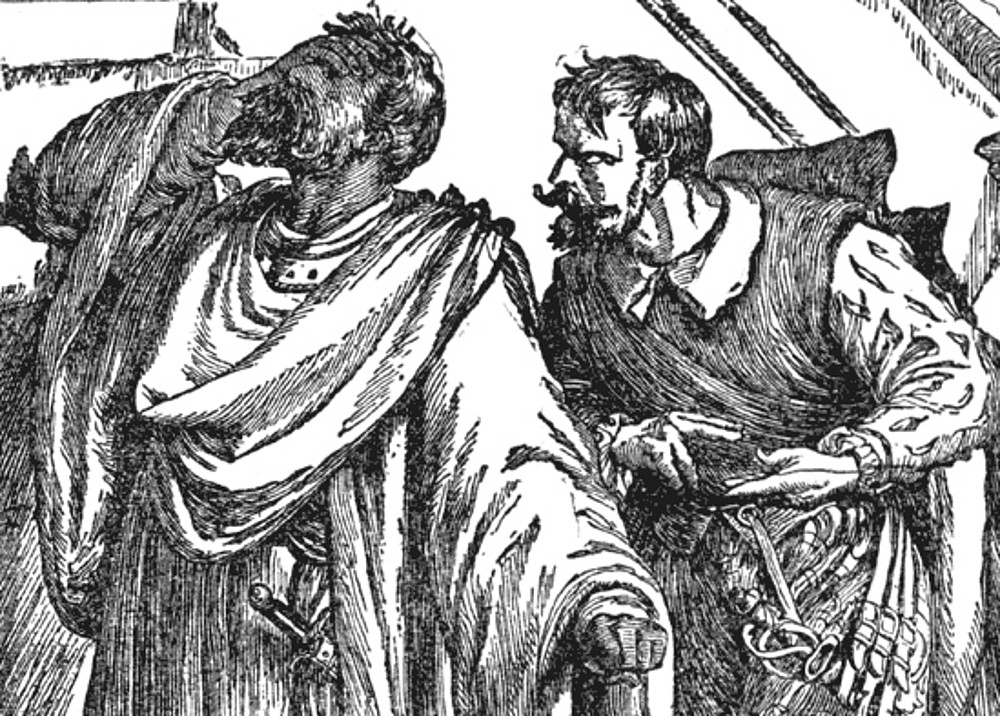
Jago (rechts), brillianter und eitler Intrigant aus Shakespeares OTHELLO, ist ein vielzitierter Typus in der Literatur. Foto: Wikimedia Commons.

Jago (rechts), brillianter und eitler Intrigant aus Shakespeares OTHELLO, ist ein vielzitierter Typus in der Literatur. Foto: Wikimedia Commons.

Tagung zu Typen in Theater und Film mit Josef Haslinger an der Uni Graz

Vom biblischen Helden Samson, der seine Kraft durch einen unfreiwilligen Haarschnitt verliert, über den eifersüchtigen Jago, der Shakespeares Othello in die Paranoia treibt, bis hin zum verqueren, problemversessene Dr. Fuhrmann aus dem Hader/Schalko-Film „Aufschneider“: Fiktive Figuren funktionieren nach bestimmten sozialen Rollenmustern. „Typen“ geben nicht nur Literatur, Bühne und Film ein charakteristisches Gesicht. Auch Graphic Novels oder Strategiespiele wie „Warhammer Fantasy“ leben von der Inszenierung bestimmter Wesenszüge charismatischer Persönlichkeiten.


Eine Tagung an der Karl-Franzens-Universität Graz heftet sich von 31. Mai bis 1. Juni 2013 an ihre Fersen und beleuchtet kulturwissenschaftliche und kultursoziologische Zusammenhänge. Höhepunkt ist eine Lesung des Autors Josef Haslinger am 1. Juni um 11 Uhr.


Personen, Figuren, Rollen und Typen sind Forschungsgegenstände des Schwerpunktbereichs „LiTheS: Literatur- und Theatersoziologie“ am Institut für Germanistik der Uni Graz. Zur insgesamt vierten „LiTheS“-Tagung sind wahre Kapazunder der kulturwissenschaftlichen sowie soziologischen Forschung geladen: Uta Gerhardt von der Universität Heidelberg spricht zur Typisierung im Theater, der Soziologe Manfred Prisching widmet sich der Individualisierung und Identitätssuche und der Grazer Musikwissenschafter Michael Walter beleuchtet den historischen Helden in der Nationaloper. Abschließend nimmt der Schriftsteller Josef Haslinger („Opernball“, „Das Vaterspiel“), Professor für literarische Ästhetik am Deutschen Literaturinstitut Leipzig und seit Mai 2013 Präsident des PEN-Zentrums Deutschland, mit einer Lesung und anschließendem Gespräch „Das Theater mit den Figuren“ ins Visier.


Die Tagung ist Teil des im Sommersemester 2013 angebotenen Moduls „LitheS“, organisiert von der Germanistin Ao.Univ.-Prof. Dr. Beatrix Müller-Kampel und vom Kabarettisten, Autor und Schauspieler Alfred Dorfer. Der Kabarettist Josef Hader referierte in diesem Rahmen ebenfalls kürzlich an der Uni Graz.

Tagung: Person – Figur – Rolle – Typ: Kulturwissenschaftliche und kultursoziologische Zusammenhänge
Zeit: Donnerstag, 30. Mai, bis Samstag, 1. Juni 2013
Ort: Universität Graz, Hauptgebäude, 1. Stock, Hörsaal 01.18


Das genaue Programm finden Sie unter: http://lithes.uni-graz.at/veranstalt.html

created by Gerhild Kastrun

Related news

Commissioned by NATO: University of Graz tests high-tech textiles

As part of an international project, antimicrobial and fire-resistant fabrics with UV protection are being developed in Zagreb. Pharmacists from the University of Graz are ensuring that these fabrics are skin-friendly.

The Arctic up close: ORF special feature on the University of Graz’s research station in S

Students from the University of Graz are spending two weeks conducting research at the Univerisity of Graz research station at the Sermilik Fjord in Greenland, which has been operational for three years. They are measuring glacial runoff, tracking ice melt in real time and installing weather stations. ORF is following the expedition and will be reporting on the special feature ‘Arctic Adventure’ across its various channels from 20 July.

Medicine for ants: Caffeine prolongs the life of infected insects

Black coffee stimulates us and acts against bacteria. So, can caffeine also be good for insects? Yes, confirm biologists of the University of Graz. When ants suffer from a fungal disease, they consume more caffeine and remain active for longer.

How formulas are making medicine more personalised

When Federica Caforio talks about the heart, it doesn’t sound like an operating theatre, but rather like equations, parameters and simulations. Yet this is precisely where the medical promise of her research lies: one day, clinical data will be used to create a digital twin of the heart – a virtual model that will enable a better understanding of diseases and allow for more personalised treatment plans. She will be presenting her research at the ‘ECMTB 2026’ mathematics conference.

Begin of page section:
Additional information:

University of Graz
Universitaetsplatz 3
8010 Graz
Austria
  • Contact
  • Web Editors
  • Moodle
  • UNIGRAZonline
  • Imprint
  • Data Protection Declaration
  • Accessibility Declaration
Weatherstation
Uni Graz

End of this page section. Go to overview of page sections

End of this page section. Go to overview of page sections

Begin of page section:

End of this page section. Go to overview of page sections