Begin of page section:
Page sections:

  • Go to contents (Accesskey 1)
  • Go to position marker (Accesskey 2)
  • Go to main navigation (Accesskey 3)
  • Go to sub navigation (Accesskey 4)
  • Go to additional information (Accesskey 5)
  • Go to page settings (user/language) (Accesskey 8)
  • Go to search (Accesskey 9)

End of this page section. Go to overview of page sections

Begin of page section:
Page settings:

English en
Deutsch de
Search
Login

End of this page section. Go to overview of page sections

Begin of page section:
Search:

Search for details about Uni Graz
Close

End of this page section. Go to overview of page sections


Search

Begin of page section:
Main navigation:

Page navigation:

  • University

    University
    • About the University
    • Organisation
    • Faculties
    • Library
    • Working at University of Graz
    • Campus
    Developing solutions for the world of tomorrow - that is our mission. Our students and our researchers take on the great challenges of society and carry the knowledge out.
  • Research Profile

    Research Profile
    • Our Expertise
    • Research Questions
    • Research Portal
    • Promoting Research
    • Research Transfer
    • Ethics in Research
    Scientific excellence and the courage to break new ground. Research at the University of Graz creates the foundations for making the future worth living.
  • Studies

    Studies
    • Prospective Students
    • Students
  • Community

    Community
    • International
    • Location
    • Research and Business
    • Alumni
    The University of Graz is a hub for international research and brings together scientists and business experts. Moreover, it fosters the exchange and cooperation in study and teaching.
  • Spotlight
Topics
  • Our digital Advent calendar
  • Sustainable University
  • Researchers answer
  • Work for us
Close menu

End of this page section. Go to overview of page sections

Begin of page section:
You are here:

University of Graz News Role model for inclusion in the workplace: University of Graz receives Diversitas Award

End of this page section. Go to overview of page sections

Tuesday, 03 December 2024

Role model for inclusion in the workplace: University of Graz receives Diversitas Award

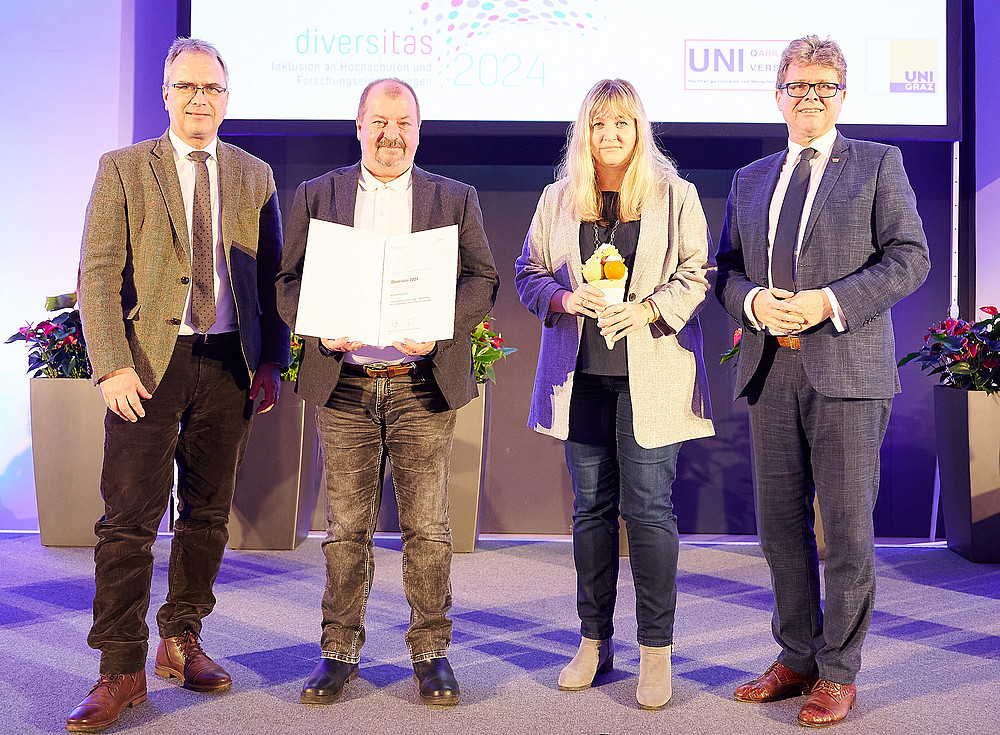
Peter Riedler, Alois Pranger, Lydia Kurz-Frieß, Martin Polaschek at the Diversitas Award ceremony ©BMBWF/Sabine Klimpt

Minister of Science Martin Polaschek (right) presented Rector Peter Riedler, Alois Pranger and Lydia Kurz-Frieß from the Human Resources Department of the University of Graz with a Diversitas Recognition Award for the "Uniqability meets University" project. Photo: BMBWF/Sabine Klimpt

How can people with disabilities find a suitable job at the university? The University of Graz has an answer to this question. In 2016, it launched the "Uniqability meets University" project to attract more people with disabilities as employees and to offer them the best possible conditions. The initiative has been very successful and is a model project throughout Austria. On 2 December 2024, it was awarded a Diversitas prize by the Federal Ministry of Education, Science and Research for this project, endowed with 12,500 euros.

"The University of Graz is a workplace for people with very different talents and needs. We are proud of that. Together, we are making our university a place of practiced diversity," says Rector Peter Riedler, underlining the importance of promoting diversity in all areas. The "Uniqability meets University" project is particularly successful in the inclusion of people with disabilities in the workplace.

Around 65 employees with disabilities are currently working at the University of Graz as part of this initiative. These are people with a degree of disability of at least 50 per cent, as confirmed by the authorities. They can work part-time for up to 20 hours a week, depending on what suits them.

They found their way to the university via a procedure developed especially for them: "People from this target group don't apply for a specific, advertised position, but send unsolicited applications," explains Lydia Kurz-Frieß, the person of contact in the Human Resources department. Thanks to the cooperation with the Austrian Public Employment Service (AMS) and associations such as Jugend am Werk, Chance B or LebensGroß, this opportunity is now being taken up more and more.

"We invite each applicant to a personal interview to explore their abilities, skills and wishes. Then, taking into account their respective impairments, we create a suitable workplace," says Kurz-Frieß, describing the procedure. This allows the new employees to contribute their talents in the best possible way.

The range of employment is diverse: administrative and scientific activities are just as much in demand as manual tasks in the Botanical Garden or in the university's own workshops. A team from the "Uniqability meets University" project, which is part of the Human Resources department, is on hand to support the new colleagues as well as the managers of the departments and institutes where they work. It provides support with organisational tasks, training needs or necessary adaptations.

Regular feedback sessions with all parties involved confirm the success of the initiative for the sustainable inclusion of people with disabilities – as do the employment figures. Like every employer, the University of Graz is legally obliged to employ one person with a disability for every 25 employees. In 2023, it met the quota by 98 per cent, in 2015 only by 55 per cent. In 2020, the Austrian Court of Audit found that the University of Graz was the Austrian university that best met the requirements for employing people with disabilities.

created by Gudrun Pichler

Related news

Chemical Christmas show at the University of Graz: An explosive evening at the Schauspielh

At the beginning of December, the University of Graz transformed the theater into a laboratory: as part of “Chemical Life,” teacher training students staged a chemical Christmas show for Styrian school classes—complete with ethanol rockets, nitrogen snow, and glowing effects. An evening designed to inspire interest in studying chemistry.

Train by train: Koralm railway accelerates exchange between the Universities

Lectures at the University of Klagenfurt in the morning, seminars at the University of Graz in the afternoon: Austria's longest tunnel and a journey time of around 45 minutes make it easy. The Koralm railway increases the speed of networking between the two university locations. The collaboration builds on existing cooperation - for example in the areas of teacher training, Slavic studies and as employers, the universities are well coordinated.

On the trail of the Big Bang: University of Graz receives 1.5 million euros for doctoral programmes

The Austrian Science Fund FWF has selected the Doctoral Programme in Theoretical Particle Physics at the University of Graz for funding from the Doc.funds. Six young scientists will be funded for 3.5 years. They will gain fundamentally new insights into the origins of the world.

From trans women and knee prostheses: sports science prizes awarded

Walking better with a prosthesis, successfully getting rid of excess weight, training more effectively, more fairness for trans people in sport: these were the topics addressed by the students at the University of Graz who were awarded the sports science prizes for their Master's theses on 3 December 2025.

Begin of page section:
Additional information:

University of Graz
Universitaetsplatz 3
8010 Graz
Austria
  • Contact
  • Web Editors
  • Moodle
  • UNIGRAZonline
  • Imprint
  • Data Protection Declaration
  • Accessibility Declaration
Weatherstation
Uni Graz

End of this page section. Go to overview of page sections

End of this page section. Go to overview of page sections

Begin of page section:

End of this page section. Go to overview of page sections