Begin of page section:
Page sections:

  • Go to contents (Accesskey 1)
  • Go to position marker (Accesskey 2)
  • Go to main navigation (Accesskey 3)
  • Go to sub navigation (Accesskey 4)
  • Go to additional information (Accesskey 5)
  • Go to page settings (user/language) (Accesskey 8)
  • Go to search (Accesskey 9)

End of this page section. Go to overview of page sections

Begin of page section:
Page settings:

English en
Deutsch de
Search
Login

End of this page section. Go to overview of page sections

Begin of page section:
Search:

Search for details about Uni Graz
Close

End of this page section. Go to overview of page sections


Search

Begin of page section:
Main navigation:

Page navigation:

  • University

    University
    • About the University
    • Organisation
    • Faculties
    • Library
    • Working at University of Graz
    • Campus
    Developing solutions for the world of tomorrow - that is our mission. Our students and our researchers take on the great challenges of society and carry the knowledge out.
  • Research Profile

    Research Profile
    • Our Expertise
    • Research Questions
    • Research Portal
    • Promoting Research
    • Research Transfer
    • Ethics in Research
    Scientific excellence and the courage to break new ground. Research at the University of Graz creates the foundations for making the future worth living.
  • Studies

    Studies
    • Prospective Students
    • Students
  • Community

    Community
    • International
    • Location
    • Research and Business
    • Alumni
    The University of Graz is a hub for international research and brings together scientists and business experts. Moreover, it fosters the exchange and cooperation in study and teaching.
  • Spotlight
Topics
  • Our digital Advent calendar
  • Sustainable University
  • Researchers answer
  • Work for us
Close menu

End of this page section. Go to overview of page sections

Begin of page section:
You are here:

University of Graz News Rising cost of living for insects: Energy demand increases with climate change

End of this page section. Go to overview of page sections

Friday, 05 April 2024

Rising cost of living for insects: Energy demand increases with climate change

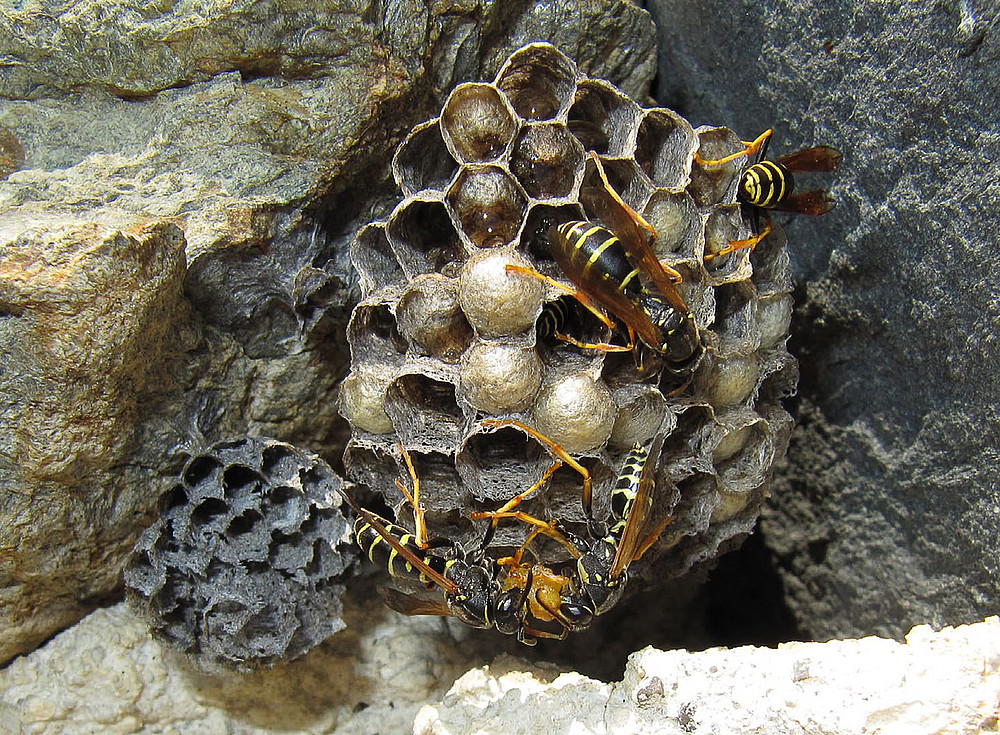
Wasp nest between stones, four wasps on it

The animal project team members: Field wasps of the species Polistes biglumis from the Alps sharing prey and cooling the nest with drops of water. Polistes dominula from the Austrian and Italian lowlands and Polistes gallicus from Italy were also recruited. Photo: Uni Graz/Stabentheiner

It sounds paradoxical: when the climate gets warmer, insects need more energy. Biologists at the University of Graz have demonstrated this using the example of paper wasps of the genus Polistes. Their mated queens spend the cold season in hidden winter quarters and live on the reserves built up in autumn. "A special metabolic characteristic of insects is that their energy requirements increase exponentially at rest as the outside temperature rises," says Anton Stabentheiner, lead author of the study, which was recently published in the Journal of Comparative Physiology B.

"If the energy requirements of insects increase due to warm weather during hibernation, this can lead to premature depletion of their reserves. This means that they have to obtain more food in summer to make up for this deficit, both for their own metabolism and for rearing their offspring," explains Anton Stabentheiner.
The results of the study include concrete figures: "Our investigations suggest that a temperature rise of two degrees Celsius would result in a 26 to 33 per cent higher energy requirement just for hibernation," reports Helmut Kovac, co-author of the publication. For the summer season, the biologists expect an increase of 12 to 24 per cent.
The latest research has shown that although the paper wasps could maintain their basic metabolism for an entire summer with the energy reserves remaining in spring, the daily flight times for nest building and foraging would be limited to a few hours. Detailed measurements show: "The fat reserves could still be sufficient for new nest building even in climate scenarios of two degrees of warming and more. However, the carbohydrate and sugar reserves, which are more depleted after a warm winter, pose a major problem. This is because a basic supply of sugar is essential for many metabolic functions, for example in the nervous system and in the muscles," the scientists explain.
The study therefore proves that, in addition to shrinking habitats and pesticides, climate change is also making life difficult for insects.

In addition to the project leaders Helmut Kovac and Anton Stabentheiner, the research team of the Eco-Physiology and Eco-Ethology working group also includes Helmut Käfer, Edith Stabentheiner, Regina Willfurth and Astrid Bay Amstrup.

Publications
Stabentheiner et al.: The costs of overwintering in paper wasps (Polistes dominula and Polistes gallicus): the use of energy stores. Journal of Comparative Physiology B (2024).
https://doi.org/10.1007/s00360-024-01540-w

Kovac et al.: The Impact of Climate on the Energetics of Overwintering Paper Wasp Gynes (Polistes dominula and Polistes gallicus). Insects (2023).
https://doi.org/10.3390/insects14110849

created by Gudrun Pichler

Related news

Chemical Christmas show at the University of Graz: An explosive evening at the Schauspielh

At the beginning of December, the University of Graz transformed the theater into a laboratory: as part of “Chemical Life,” teacher training students staged a chemical Christmas show for Styrian school classes—complete with ethanol rockets, nitrogen snow, and glowing effects. An evening designed to inspire interest in studying chemistry.

Train by train: Koralm railway accelerates exchange between the Universities

Lectures at the University of Klagenfurt in the morning, seminars at the University of Graz in the afternoon: Austria's longest tunnel and a journey time of around 45 minutes make it easy. The Koralm railway increases the speed of networking between the two university locations. The collaboration builds on existing cooperation - for example in the areas of teacher training, Slavic studies and as employers, the universities are well coordinated.

On the trail of the Big Bang: University of Graz receives 1.5 million euros for doctoral programmes

The Austrian Science Fund FWF has selected the Doctoral Programme in Theoretical Particle Physics at the University of Graz for funding from the Doc.funds. Six young scientists will be funded for 3.5 years. They will gain fundamentally new insights into the origins of the world.

From trans women and knee prostheses: sports science prizes awarded

Walking better with a prosthesis, successfully getting rid of excess weight, training more effectively, more fairness for trans people in sport: these were the topics addressed by the students at the University of Graz who were awarded the sports science prizes for their Master's theses on 3 December 2025.

Begin of page section:
Additional information:

University of Graz
Universitaetsplatz 3
8010 Graz
Austria
  • Contact
  • Web Editors
  • Moodle
  • UNIGRAZonline
  • Imprint
  • Data Protection Declaration
  • Accessibility Declaration
Weatherstation
Uni Graz

End of this page section. Go to overview of page sections

End of this page section. Go to overview of page sections

Begin of page section:

End of this page section. Go to overview of page sections