Begin of page section:
Page sections:

  • Go to contents (Accesskey 1)
  • Go to position marker (Accesskey 2)
  • Go to main navigation (Accesskey 3)
  • Go to sub navigation (Accesskey 4)
  • Go to additional information (Accesskey 5)
  • Go to page settings (user/language) (Accesskey 8)
  • Go to search (Accesskey 9)

End of this page section. Go to overview of page sections

Begin of page section:
Page settings:

English en
Deutsch de
Search
Login

End of this page section. Go to overview of page sections

Begin of page section:
Search:

Search for details about Uni Graz
Close

End of this page section. Go to overview of page sections


Search

Begin of page section:
Main navigation:

Page navigation:

  • University

    University
    • About the University
    • Organisation
    • Faculties
    • Library
    • Working at University of Graz
    • Campus
    Developing solutions for the world of tomorrow - that is our mission. Our students and our researchers take on the great challenges of society and carry the knowledge out.
  • Research Profile

    Research Profile
    • Our Expertise
    • Research Questions
    • Research Portal
    • Promoting Research
    • Research Transfer
    • Ethics in Research
    Scientific excellence and the courage to break new ground. Research at the University of Graz creates the foundations for making the future worth living.
  • Studies

    Studies
    • Prospective Students
    • Students
  • Community

    Community
    • International
    • Location
    • Research and Business
    • Alumni
    The University of Graz is a hub for international research and brings together scientists and business experts. Moreover, it fosters the exchange and cooperation in study and teaching.
  • Spotlight
Topics
  • Our digital Advent calendar
  • Sustainable University
  • Researchers answer
  • Work for us
Close menu

End of this page section. Go to overview of page sections

Begin of page section:
You are here:

University of Graz News Research without borders in the European University Alliance Arqus

End of this page section. Go to overview of page sections

Thursday, 31 October 2024

Research without borders in the European University Alliance Arqus

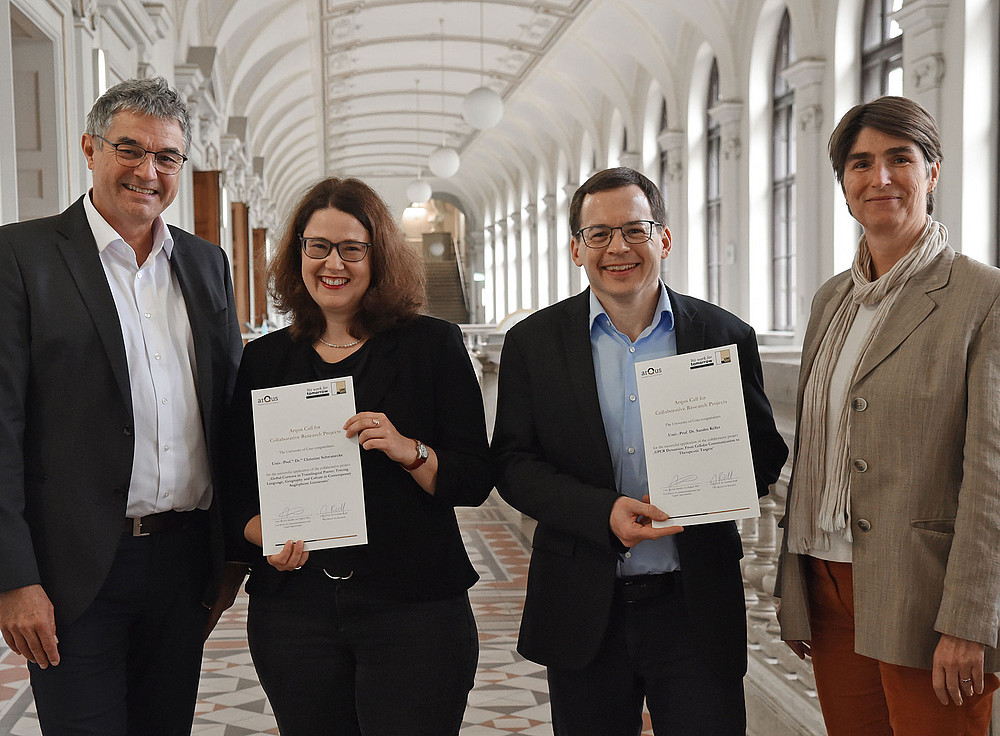
Joachim Reidl, Christine Schwanecke, Sandro Keller and Mireille van Poppel in the corridor in front of the auditorium of the University of Graz ©Uni Graz/Pichler

Christine Schwanecke and Sandro Keller were presented with the funding certificates for their Arqus Collaborative Research Projects by Vice-Rector Joachim Reidl and Vice-Rector Mireille van Poppel. Photo: Uni Graz/Pichler

International cooperation strengthens cutting-edge research, the results of which benefit us all. As part of the European University Alliance Arqus, researchers from the University of Graz are collaborating with colleagues from eight other universities on current topics and societal challenges. Two new projects have just started. The group led by Sandro Keller, Professor of Biophysics, is studying the mechanisms of cell communication as a prerequisite for the development of new, more effective drugs. Christine Schwanecke, Professor of English Literature and Cultural Studies and Director of the Centre for Cultural Studies, and her colleague Lisa Schantl are investigating the special features of contemporary English-language poetry by authors who grew up speaking another language – as an example of how language can overcome the divisions between different cultures.

Sandro Keller's and Christine Schwanecke's projects were rated as excellent by independent reviewers and selected from a total of 19 submissions for funding through the Arqus Collaborative Research programme. These funds will be used to finance one doctoral student per project for three years to promote young researchers. They will also support the exchange of expertise and know-how through a research stay at the university of the respective cooperation partner.

New targets for precise medicines
How do cells communicate with each other? And why is this knowledge crucial for developing better drugs? "If the exchange of information and substances between cells doesn't work properly, this can lead to diseases such as cancer, Alzheimer's, or the rare metabolic disease cystic fibrosis," says Sandro Keller. He and his team are unraveling the molecular mechanisms of this communication, which is mediated by proteins in the cell membrane. So-called G protein-coupled receptors play an important role in this process, acting as messenger substances or drugs. "In the Arqus-funded project, we are investigating the function of the receptor that binds acetylcholine. This neurotransmitter, whose role was discovered about a hundred years ago by Nobel Prize winner Otto Loewi at the University of Graz, is important for brain development and the control of heart rhythm," says Keller. "With our findings, we want to open up new possibilities for targeted therapies of cardiac arrhythmias with fewer side effects," says the researcher. The co-operation partner is the renowned biochemist Irene Coin, Professor at the University of Leipzig.

Poetry that overcomes cultural barriers
What makes poetry by authors who do not write in their native language so special? And what answers can this kind of literature provide to current social issues? "Especially today, in a time of growing nationalisms, 'translanguage poetry' is an example of socially relevant literature; it brings different languages and cultures together and emphasises what unites them," says Christine Schwanecke. Together with Lisa Schantl, editor of Tint Journal, an online literary magazine dedicated to ESL or non-native English creative writing, she is analysing contemporary English-language poetry written by people with a first- or second-generation migration background. "In terms of content, origin and belonging are key issues. The poems allow a critical view of the present that doesn't just mark things in black and white, but instead embraces diversity and ambiguity. Linguistically, this literature is innovative in terms of vocabulary and grammar. It not only questions conventional thought structures, but also takes poetry off its alleged dusty pedestal and makes this art form accessible to a wider audience," contends Schwanecke, emphasising its importance. One example is "dub poetry" of Jamaican origin, which is usually presented in performances. The cooperation partner in the Arqus-funded project is professor Rūta Šlapkauskaitė from Vilnius University. Lisa Schantl is devoting her doctoral thesis to this research.

In addition to the University of Graz, the European University Alliance Arqus includes the University of Granada/Spain, the University of Leipzig/Germany, the University Claude Bernard Lyon 1/France, Maynooth University/Ireland, the University of Minho/Portugal, the University of Padua/Italy, the University of Vilnius/Lithuania, and the University of Wroclaw/Poland.

The Arqus Innovation Fund has also recently funded a project at the University of Graz: Fiasco Fest goes Arqus.

created by Gudrun Pichler

Related news

Chemical Christmas show at the University of Graz: An explosive evening at the Schauspielh

At the beginning of December, the University of Graz transformed the theater into a laboratory: as part of “Chemical Life,” teacher training students staged a chemical Christmas show for Styrian school classes—complete with ethanol rockets, nitrogen snow, and glowing effects. An evening designed to inspire interest in studying chemistry.

Train by train: Koralm railway accelerates exchange between the Universities

Lectures at the University of Klagenfurt in the morning, seminars at the University of Graz in the afternoon: Austria's longest tunnel and a journey time of around 45 minutes make it easy. The Koralm railway increases the speed of networking between the two university locations. The collaboration builds on existing cooperation - for example in the areas of teacher training, Slavic studies and as employers, the universities are well coordinated.

On the trail of the Big Bang: University of Graz receives 1.5 million euros for doctoral programmes

The Austrian Science Fund FWF has selected the Doctoral Programme in Theoretical Particle Physics at the University of Graz for funding from the Doc.funds. Six young scientists will be funded for 3.5 years. They will gain fundamentally new insights into the origins of the world.

From trans women and knee prostheses: sports science prizes awarded

Walking better with a prosthesis, successfully getting rid of excess weight, training more effectively, more fairness for trans people in sport: these were the topics addressed by the students at the University of Graz who were awarded the sports science prizes for their Master's theses on 3 December 2025.

Begin of page section:
Additional information:

University of Graz
Universitaetsplatz 3
8010 Graz
Austria
  • Contact
  • Web Editors
  • Moodle
  • UNIGRAZonline
  • Imprint
  • Data Protection Declaration
  • Accessibility Declaration
Weatherstation
Uni Graz

End of this page section. Go to overview of page sections

End of this page section. Go to overview of page sections

Begin of page section:

End of this page section. Go to overview of page sections