
Begin of page section:
Page sections:

  • Go to contents (Accesskey 1)
  • Go to position marker (Accesskey 2)
  • Go to main navigation (Accesskey 3)
  • Go to sub navigation (Accesskey 4)
  • Go to additional information (Accesskey 5)
  • Go to page settings (user/language) (Accesskey 8)
  • Go to search (Accesskey 9)

End of this page section. Go to overview of page sections

Begin of page section:
Page settings:

English en
Deutsch de
Search
Login

End of this page section. Go to overview of page sections

Begin of page section:
Search:

Search for details about Uni Graz
Close

End of this page section. Go to overview of page sections


Search

Begin of page section:
Main navigation:

Page navigation:

  • University

    University
    • About the University
    • Organisation
    • Faculties
    • Library
    • Working at University of Graz
    • Campus
    Developing solutions for the world of tomorrow - that is our mission. Our students and our researchers take on the great challenges of society and carry the knowledge out.
  • Research Profile

    Research Profile
    • Our Expertise
    • Research Questions
    • Research Portal
    • Promoting Research
    • Research Transfer
    • Ethics in Research
    • Commission for Scientific Integrity
    Scientific excellence and the courage to break new ground. Research at the University of Graz creates the foundations for making the future worth living.
  • Studies

    Studies
    • Prospective Students
    • Students
  • Community

    Community
    • International
    • Location
    • Research and Business
    • Alumni
    The University of Graz is a hub for international research and brings together scientists and business experts. Moreover, it fosters the exchange and cooperation in study and teaching.
  • Spotlight
Topics
  • Sustainable University
  • Researchers answer
  • Work for us
Close menu

End of this page section. Go to overview of page sections

Begin of page section:
You are here:

University of Graz News Research for healthy aging: FWF funds Cluster of Excellence "MetAGE" with 18 million euros

End of this page section. Go to overview of page sections

Monday, 06 May 2024

Research for healthy aging: FWF funds Cluster of Excellence "MetAGE" with 18 million euros

Graphic representation of a human body, consisting of a network of lines and points ©AntonKhrupinArt - stock.adobe.com

The aim of research in the "MetAGE" Cluster of Excellence is to gain a better understanding of healthy aging. Photo: AntonKhrupinArt - stock.adobe.com

Six researchers from the Field of Excellence "BioHealth" at the University of Graz, together with colleagues from the Medical Universities of Graz and Vienna, have acquired an FWF-funded "Cluster of Excellence". Now a newly formed center of excellence will be created under the leadership of the University of Graz. The aim is to gain a better understanding of healthy aging. The findings will flow directly into clinical research.

"The FWF decision in favor of the 'MetAGE' Cluster of Excellence is an award for the outstanding research work, for the high scientific quality and especially for the many years of cooperation between the teams," says Peter Riedler, Rector of the University of Graz, delighted with the funding approval from Vienna. "The success proves us right, and I would like to thank the teams around Frank Madeo and all partners for their tireless efforts," says Riedler.

"The collaboration between scientists from the University of Graz, the Medical University of Vienna and the Medical University of Graz within the framework of 'MetAGE' underlines our joint commitment to the benefit of society. As Rector of the Medical University of Graz, I am particularly pleased that our university will contribute its expertise in the field of aging research and research into age-associated diseases to this project," emphasises Andrea Kurz, Rector of the Medical University of Graz.

Michaela Fritz, Vice Rector for Research and Innovation at the Medical University of Vienna, particularly emphasises the application-oriented aspect of "MetAGE". "I am convinced that this excellent consortium will succeed in improving our understanding of age-related diseases and applying these findings directly to patient care."


MetAGE: Metabolic control of aging and disease – from models to humans

The large-scale research project "MetAGE: Metabolic control of aging and disease – from models to humans" focuses on healthy aging. The aim is to better understand the age-related loss of metabolic control both in humans and in model organisms. The scientists are investigating how disturbances in metabolic control promote the risk of age-related diseases. At the same time, targeted nutritional interventions will be clinically tested. What is special about MetAGE is that the knowledge gained through basic research is transferred directly into clinical research. This strengthens the idea of prevention, so that a 'medicine of disease' becomes a 'medicine of health' in the future.

The Austrian Science Fund FWF announced on Monday that the "MetAGE" excellence application will be funded with around 18 million euros as a Cluster of Excellence. With an own contribution of around 12 million euros, a total volume of around 30 million euros will be invested in the "MetAGE" Cluster of Excellence over the next five years.

In order to develop sustainable solutions for the future, researchers at the University of Graz have been working together with partners on an interdisciplinary basis at the university and across institutions for many years. "Our researchers are highly motivated to expand cutting-edge research at our university in the essential topics of the future and to successively expand our collaborations. 'MetAGE' is proof of this," concludes Joachim Reidl, Vice-Rector for Research at the University of Graz.

Service:

    Interactive map of the FWF excellentaustria.fwf.ac.at
    University of Graz www.uni-graz.at
    Medical University of Graz www.medunigraz.at
    Medical University of Vienna www.meduniwien.ac.at/web/
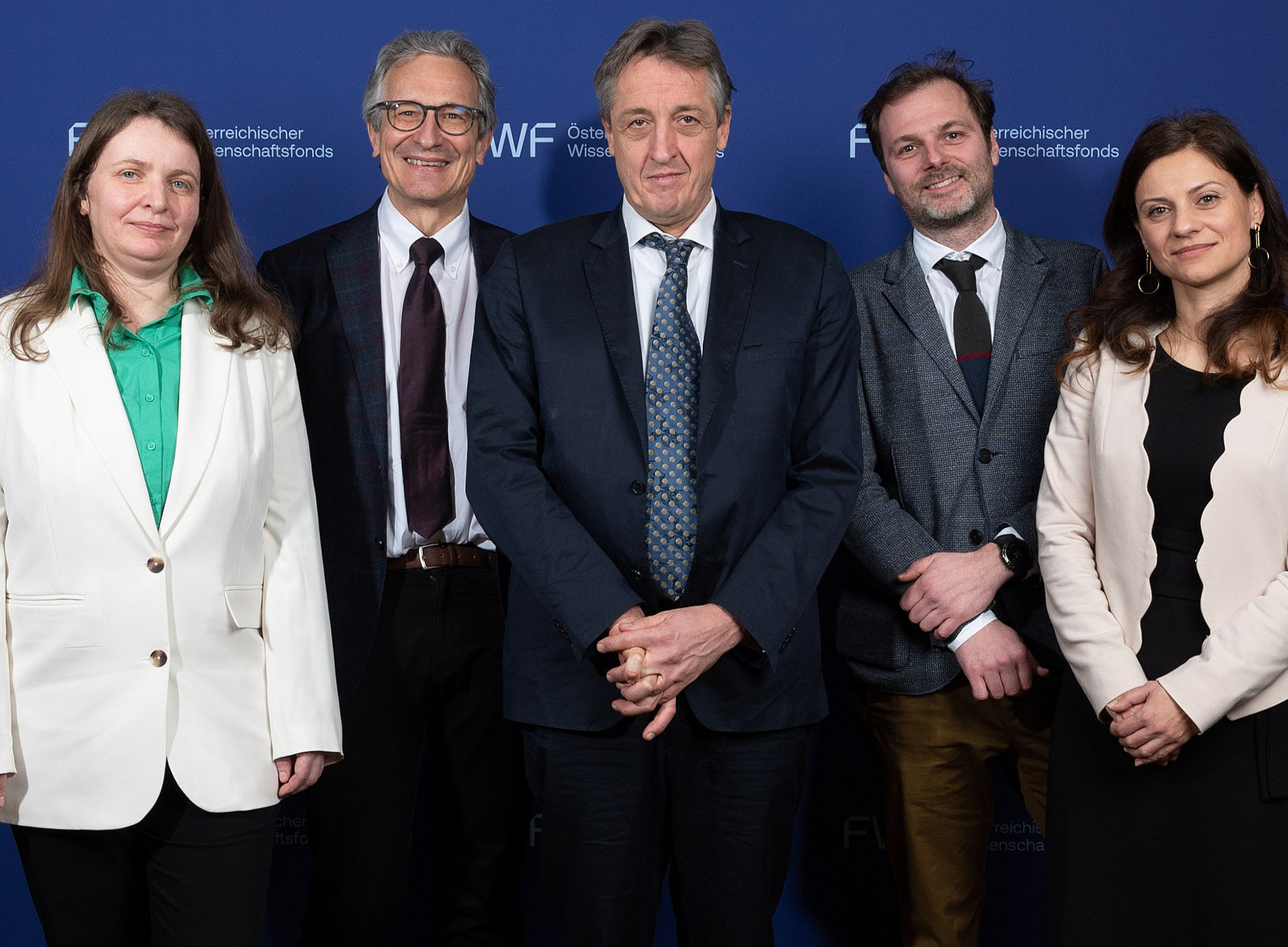
Brigitte Pertschy, Thomas Pieber, Frank Madeo, Thomas Scherer, Martina Schweiger, standing in front of a blue background with FWF logo
F.l.t.r.: Brigitte Pertschy, Thomas Pieber, Frank Madeo, Thomas Scherer, Martina Schweiger. Photo: FWF/Daniel Novotny
created by Gudrun Pichler

Related news

Electrons and AI: New approaches to the search for new medicines

Researchers at the University of Graz are revolutionising the development of new medicines by combining electrochemistry and artificial intelligence. Thanks to smart optimisation, the search for new active ingredients will in future be faster, more sustainable and safer.

Universities call for sustained investment in the Southern Education Region

University rectors are calling for an adequately funded budget for the Southern Education Region

University of Graz in the summer semester 2026: An overview of the best events

From crime fiction evenings to open houses and campus festivals: the University of Graz is offering a diverse programme for students, curious minds and culture enthusiasts in the 2026 summer semester.

Inequalities: why women are more strongly affected by climate security risks

Climate change affects us all. And yet some people are affected by it more than others. “In many societies, women have less access to protection resources . At the same time, they are more often responsible for unpaid care work. That is why they suffer more intensely from the threats posed by a changing global climate,” Atieh Khatibi, the legal scholar at the Research Center for Climate Law (ClimLaw:Graz), University of Graz highlights. She is researching her project on the effects of climate security risks on women’s human rights, particularly in her home country, Iran.

Begin of page section:
Additional information:

University of Graz
Universitaetsplatz 3
8010 Graz
Austria
  • Contact
  • Web Editors
  • Moodle
  • UNIGRAZonline
  • Imprint
  • Data Protection Declaration
  • Accessibility Declaration
Weatherstation
Uni Graz

End of this page section. Go to overview of page sections

End of this page section. Go to overview of page sections

Begin of page section:

End of this page section. Go to overview of page sections