Begin of page section:
Page sections:

  • Go to contents (Accesskey 1)
  • Go to position marker (Accesskey 2)
  • Go to main navigation (Accesskey 3)
  • Go to sub navigation (Accesskey 4)
  • Go to additional information (Accesskey 5)
  • Go to page settings (user/language) (Accesskey 8)
  • Go to search (Accesskey 9)

End of this page section. Go to overview of page sections

Begin of page section:
Page settings:

English en
Deutsch de
Search
Login

End of this page section. Go to overview of page sections

Begin of page section:
Search:

Search for details about Uni Graz
Close

End of this page section. Go to overview of page sections


Search

Begin of page section:
Main navigation:

Page navigation:

  • University

    University
    • About the University
    • Organisation
    • Faculties
    • Library
    • Working at University of Graz
    • Campus
    Developing solutions for the world of tomorrow - that is our mission. Our students and our researchers take on the great challenges of society and carry the knowledge out.
  • Research Profile

    Research Profile
    • Our Expertise
    • Research Questions
    • Research Portal
    • Promoting Research
    • Research Transfer
    • Ethics in Research
    Scientific excellence and the courage to break new ground. Research at the University of Graz creates the foundations for making the future worth living.
  • Studies

    Studies
    • Prospective Students
    • Students
  • Community

    Community
    • International
    • Location
    • Research and Business
    • Alumni
    The University of Graz is a hub for international research and brings together scientists and business experts. Moreover, it fosters the exchange and cooperation in study and teaching.
  • Spotlight
Topics
  • Our digital Advent calendar
  • Sustainable University
  • Researchers answer
  • Work for us
Close menu

End of this page section. Go to overview of page sections

Begin of page section:
You are here:

University of Graz News Religionen im Gespräch

End of this page section. Go to overview of page sections

Tuesday, 08 April 2014

Religionen im Gespräch

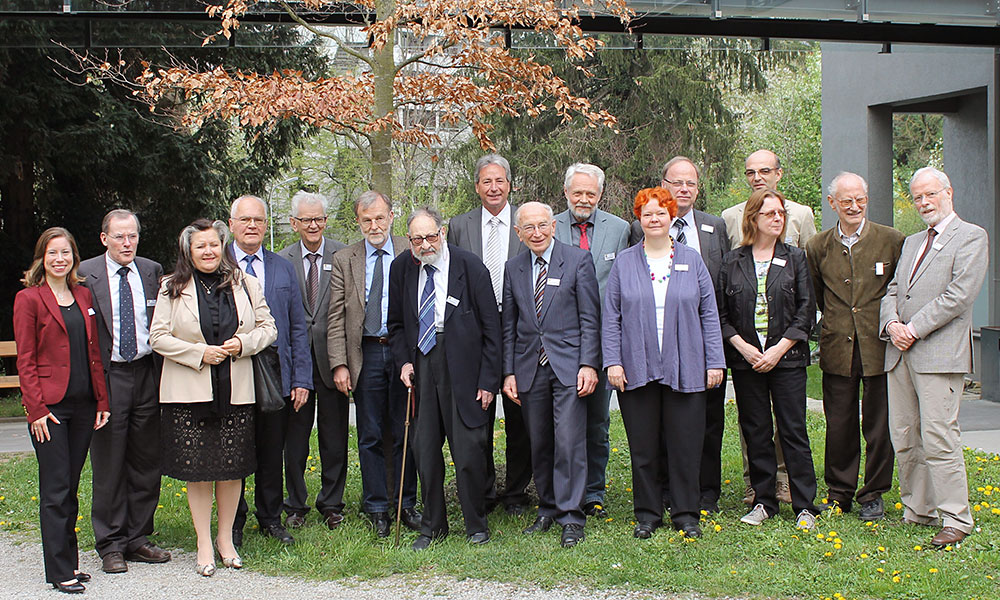
1. Reihe: Edith Petschnigg, Günter Stemberger, Irmtraud Fischer, Bertold Klappert, Johannes Marböck, Erhard Blum, Simon Lauer, Josef Wohlmuth, Gerlinde Baumann, Marie-Theres Wacker, Johann Maier, Hans Hermann Henrix (v.l.n.r.); 2. Reihe: Gerhard Langer,

1. Reihe: Edith Petschnigg, Günter Stemberger, Irmtraud Fischer, Bertold Klappert, Johannes Marböck, Erhard Blum, Simon Lauer, Josef Wohlmuth, Gerlinde Baumann, Marie-Theres Wacker, Johann Maier, Hans Hermann Henrix (v.l.n.r.); 2. Reihe: Gerhard Langer, Klaus Wengst, Albert Gerhards, Peter Ebenbauer (v.l.n.r.)

Eine Tagung am Universitätszentrum Theologie beleuchtete den jüdisch-christlichen Dialog nach 1945 und seine Auswirkungen

Der jüdisch-christliche Dialog stand im Mittelpunkt einer Tagung, die von 4. bis 5. April 2014 am Grazer Universitätszentrum Theologie stattfand. Das Symposium wurde vom Institut für Alttestamentliche Bibelwissenschaft organisiert, im Rahmen eines vom Österreichischen Wissenschaftsfonds FWF geförderten Forschungsprojekts unter der Leitung von Univ.-Prof. Dr. Irmtraud Fischer. Im Projekt dokumentiert und analysiert die Dissertantin MMag. Edith Petschnigg die historische Entwicklung des jüdisch-christlichen Dialogs in Österreich und Deutschland nach 1945.


„Beinahe die gesamte Kirchengeschichte hindurch definierte sich das Christentum in Abgrenzung zum Judentum. Erst die Tragödie der Schoa markierte für die christliche Theologie einen entscheidenden Wendepunkt in der Definition ihrer Haltung zum Judentum und damit zum ersten Teil ihrer Heiligen Schriften, dem Alten Testament bzw. der Hebräischen Bibel“, erklärt Edith Petschnigg. Ein wesentliches Resultat des allmählich stattfindenden Umdenkprozesses stellt der jüdisch-christliche Dialog dar.

Im Mittelpunkt der internationalen Tagung in Graz standen die Veränderungen in der Theologie, die der jüdisch-christliche Dialog mit sich brachte und bringt. Evangelische, katholische und jüdische ExpertInnen zeichneten wesentliche Stationen dieses theologischen Wandels aus ihrer jeweiligen Perspektive nach. Zu Wort kamen VertreterInnen der alt- und neutestamentlichen Bibelwissenschaft, Liturgiewissenschaft, Feministischen Theologie, Systematischen Theologie und Judaistik.

Am Freitagabend hielt Prof. Dr.h.c. Hans Hermann Henrix aus Aachen im Rahmen der Tagung einen öffentlichen Vortrag im Bildungshaus Mariatrost zum Thema „Kirche ohne Judentum? Eine Vergewisserung der Präsenz des Jüdischen in der ökumenischen Theologie“. Das Bildungshaus Mariatrost schloss damit an seine lange Tradition im Engagement für das jüdisch-christliche Gespräch an. Von 1982 bis 2007 veranstaltete das Haus im Zwei-Jahresrhythmus die „Österreichische Christlich-Jüdische Bibelwoche“, die von der Grazer Erwachsenenbildnerin Dr. Erika Horn initiiert worden war. „Graz spielte im österreichischen Kontext damit lange Zeit eine Vorreiterrolle im Feld des jüdisch-christlichen Gesprächs“, so Petschnigg.

created by Gudrun Pichler

Related news

Chemical Christmas show at the University of Graz: An explosive evening at the Schauspielh

At the beginning of December, the University of Graz transformed the theater into a laboratory: as part of “Chemical Life,” teacher training students staged a chemical Christmas show for Styrian school classes—complete with ethanol rockets, nitrogen snow, and glowing effects. An evening designed to inspire interest in studying chemistry.

Train by train: Koralm railway accelerates exchange between the Universities

Lectures at the University of Klagenfurt in the morning, seminars at the University of Graz in the afternoon: Austria's longest tunnel and a journey time of around 45 minutes make it easy. The Koralm railway increases the speed of networking between the two university locations. The collaboration builds on existing cooperation - for example in the areas of teacher training, Slavic studies and as employers, the universities are well coordinated.

On the trail of the Big Bang: University of Graz receives 1.5 million euros for doctoral programmes

The Austrian Science Fund FWF has selected the Doctoral Programme in Theoretical Particle Physics at the University of Graz for funding from the Doc.funds. Six young scientists will be funded for 3.5 years. They will gain fundamentally new insights into the origins of the world.

From trans women and knee prostheses: sports science prizes awarded

Walking better with a prosthesis, successfully getting rid of excess weight, training more effectively, more fairness for trans people in sport: these were the topics addressed by the students at the University of Graz who were awarded the sports science prizes for their Master's theses on 3 December 2025.

Begin of page section:
Additional information:

University of Graz
Universitaetsplatz 3
8010 Graz
Austria
  • Contact
  • Web Editors
  • Moodle
  • UNIGRAZonline
  • Imprint
  • Data Protection Declaration
  • Accessibility Declaration
Weatherstation
Uni Graz

End of this page section. Go to overview of page sections

End of this page section. Go to overview of page sections

Begin of page section:

End of this page section. Go to overview of page sections