Begin of page section:
Page sections:

  • Go to contents (Accesskey 1)
  • Go to position marker (Accesskey 2)
  • Go to main navigation (Accesskey 3)
  • Go to sub navigation (Accesskey 4)
  • Go to additional information (Accesskey 5)
  • Go to page settings (user/language) (Accesskey 8)
  • Go to search (Accesskey 9)

End of this page section. Go to overview of page sections

Begin of page section:
Page settings:

English en
Deutsch de
Search
Login

End of this page section. Go to overview of page sections

Begin of page section:
Search:

Search for details about Uni Graz
Close

End of this page section. Go to overview of page sections


Search

Begin of page section:
Main navigation:

Page navigation:

  • University

    University
    • About the University
    • Organisation
    • Faculties
    • Library
    • Working at University of Graz
    • Campus
    Developing solutions for the world of tomorrow - that is our mission. Our students and our researchers take on the great challenges of society and carry the knowledge out.
  • Research Profile

    Research Profile
    • Our Expertise
    • Research Questions
    • Research Portal
    • Promoting Research
    • Research Transfer
    • Ethics in Research
    • Commission for Scientific Integrity
    Scientific excellence and the courage to break new ground. Research at the University of Graz creates the foundations for making the future worth living.
  • Studies

    Studies
    • Prospective Students
    • Students
  • Community

    Community
    • International
    • Location
    • Research and Business
    • Alumni
    The University of Graz is a hub for international research and brings together scientists and business experts. Moreover, it fosters the exchange and cooperation in study and teaching.
  • Spotlight
Topics
  • Sustainable University
  • Researchers answer
  • Work for us
Close menu

End of this page section. Go to overview of page sections

Begin of page section:
You are here:

University of Graz News Rekordschmelze

End of this page section. Go to overview of page sections

Friday, 31 March 2023

Rekordschmelze

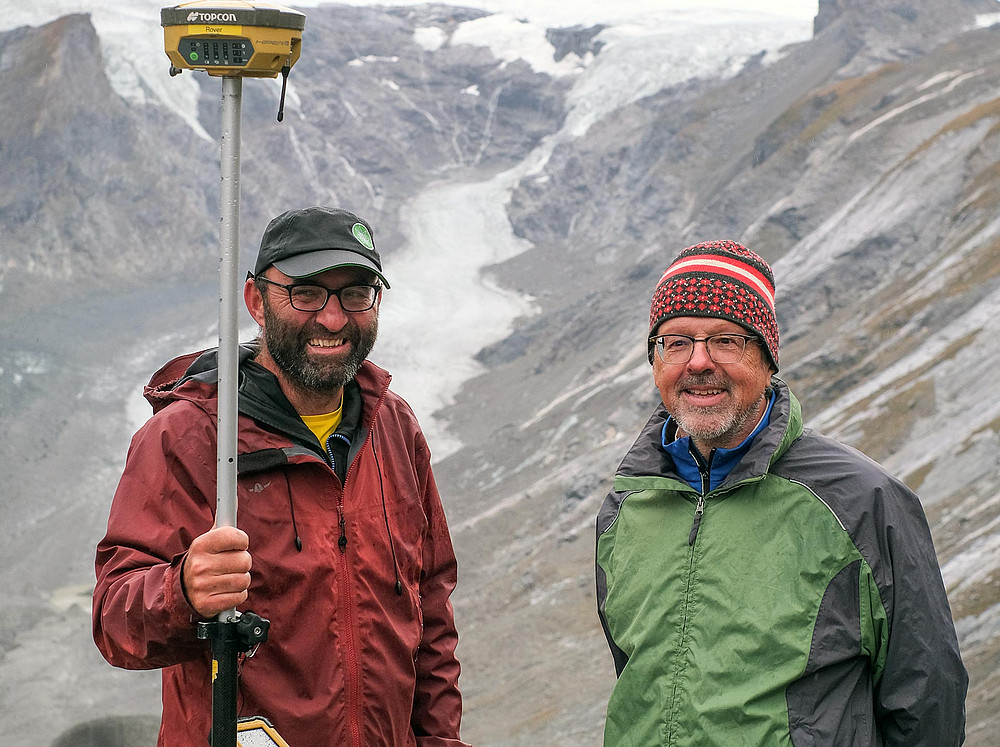
Andreas Kellerer-Pirklbauer und Gerhard Lieb von der Uni Graz mit Messgerät vor einem Gletscher ©Simon Schöpf

Andreas Kellerer-Pirklbauer und Gerhard Lieb (v.l.) von der Uni Graz leiten den Gletschermessdienst des Österreichischen Alpenvereins. Foto: Alpenverein / Simon Schöpf

Aktueller Gletscherbericht belegt rapiden Schwund des Eises in den österreichischen Alpen

Seit 132 Jahren beobachtet der Gletschermessdienst des Österreichischen Alpenvereins das Eis in den heimischen Gebirgsgruppen. Die Aufzeichnungen dokumentieren das rasante Abschmelzen im Zusammenhang mit dem Klimawandel. Der aktuellste Bericht, der am 31. März 2023 im Rahmen einer Online-Pressekonferenz präsentiert wurde, offenbart neue Rekordwerte. Gerhard Karl Lieb und Andreas Kellerer-Pirklbauer vom Institut für Geographie und Raumforschung der Universität Graz, Leiter des Gletschermessdienstes, analysierten die Ursachen für den massiven Schwund im Zeitraum 2021/2022.

Die größte Längenänderung wurde erneut in der Venedigergruppe gemessen, wo sich das Schlatenkees um 89,5 Meter zurückzog. Im Jahr davor waren es 54,5 Meter gewesen. Platz 2 belegt die Pasterze am Großglockner. Sie verlor 87,4 Meter. Im Mittel sind die 89 vom Alpenverein beobachteten österreichischen Gletscher um 28,7 Meter kürzer geworden. „Die enormen Verluste erklären sich aus der Kombination unterdurchschnittlicher Schneemengen im Winter mit einer erneut langen und sehr warmen Schmelzperiode, die schon an der Monatswende Mai/Juni einsetzte und bis in den September hinein andauerte“, analysieren Lieb und Kellerer-Pirklbauer die Ergebnisse.

Die aktuellen Rückzugswerte sind die höchsten seit Beginn der Alpenvereins-Messreihe im Jahr 1891. „Das Schwinden der Gletscher macht unzweifelhaft die Folgen des anthropogen massiv verstärkten Klimawandels deutlich“, so die Forscher. „Die österreichischen Alpen werden in einigen Jahrzehnten so gut wie eisfrei sein – mit ,optimistischer‘ Prognose bis 2075, wahrscheinlich aber deutlich früher.“

Nähere Informationen im >> Gletscherbericht des Österreichischen Alpenvereins 2021/22

created by Gudrun Pichler

Related news

Interpreting data: Why studies sometimes get it wrong

Hilmar Brohmer and Ziva Korda from the Institute of Psychology, together with 500 international colleagues, have re-evaluated a hundred scientific publications and have often come to different conclusions.

Crystal-clear: AI method revolutionises solar observation

The Sun makes life on Earth possible. However, its magnetic fields can also cause massive disruption. This makes it all the more important to gain a better understanding of the processes taking place on our nearest star. A research team from the University of Graz and the High Altitude Observatory in Boulder (USA) has succeeded in doing just that. The astrophysicists have developed an AI-supported method that makes even the smallest structures on the Sun visible. The scientists are convinced that this will bring about a lasting change in solar observation and that the new method can be used for the planned European Solar Telescope.

Long Night of Research: How many languages are there in the world?

From a linguistic perspective, there are worlds of difference between Bern, Berlin and Vienna. A dialect impersonator will demonstrate live just how varied German can sound. How many languages are there in the world? What are their distinctive features? Which of these are spoken in Austria? These and other questions will be answered during the Long Night of Research at the University of Graz: on Friday, 24 April 2025, from 5 pm to 11 pm, in the University Library. Visitors can immerse themselves in the diversity of languages without travelling far by taking part in a quiz at the station.

Dual role: Researchers show that platelets can worsen disease

Platelets are best known as rapid responders in the event of injury. They stop bleeding and are indispensable for wound healing. “However, thrombocytes can also aggravate diseases, especially when inflammatory processes are involved,” explains Marion Mußbacher, a pharmacist at the University of Graz. She investigated the “dual role” of platelets in relation to fatty liver disease, a condition closely linked to obesity and type 2 diabetes.

Begin of page section:
Additional information:

University of Graz
Universitaetsplatz 3
8010 Graz
Austria
  • Contact
  • Web Editors
  • Moodle
  • UNIGRAZonline
  • Imprint
  • Data Protection Declaration
  • Accessibility Declaration
Weatherstation
Uni Graz

End of this page section. Go to overview of page sections

End of this page section. Go to overview of page sections

Begin of page section:

End of this page section. Go to overview of page sections