Begin of page section:
Page sections:

  • Go to contents (Accesskey 1)
  • Go to position marker (Accesskey 2)
  • Go to main navigation (Accesskey 3)
  • Go to sub navigation (Accesskey 4)
  • Go to additional information (Accesskey 5)
  • Go to page settings (user/language) (Accesskey 8)
  • Go to search (Accesskey 9)

End of this page section. Go to overview of page sections

Begin of page section:
Page settings:

English en
Deutsch de
Search
Login

End of this page section. Go to overview of page sections

Begin of page section:
Search:

Search for details about Uni Graz
Close

End of this page section. Go to overview of page sections


Search

Begin of page section:
Main navigation:

Page navigation:

  • University

    University
    • About the University
    • Organisation
    • Faculties
    • Library
    • Working at University of Graz
    • Campus
    Developing solutions for the world of tomorrow - that is our mission. Our students and our researchers take on the great challenges of society and carry the knowledge out.
  • Research Profile

    Research Profile
    • Our Expertise
    • Research Questions
    • Research Portal
    • Promoting Research
    • Research Transfer
    • Ethics in Research
    • Commission for Scientific Integrity
    Scientific excellence and the courage to break new ground. Research at the University of Graz creates the foundations for making the future worth living.
  • Studies

    Studies
    • Prospective Students
    • Students
  • Community

    Community
    • International
    • Location
    • Research and Business
    • Alumni
    The University of Graz is a hub for international research and brings together scientists and business experts. Moreover, it fosters the exchange and cooperation in study and teaching.
  • Spotlight
Topics
  • Sustainable University
  • Researchers answer
  • Work for us
Close menu

End of this page section. Go to overview of page sections

Begin of page section:
You are here:

University of Graz News Quantum research: Images provide a better understanding of light and matter

End of this page section. Go to overview of page sections

Tuesday, 19 March 2024

Quantum research: Images provide a better understanding of light and matter

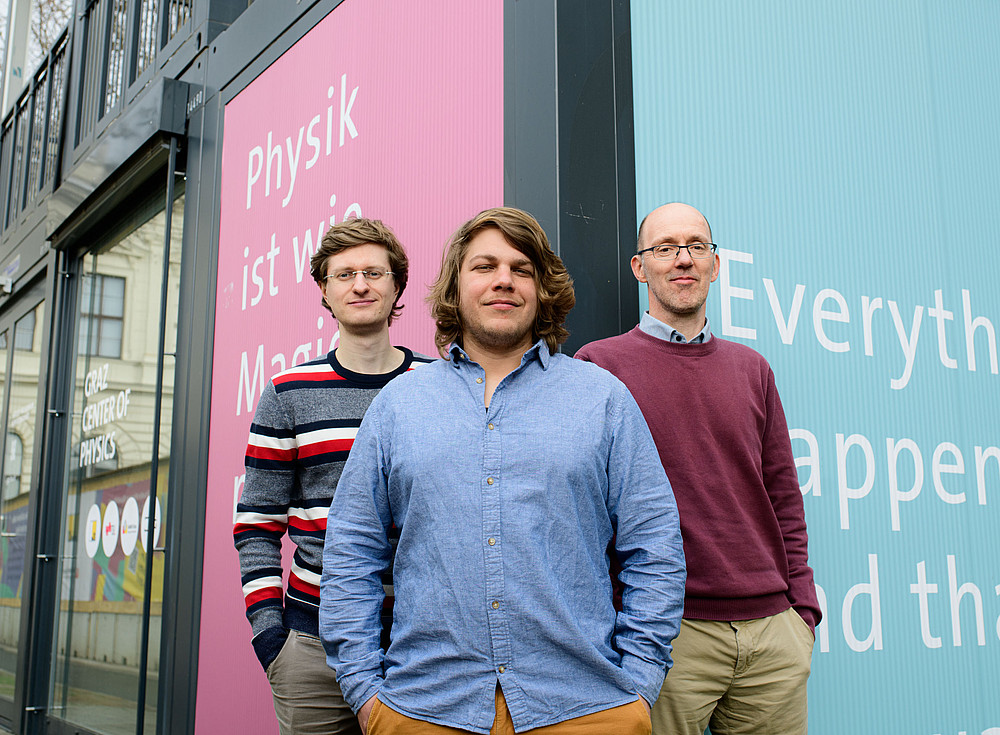
Scientist-Team of the University of Graz ©Uni Graz/Tzivanopoulos

Scientist-Team of the University of Graz: Andreas Windischbacher, Christian Kern und Peter Puschnig. Foto: Uni Graz/Tzivanopoulos

An international team of researchers has been able to take photos of a special specimen from the world of quantum research for the first time: the exciton. The findings are to be used to generate even more electricity from sunlight using innovative photovoltaic systems.

It is common and yet one of the most important physical reactions from the world of quantum research: light meets matter and this leads to a wide variety of phenomena; people risk sunburn, black surfaces become hot and electricity is generated in photovoltaic systems. But what is behind it all? When a particle of light, a photon, hits an electron in a molecule, it throws the electron out of its orbit. Experts say that the electron is excited and reaches a higher level. In doing so, it leaves behind an empty space, an electron hole, to which it remains quantum mechanically connected. The result is a quasi-particle called an “exciton”.

But what properties do these quasi-particles have, what are they capable of, and what do they look like? Clarifying these questions has long been a major challenge. Researchers from the Universities of Göttingen, Graz, Kaiserslautern-Landau and Grenoble-Alpes have now achieved a decisive breakthrough. They were able to capture several images of such excitons. A remarkable achievement considering the rapid change and the tiny size. We are talking about 0.000000000000001 seconds and a length of 0.000000001 metres. The groundbreaking results were published in the journal Nature Communications.

Wiebke Bennecke, physicist at the University of Göttingen and first author of the study, explains: “We record the changes with extraordinarily precise spatial and temporal resolution and relate them to the theoretical predictions of quantum mechanics.” The researchers refer to this new method as photoemission exciton tomography.

Complex images

This technology enables the scientists to measure and visualise the quantum mechanical wave function of the excitons. The team at the University of Graz makes a significant contribution to the evaluation of the data by providing the theoretical models for the analysis. “The setup in Göttingen is unique and can take these complex images. We can then explain what you see on them,” says Peter Puschnig, head of the research team at the University of Graz.

Göttingen physicist Dr Matthijs Jansen explains the significance of the findings: “We have investigated organic carbon-based semiconductors, which are used in special photovoltaic systems or in the OLED screens of smartphones, for example.” The images illustrate how the exciton quickly spreads across several molecules and shrinks again within a few femtoseconds (one millionth of a billionth of a second).

Puschnig emphasises: “The results confirm the theoretical model we are working on at the University of Graz.” This can be helpful, for example, in the development of new photovoltaic technology on an organic basis. “We now have a more profound understanding of how the process of generating electricity with such systems works.” The vision behind the research: using new technologies to generate more electricity from sunlight.

Next step: Videos

These new photos of the excitons are by no means the end of the research, but rather the beginning of further intensive analyses. The next step is to record videos of the quasi-particles, says Göttingen researcher Jansen: “We hope that this knowledge will contribute to the development of more efficient materials for solar cells.”

The team in Graz is now also focussing on the further development of the underlying theory. The researchers received funding for this from the EU ERC grants under the title “Orbital Cinema”.

This research was funded by the German Research Foundation (DFG) as part of the Collaborative Research Centres “Atomic Control of Energy Conversion” and “Mathematics of Experimentation” in Göttingen and “Spin+X” in Kaiserslautern-Landau.

Publication
Bennecke, W. et al, Disentangling the multiorbital contributions of excitons by photoemission exciton tomography. Nature Communications (2024).


created by Roman Vilgut

Related news

Studying at the University of Graz: How to enrol

Ready for a new chapter in your life with the start of your studies at the University of Graz in the winter semester 2026/27? Here you will find information on deadlines, admission procedures, registration, and everything else you need to successfully start your studies in the fall.

Interpreting data: Why studies sometimes get it wrong

Hilmar Brohmer and Ziva Korda from the Institute of Psychology, together with 500 international colleagues, have re-evaluated a hundred scientific publications and have often come to different conclusions.

Crystal-clear: AI method revolutionises solar observation

The Sun makes life on Earth possible. However, its magnetic fields can also cause massive disruption. This makes it all the more important to gain a better understanding of the processes taking place on our nearest star. A research team from the University of Graz and the High Altitude Observatory in Boulder (USA) has succeeded in doing just that. The astrophysicists have developed an AI-supported method that makes even the smallest structures on the Sun visible. The scientists are convinced that this will bring about a lasting change in solar observation and that the new method can be used for the planned European Solar Telescope.

Long Night of Research: How many languages are there in the world?

From a linguistic perspective, there are worlds of difference between Bern, Berlin and Vienna. A dialect impersonator will demonstrate live just how varied German can sound. How many languages are there in the world? What are their distinctive features? Which of these are spoken in Austria? These and other questions will be answered during the Long Night of Research at the University of Graz: on Friday, 24 April 2025, from 5 pm to 11 pm, in the University Library. Visitors can immerse themselves in the diversity of languages without travelling far by taking part in a quiz at the station.

Begin of page section:
Additional information:

University of Graz
Universitaetsplatz 3
8010 Graz
Austria
  • Contact
  • Web Editors
  • Moodle
  • UNIGRAZonline
  • Imprint
  • Data Protection Declaration
  • Accessibility Declaration
Weatherstation
Uni Graz

End of this page section. Go to overview of page sections

End of this page section. Go to overview of page sections

Begin of page section:

End of this page section. Go to overview of page sections