Begin of page section:
Page sections:

  • Go to contents (Accesskey 1)
  • Go to position marker (Accesskey 2)
  • Go to main navigation (Accesskey 3)
  • Go to sub navigation (Accesskey 4)
  • Go to additional information (Accesskey 5)
  • Go to page settings (user/language) (Accesskey 8)
  • Go to search (Accesskey 9)

End of this page section. Go to overview of page sections

Begin of page section:
Page settings:

English en
Deutsch de
Search
Login

End of this page section. Go to overview of page sections

Begin of page section:
Search:

Search for details about Uni Graz
Close

End of this page section. Go to overview of page sections


Search

Begin of page section:
Main navigation:

Page navigation:

  • University

    University
    • About the University
    • Organisation
    • Faculties
    • Library
    • Working at University of Graz
    • Campus
    Developing solutions for the world of tomorrow - that is our mission. Our students and our researchers take on the great challenges of society and carry the knowledge out.
  • Research Profile

    Research Profile
    • Our Expertise
    • Research Questions
    • Research Portal
    • Promoting Research
    • Research Transfer
    • Ethics in Research
    Scientific excellence and the courage to break new ground. Research at the University of Graz creates the foundations for making the future worth living.
  • Studies

    Studies
    • Prospective Students
    • Students
  • Community

    Community
    • International
    • Location
    • Research and Business
    • Alumni
    The University of Graz is a hub for international research and brings together scientists and business experts. Moreover, it fosters the exchange and cooperation in study and teaching.
  • Spotlight
Topics
  • Our digital Advent calendar
  • Sustainable University
  • Researchers answer
  • Work for us
Close menu

End of this page section. Go to overview of page sections

Begin of page section:
You are here:

University of Graz News Preisregen

End of this page section. Go to overview of page sections

Tuesday, 20 May 2014

Preisregen

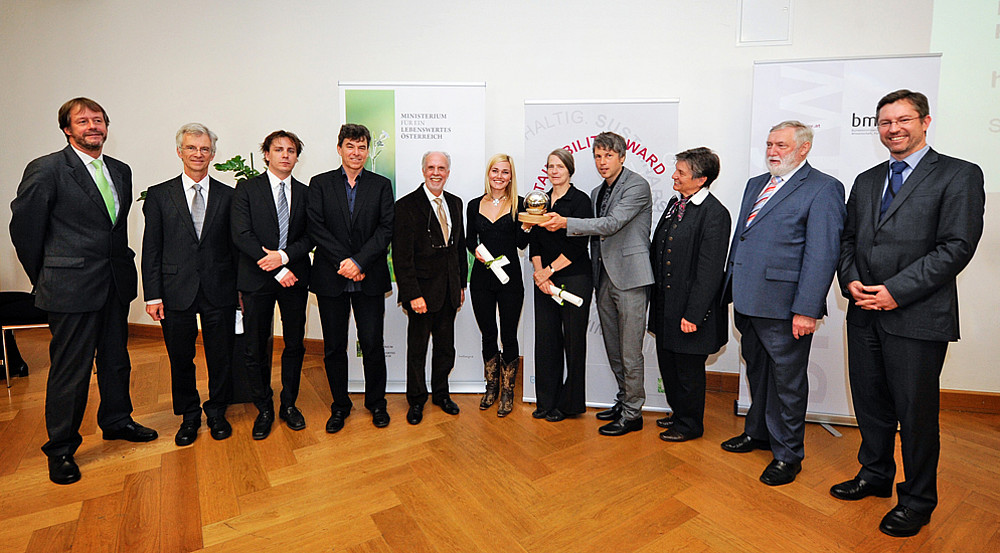
Wolfram Tertschnig, Bundesministerium für Land- und Forstwirtschaft, Umwelt und Wasserwirtschaft, Bernhard Hofmann-Wellenhof, Vizerektor für Lehre an der TU Graz, Matthias Litschauer, BOKU Wien, Franz Embacher, Universität Wien, Friedrich Zimmermann, U

Wolfram Tertschnig, Bundesministerium für Land- und Forstwirtschaft, Umwelt und Wasserwirtschaft, Bernhard Hofmann-Wellenhof, Vizerektor für Lehre an der TU Graz, Matthias Litschauer, BOKU Wien, Franz Embacher, Universität Wien, Friedrich Zimmermann, Universität Graz, Ricarda Rindlisbacher, Universität Graz, Helga Kromp-Kolb, BOKU Wien, Mag. Richard Kromp, BOKU Wien, Barbara Hinterstoisser, Boku Wien, Franz Fischler, Präsident des Europäischen Forums Alpbach und Elmar Pichl, Sektionsleiter des Bundesministerium für Wissenschaft, Forschung und Wirtschaft (v.l.). Foto: Gunter Pusch/HBF.

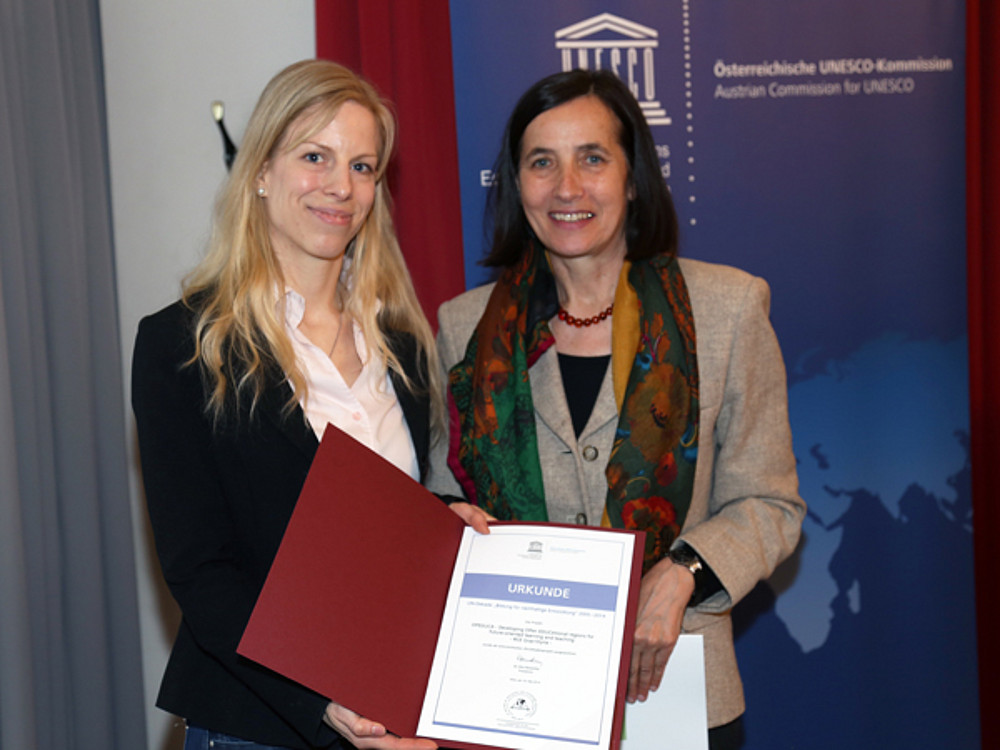
Heidrun Kögler, Projektmitarbeiterin im OPEDUCA Projekt, und Gabriele Eschig, Generalsekretärin der Österreichischen UNESCO-Kommission (v.l.). Foto:ÖUK/Othmar Pehböck

Heidrun Kögler, Projektmitarbeiterin im OPEDUCA Projekt, und Gabriele Eschig, Generalsekretärin der Österreichischen UNESCO-Kommission (v.l.). Foto:ÖUK/Othmar Pehböck

Nachhaltigkeits-Oscar und mehr für das Sustainicum-Projekt

Große Auszeichnung: Das vom Institut für Geographie und Raumforschung sowie vom Regional Centre of Expertise (RCE Graz-Styria) der Uni Graz, von der Universität für Bodenkultur Wien und der TU Graz getragene Projekt Projekt "Sustainicum – Collection: Lehrmaterialien für Bildung zur Nachhaltigkeit" konnte den begehrten "Sustainability Award", auch "Nachhaltigkeits-Oscar" genannt, einheimsen.


O.Univ.-Prof. Dr. Friedrich Zimmermann nahm die Auszeichnung, die vom Bundesministerium für Wissenschaft, Forschung und Wirtschaft sowie vom Bundesministerium für Land- und Forstwirtschaft, Umwelt und Wasserwirtschaft alle zwei Jahre vergeben wird, vergangene Woche in Wien entgegen.


Das Projekt zielt darauf ab, nachhaltigkeitsrelevante Themen aus der Sicht verschiedener Fachgebiete in die universitäre Lehre einzubringen. Lehrende können laufend ihre eigenen Ressourcen zum Thema Nachhaltigkeit über eine Plattform ihren KollegInnen zur Verfügung stellen. Die Nutzung der Sammlung ist unkompliziert und kostenlos. Und das Netzwerk wächst: Derzeit wird die "Sustainicum-Collection" im Rahmen des TEMPUS Projektes CONSUS für die Region "Western Balkan" aufbereitet. In einem weiteren Schritt wird die Nutzbarmachung für Schulen - im Rahmen des "OPEDUCA-Projektes" des RCE Graz-Styria der Universität Graz - initiiert.


Das Bildungsprojekt "OPEDUCA" - die Abkürzung steht für "Open Educational Area" - fördert den Aufbau von offenen Lernregionen, in denen Schulen, Forschungseinrichtungen und Unternehmen mit- und voneinander lernen. Ziel ist es unter anderem, SchülerInnen den Spaß und die Freude an der Wissensaneignung zurückgeben. Dieses Vorhaben war der österreichischen UNESCO-Kommission eine Auszeichnung wert: Ebenfalls vergangene Woche ehrte sie das OPEDUCA-Projekt als offizielles UN-Dekadenprojekt. All diesen Initiativen gemeinsam ist die Unterstützung des ganzheitlichen Lernens mit konkretem Bezug zum Lebensalltag.


Schließlich erreichte ein weiteres Projekt des RCE den dritten Platz beim Sustainability Award: "University Educators for Sustainable Development", kurz UE4SD. Das EU-Projekt hat das Ziel, Nachhaltigkeitskompetenzen von Lehrenden an europäischen Hochschulen durch professionelle Weiterbildung zu stärken. 55 PartnerInnen aus dem Hochschulsektor aus 33 europäischen Ländern haben sich dazu vernetzt.


created by Gerhild Kastrun

Related news

Chemical Christmas show at the University of Graz: An explosive evening at the Schauspielh

At the beginning of December, the University of Graz transformed the theater into a laboratory: as part of “Chemical Life,” teacher training students staged a chemical Christmas show for Styrian school classes—complete with ethanol rockets, nitrogen snow, and glowing effects. An evening designed to inspire interest in studying chemistry.

Train by train: Koralm railway accelerates exchange between the Universities

Lectures at the University of Klagenfurt in the morning, seminars at the University of Graz in the afternoon: Austria's longest tunnel and a journey time of around 45 minutes make it easy. The Koralm railway increases the speed of networking between the two university locations. The collaboration builds on existing cooperation - for example in the areas of teacher training, Slavic studies and as employers, the universities are well coordinated.

On the trail of the Big Bang: University of Graz receives 1.5 million euros for doctoral programmes

The Austrian Science Fund FWF has selected the Doctoral Programme in Theoretical Particle Physics at the University of Graz for funding from the Doc.funds. Six young scientists will be funded for 3.5 years. They will gain fundamentally new insights into the origins of the world.

From trans women and knee prostheses: sports science prizes awarded

Walking better with a prosthesis, successfully getting rid of excess weight, training more effectively, more fairness for trans people in sport: these were the topics addressed by the students at the University of Graz who were awarded the sports science prizes for their Master's theses on 3 December 2025.

Begin of page section:
Additional information:

University of Graz
Universitaetsplatz 3
8010 Graz
Austria
  • Contact
  • Web Editors
  • Moodle
  • UNIGRAZonline
  • Imprint
  • Data Protection Declaration
  • Accessibility Declaration
Weatherstation
Uni Graz

End of this page section. Go to overview of page sections

End of this page section. Go to overview of page sections

Begin of page section:

End of this page section. Go to overview of page sections