Begin of page section:
Page sections:

  • Go to contents (Accesskey 1)
  • Go to position marker (Accesskey 2)
  • Go to main navigation (Accesskey 3)
  • Go to sub navigation (Accesskey 4)
  • Go to additional information (Accesskey 5)
  • Go to page settings (user/language) (Accesskey 8)
  • Go to search (Accesskey 9)

End of this page section. Go to overview of page sections

Begin of page section:
Page settings:

English en
Deutsch de
Search
Login

End of this page section. Go to overview of page sections

Begin of page section:
Search:

Search for details about Uni Graz
Close

End of this page section. Go to overview of page sections


Search

Begin of page section:
Main navigation:

Page navigation:

  • University

    University
    • About the University
    • Organisation
    • Faculties
    • Library
    • Working at University of Graz
    • Campus
    Developing solutions for the world of tomorrow - that is our mission. Our students and our researchers take on the great challenges of society and carry the knowledge out.
  • Research Profile

    Research Profile
    • Our Expertise
    • Research Questions
    • Research Portal
    • Promoting Research
    • Research Transfer
    • Ethics in Research
    Scientific excellence and the courage to break new ground. Research at the University of Graz creates the foundations for making the future worth living.
  • Studies

    Studies
    • Prospective Students
    • Students
  • Community

    Community
    • International
    • Location
    • Research and Business
    • Alumni
    The University of Graz is a hub for international research and brings together scientists and business experts. Moreover, it fosters the exchange and cooperation in study and teaching.
  • Spotlight
Topics
  • Our digital Advent calendar
  • Sustainable University
  • Researchers answer
  • Work for us
Close menu

End of this page section. Go to overview of page sections

Begin of page section:
You are here:

University of Graz News Plankton and ice: How global warming is changing the supply of nutrients in the oceans

End of this page section. Go to overview of page sections

Monday, 20 November 2023

Plankton and ice: How global warming is changing the supply of nutrients in the oceans

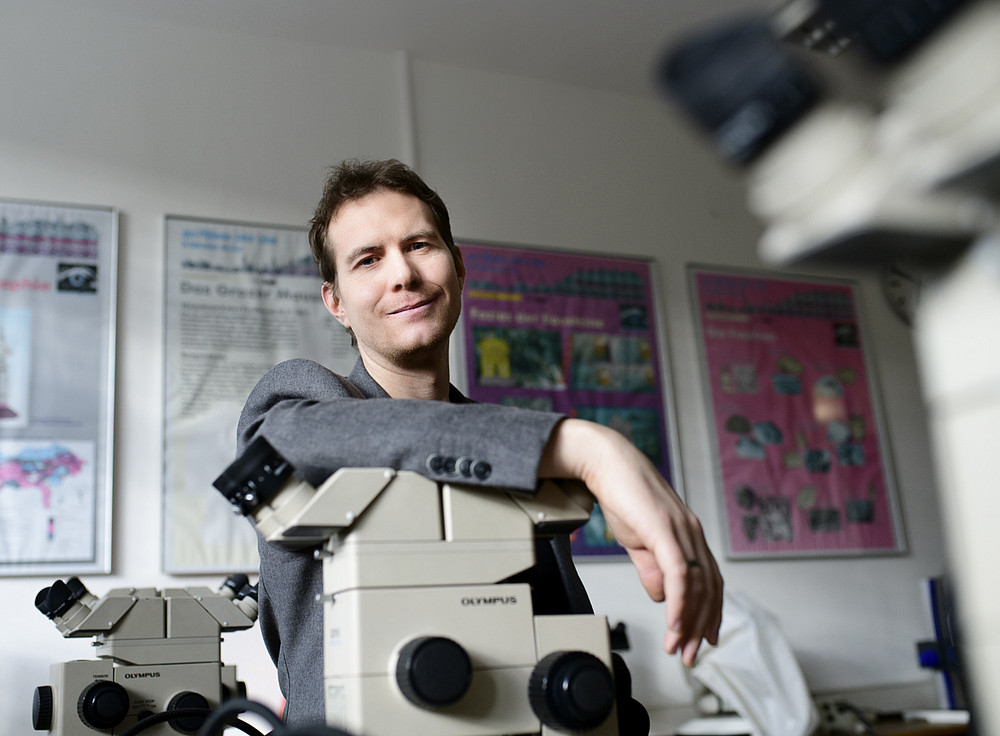
Earth scientist Gerald Auer leans over a microscope. ©Uni Graz/Tzivanopoulos

Earth scientist Gerald Auer obtains climate predictions from prehistoric soil samples. Photo: University of Graz/Tzivanopoulos

Climate change not only affects weather phenomena such as El Niño or the monsoon, but also ocean currents and consequently the food chain. The associated disappearance of fishing grounds could have massive ecological and economic consequences. How ice melt, ocean circulation and nutrient content interact is not yet fully understood. Gerald Auer uses primeval soil samples to investigate the background.

"A rise in water temperature slows down the circulation in the oceans," explains Gerald Auer, earth scientist at the University of Graz. The melting of sea ice is likely to greatly accelerate this process and would also have consequences for plankton and the entire food chain. "We have found clear indications of this in our research work," explains Auer. He is co-leader of the international project "Tracing Intermediate Water Current Changes and Sea Ice Expansion in the Indian Ocean", which is investigating how climate change has affected ocean currents. "Climate change also influences the transport of nutrients and thus the living conditions in the water," the scientist adds.

As part of a pilot project of the International Ocean Discovery Programme at the Kochi Core Center in Japan, the team has access to unique scientific drill cores of million-year-old sediments from the Indian Ocean. "This allows us to recognise the consequences of climate change and find direct analogies for future scenarios. This is a valuable contribution to understanding the effects of climate change on the nutrient cycle of our oceans," reports Auer.

The researchers suspect a collapse in the food supply near the equator. They have just published what this could mean in a study in Climate of the Past: warmer climate conditions, as predicted for the coming centuries, reduced the nutrients in the ocean twelve million years ago. As a result, there was much less and very different plankton in the Arabian Sea than there is today. The marine food chain was only able to develop in its current form due to the glaciation of the Antarctic.

The research work of the Austrian team in Japan - the University of Vienna was also involved alongside Graz - was financially supported by the Austrian Academy of Sciences, the Austrian Science Fund FWF and an initiative of the European Consortium for Ocean Drilling. The research was carried out in collaboration with the Atmosphere and Ocean Research Institute of the University of Tokyo, the University of Kochi and the Japan Agency for Marine Earth Sciences and Technology.

Publication:
Auer G., Bialik O. M., Antoulas M.-E., Vogt-Vincent N. and Piller W. E. (2023) Biotic response of plankton communities to Middle to Late Miocene monsoon wind and nutrient flux changes in the Oman margin upwelling zone. Climate of the Past 19, 2313–2340.

created by Dagmar Eklaude

Related news

Chemical Christmas show at the University of Graz: An explosive evening at the Schauspielh

At the beginning of December, the University of Graz transformed the theater into a laboratory: as part of “Chemical Life,” teacher training students staged a chemical Christmas show for Styrian school classes—complete with ethanol rockets, nitrogen snow, and glowing effects. An evening designed to inspire interest in studying chemistry.

Train by train: Koralm railway accelerates exchange between the Universities

Lectures at the University of Klagenfurt in the morning, seminars at the University of Graz in the afternoon: Austria's longest tunnel and a journey time of around 45 minutes make it easy. The Koralm railway increases the speed of networking between the two university locations. The collaboration builds on existing cooperation - for example in the areas of teacher training, Slavic studies and as employers, the universities are well coordinated.

On the trail of the Big Bang: University of Graz receives 1.5 million euros for doctoral programmes

The Austrian Science Fund FWF has selected the Doctoral Programme in Theoretical Particle Physics at the University of Graz for funding from the Doc.funds. Six young scientists will be funded for 3.5 years. They will gain fundamentally new insights into the origins of the world.

From trans women and knee prostheses: sports science prizes awarded

Walking better with a prosthesis, successfully getting rid of excess weight, training more effectively, more fairness for trans people in sport: these were the topics addressed by the students at the University of Graz who were awarded the sports science prizes for their Master's theses on 3 December 2025.

Begin of page section:
Additional information:

University of Graz
Universitaetsplatz 3
8010 Graz
Austria
  • Contact
  • Web Editors
  • Moodle
  • UNIGRAZonline
  • Imprint
  • Data Protection Declaration
  • Accessibility Declaration
Weatherstation
Uni Graz

End of this page section. Go to overview of page sections

End of this page section. Go to overview of page sections

Begin of page section:

End of this page section. Go to overview of page sections