Begin of page section:
Page sections:

  • Go to contents (Accesskey 1)
  • Go to position marker (Accesskey 2)
  • Go to main navigation (Accesskey 3)
  • Go to sub navigation (Accesskey 4)
  • Go to additional information (Accesskey 5)
  • Go to page settings (user/language) (Accesskey 8)
  • Go to search (Accesskey 9)

End of this page section. Go to overview of page sections

Begin of page section:
Page settings:

English en
Deutsch de
Search
Login

End of this page section. Go to overview of page sections

Begin of page section:
Search:

Search for details about Uni Graz
Close

End of this page section. Go to overview of page sections


Search

Begin of page section:
Main navigation:

Page navigation:

  • University

    University
    • About the University
    • Organisation
    • Faculties
    • Library
    • Working at University of Graz
    • Campus
    Developing solutions for the world of tomorrow - that is our mission. Our students and our researchers take on the great challenges of society and carry the knowledge out.
  • Research Profile

    Research Profile
    • Our Expertise
    • Research Questions
    • Research Portal
    • Promoting Research
    • Research Transfer
    • Ethics in Research
    Scientific excellence and the courage to break new ground. Research at the University of Graz creates the foundations for making the future worth living.
  • Studies

    Studies
    • Prospective Students
    • Students
  • Community

    Community
    • International
    • Location
    • Research and Business
    • Alumni
    The University of Graz is a hub for international research and brings together scientists and business experts. Moreover, it fosters the exchange and cooperation in study and teaching.
  • Spotlight
Topics
  • Our digital Advent calendar
  • Sustainable University
  • Researchers answer
  • Work for us
Close menu

End of this page section. Go to overview of page sections

Begin of page section:
You are here:

University of Graz News Planet mit Ablaufdatum

End of this page section. Go to overview of page sections

Thursday, 01 June 2017

Planet mit Ablaufdatum

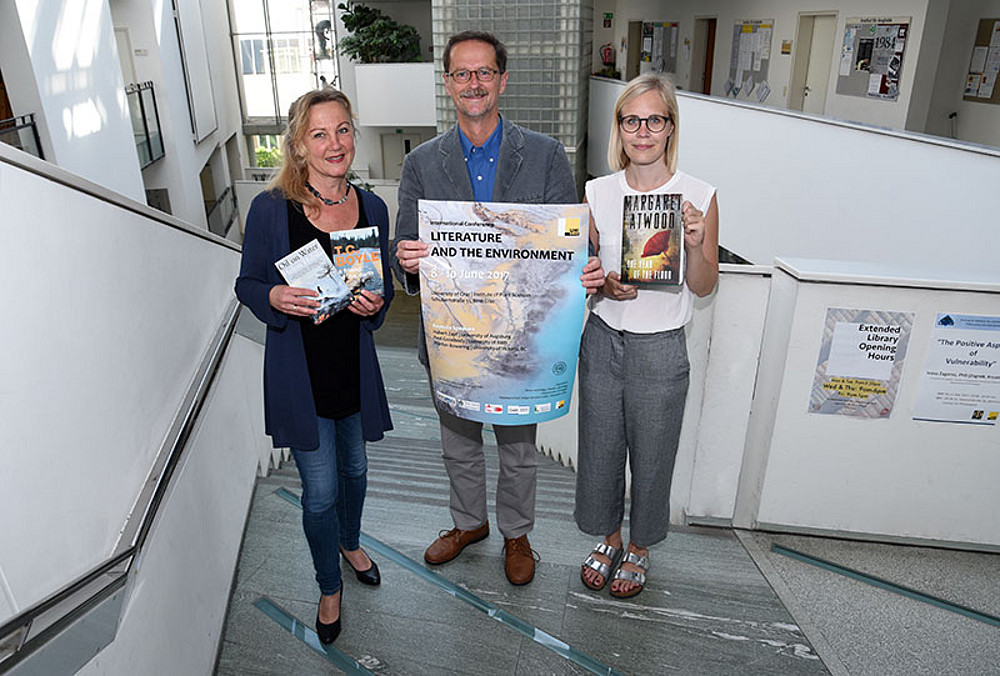
Maria und Martin Löschnigg sowie Rebekka Schuh (v.l.). organisieren die Tagung zu Umweltlilteratur. Foto: Uni Graz/Kastrun.

Maria und Martin Löschnigg sowie Rebekka Schuh (v.l.). organisieren die Tagung zu Umweltlilteratur. Foto: Uni Graz/Kastrun.

ForscherInnen untersuchen an der Uni Graz, wie Literatur zum Umweltschutz beitragen kann

Naturkatastrophen, Pandemien, zerstörte Tier- und Pflanzenwelt: Seit Jahrzehnten zeichnet die „Climate Fiction“, kurz „Cli-Fi“, ein düsteres Bild der Zukunft. Ursprünglich im anglo-amerikanischen Raum stark verwurzelt, fällt dieses Genre seit Beginn der Nuller-Jahre auch beim deutschsprachigen Publikum auf fruchtbaren Boden. Wie T.C. Boyle, Frank Schätzing und Co. helfen können, auf eine nachhaltige Umweltpolitik und Lebensweise aufmerksam zu machen, beleuchtet die dreitägige, öffentliche Konferenz „Literature and the Environment“ ab Donnerstag, 8. Juni 2017, an der Karl-Franzens-Universität Graz.


In seinem Werk „Ein Freund der Erde“ (2000) beschreibt T.C. Boyle einen von menschlichen Ansprüchen an Komfort und Luxus ruinierten Planeten. Frank Schätzing schildert in „Der Schwarm“ (2005) wie eine unbekannte, intelligente Lebensform aus dem Meer zur Gefahr für die gesamte Menschheit wird. In „Noah“ (2013) lässt Sebastian Fitzek die Manila-Pandemie die Welt ins Chaos stürzen und in „Ausgebrannt“ (2007) inszeniert Andreas Eschbach eine globale Ökokrise. Das Ziel dieser „Cli-Fi“-Romane: Die Menschheit zum Umdenken bewegen. „Wie keine andere Kommunikationsform spricht Literatur die Gefühle und Vorstellungskraft der LeserInnen an und erzeugt so Empathie. Sie leistet damit etwas, was wissenschaftlich fundierte Berichte, Dokumentationen und Statistiken nicht in diesem emotionalen Ausmaß erreichen. Zahlen und Fakten allein genügen dafür nicht“, bekräftigt Ao.Univ.-Prof. Dr. Maria Löschnigg vom Institut für Anglistik. Auch eröffnet die Literatur ihrem Publikum neue Blickwinkel: Zum Beispiel stellt Barbara Gowdy in „Der weiße Knochen“ (1999) die Welt konsequent aus Sicht von Elefanten dar, die auf der Flucht vor Elfenbeinjägern und Dürre um ihr Überleben kämpfen.


Die englischsprachige Konferenz an der Uni Graz versammelt LiteraturwissenschafterInnen und AutorInnen aus aller Welt, die sich mit der Frage beschäftigen, welchen Beitrag die Literatur zur Lösung umweltbezogener Fragen liefern kann. Die Hauptvorträge halten Hubert Zapf, Universität Augsburg, Deutschland, Axel Goodbody, University of Bath, England, sowie die kanadische Dichterin, Schriftstellerin und Dramatikerin Marilyn Bowering.


Konferenz in englischer Sprache: „Literature and the Environment“
Zeit: Donnerstag, 8. Juni, bis Samstag, 10. Juni 2017
Ort: Institut für Pflanzenwissenschaften, Schubertstraße 51, 8010 Graz


Die Teilnahme ist kostenlos, es ist keine Anmeldung erforderlich.

created by Gerhild Kastrun

Related news

Rector Peter Riedler: Starting the year with confidence

In 2026, we will continue to work consistently on positioning the University of Graz as a relevant player in Europe, while at the same time focusing on a modern, sustainable and climate-friendly university campus. When new digital applications are rolled out in January, we will not only create a stable and secure IT environment, but also modern working and studying conditions for future generations. Peter Rielder, Rector of the University of Graz

Uni Vibes 2026: the campus festival that transcends borders again

On 29 May 2026, it's that time again: the University of Graz celebrates, dances and vibrates. The campus will become a stage for art, science and music.

Setback: Austria's greenhouse gas emissions rise in 2025

Climate protection is currently facing an uphill battle. The United Nations have recently been unable to agree on a roadmap for phasing out fossil fuels, even though global warming continues to accelerate. Also Austria still does not have a national climate law with a clear target path for reducing emissions. This is evidently taking its toll: Austria’s greenhouse gas emissions rose again in 2025 for the first time in years, by around two and a half percent, according to calculations by researchers at the University of Graz. In addition to overly cautious climate action measures, this is due to somewhat colder winter months compared to 2024, which are driving up natural gas consumption.

Profound: Geoscientist Marko Bermanec deciphers processes of the Earth's plates

What happens deep down is very important to us above ground. Especially when hidden chemical processes between tectonic plates have serious consequences. Earth scientist Marko Bermanec investigates these processes in depth.

Begin of page section:
Additional information:

University of Graz
Universitaetsplatz 3
8010 Graz
Austria
  • Contact
  • Web Editors
  • Moodle
  • UNIGRAZonline
  • Imprint
  • Data Protection Declaration
  • Accessibility Declaration
Weatherstation
Uni Graz

End of this page section. Go to overview of page sections

End of this page section. Go to overview of page sections

Begin of page section:

End of this page section. Go to overview of page sections