Begin of page section:
Page sections:

  • Go to contents (Accesskey 1)
  • Go to position marker (Accesskey 2)
  • Go to main navigation (Accesskey 3)
  • Go to sub navigation (Accesskey 4)
  • Go to additional information (Accesskey 5)
  • Go to page settings (user/language) (Accesskey 8)
  • Go to search (Accesskey 9)

End of this page section. Go to overview of page sections

Begin of page section:
Page settings:

English en
Deutsch de
Search
Login

End of this page section. Go to overview of page sections

Begin of page section:
Search:

Search for details about Uni Graz
Close

End of this page section. Go to overview of page sections


Search

Begin of page section:
Main navigation:

Page navigation:

  • University

    University
    • About the University
    • Organisation
    • Faculties
    • Library
    • Working at University of Graz
    • Campus
    Developing solutions for the world of tomorrow - that is our mission. Our students and our researchers take on the great challenges of society and carry the knowledge out.
  • Research Profile

    Research Profile
    • Our Expertise
    • Research Questions
    • Research Portal
    • Promoting Research
    • Research Transfer
    • Ethics in Research
    Scientific excellence and the courage to break new ground. Research at the University of Graz creates the foundations for making the future worth living.
  • Studies

    Studies
    • Prospective Students
    • Students
  • Community

    Community
    • International
    • Location
    • Research and Business
    • Alumni
    The University of Graz is a hub for international research and brings together scientists and business experts. Moreover, it fosters the exchange and cooperation in study and teaching.
  • Spotlight
Topics
  • Our digital Advent calendar
  • Sustainable University
  • Researchers answer
  • Work for us
Close menu

End of this page section. Go to overview of page sections

Begin of page section:
You are here:

University of Graz News New findings provide basis for innovative material development

End of this page section. Go to overview of page sections

Wednesday, 21 August 2024

New findings provide basis for innovative material development

yellow, white, gray and blue spheres that are connected to each other ©University of Graz/Brandstetter

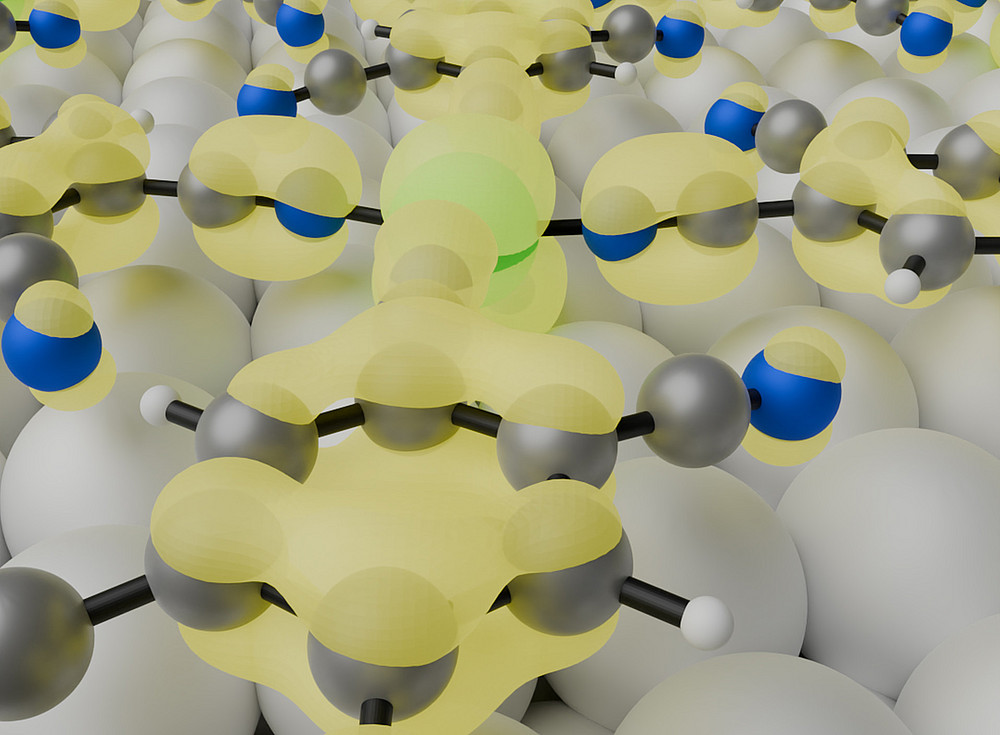
MOFs (metal-organic frameworks) are microporous materials made up of layers of inorganic building blocks connected by organic molecules. Graphic: Uni Graz/Brandstetter

If we strive for ever thinner materials, we eventually reach the two-dimensional (2D) limit, where the material is only a few atoms or even just one atom thin. These materials acquire unique mechanical, electronic and optical properties that hold great potential for innovative technologies, for example for energy conversion and storage. Physicists from the University of Graz and Forschungszentrum Jülich have now achieved a breakthrough in the development and characterisation of so-called 2D-MOFs, a special type of two-dimensional material. The scientists published their results in the renowned journals ACS Nano and Advanced Science.

2D MOFs consist of metal atoms connected by organic, i.e. carbon-based, molecules. They therefore combine the best of both worlds: Properties of metals and organic materials. This makes them a beacon of hope for a wide range of future technologies that could make electronic devices smaller, smarter and more efficient.

Physicists from the University of Graz and Forschungszentrum Jülich jointly found direct evidence of how the hierarchical arrangement of transition metals and organic connecting elements, so-called linkers, creates band structures in the 2D MOF lattice. In addition, the research demonstrates the associated multifunctional electronic and magnetic properties of the materials.

"The results of our two studies offer a new perspective on how electronic band structures in 2D MOFs can be tailored and pave the way for the integration of these materials into future electronic and photonic devices," says Peter Puschnig, emphasising the significance of the publication. The head of the "Electronic Structure of Nanomaterials" working group at the Department of Physics at the University of Graz was responsible for the theoretical investigations in the project together with Dominik Brandstetter and Andreas Windischbacher. Colleagues from Forschungszentrum Jülich carried out the experiments.

Publications:

Emergence of Band Structure in a Two-Dimensional Metal-Organic Framework upon Hierarchical Self-Assembly
D. Baranowski, M. Thaler, D. Brandstetter, A. Windischbacher, I. Cojocariu, S. Mearini, V. Chesnyak, L. Schio, L. Floreano, C. Gutiérrez Bolaños, P. Puschnig, L.L. Patera, V. Feyer, C.M. Schneider, ACS Nano, 18 (30), 19618-19627 (2024)
https://doi.org/10.1021/acsnano.4c04191

Band Structure Engineering in 2D Metal-Organic Frameworks
S. Mearini, D. Baranowski, D. Brandstetter, A. Windischbacher, I. Cojocariu, P. Gargiani, M. Valvidares, L. Schio, L. Floreano, P. Puschnig, V. Feyer and C.M. Schneider, Adv. Sci. (2024) 2404667
https://doi.org/10.1002/advs.202404667

created by Gudrun Pichler & Regine Panknin

Related news

Chemical Christmas show at the University of Graz: An explosive evening at the Schauspielh

At the beginning of December, the University of Graz transformed the theater into a laboratory: as part of “Chemical Life,” teacher training students staged a chemical Christmas show for Styrian school classes—complete with ethanol rockets, nitrogen snow, and glowing effects. An evening designed to inspire interest in studying chemistry.

Train by train: Koralm railway accelerates exchange between the Universities

Lectures at the University of Klagenfurt in the morning, seminars at the University of Graz in the afternoon: Austria's longest tunnel and a journey time of around 45 minutes make it easy. The Koralm railway increases the speed of networking between the two university locations. The collaboration builds on existing cooperation - for example in the areas of teacher training, Slavic studies and as employers, the universities are well coordinated.

On the trail of the Big Bang: University of Graz receives 1.5 million euros for doctoral programmes

The Austrian Science Fund FWF has selected the Doctoral Programme in Theoretical Particle Physics at the University of Graz for funding from the Doc.funds. Six young scientists will be funded for 3.5 years. They will gain fundamentally new insights into the origins of the world.

From trans women and knee prostheses: sports science prizes awarded

Walking better with a prosthesis, successfully getting rid of excess weight, training more effectively, more fairness for trans people in sport: these were the topics addressed by the students at the University of Graz who were awarded the sports science prizes for their Master's theses on 3 December 2025.

Begin of page section:
Additional information:

University of Graz
Universitaetsplatz 3
8010 Graz
Austria
  • Contact
  • Web Editors
  • Moodle
  • UNIGRAZonline
  • Imprint
  • Data Protection Declaration
  • Accessibility Declaration
Weatherstation
Uni Graz

End of this page section. Go to overview of page sections

End of this page section. Go to overview of page sections

Begin of page section:

End of this page section. Go to overview of page sections