Begin of page section:
Page sections:

  • Go to contents (Accesskey 1)
  • Go to position marker (Accesskey 2)
  • Go to main navigation (Accesskey 3)
  • Go to sub navigation (Accesskey 4)
  • Go to additional information (Accesskey 5)
  • Go to page settings (user/language) (Accesskey 8)
  • Go to search (Accesskey 9)

End of this page section. Go to overview of page sections

Begin of page section:
Page settings:

English en
Deutsch de
Search
Login

End of this page section. Go to overview of page sections

Begin of page section:
Search:

Search for details about Uni Graz
Close

End of this page section. Go to overview of page sections


Search

Begin of page section:
Main navigation:

Page navigation:

  • University

    University
    • About the University
    • Organisation
    • Faculties
    • Library
    • Working at University of Graz
    • Campus
    Developing solutions for the world of tomorrow - that is our mission. Our students and our researchers take on the great challenges of society and carry the knowledge out.
  • Research Profile

    Research Profile
    • Our Expertise
    • Research Questions
    • Research Portal
    • Promoting Research
    • Research Transfer
    • Ethics in Research
    Scientific excellence and the courage to break new ground. Research at the University of Graz creates the foundations for making the future worth living.
  • Studies

    Studies
    • Prospective Students
    • Students
  • Community

    Community
    • International
    • Location
    • Research and Business
    • Alumni
    The University of Graz is a hub for international research and brings together scientists and business experts. Moreover, it fosters the exchange and cooperation in study and teaching.
  • Spotlight
Topics
  • Sustainable University
  • Researchers answer
  • Work for us
Close menu

End of this page section. Go to overview of page sections

Begin of page section:
You are here:

University of Graz News Neue Perspektiven

End of this page section. Go to overview of page sections

Tuesday, 18 July 2017

Neue Perspektiven

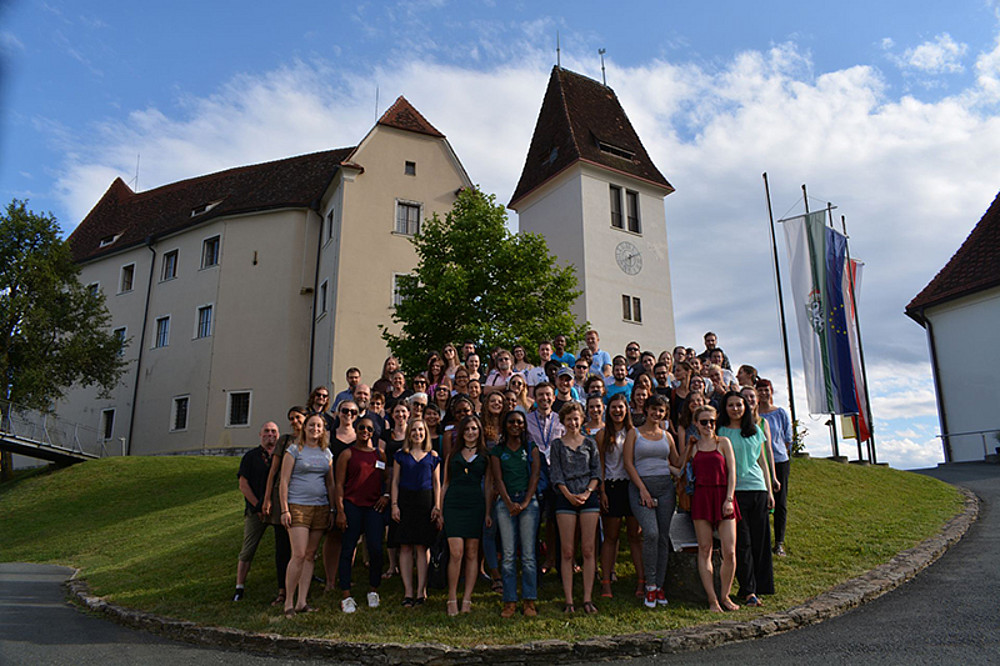
58 Studierende und rund 20 Lehrende aus über 23 Nationen und von mehr als 31 Universitäten nahmen an der Graz International Summer School teil und erörterten gesellschaftspolitische Herausforderungen.

58 Studierende und rund 20 Lehrende aus über 23 Nationen und von mehr als 31 Universitäten nahmen an der Graz International Summer School teil und erörterten gesellschaftspolitische Herausforderungen.

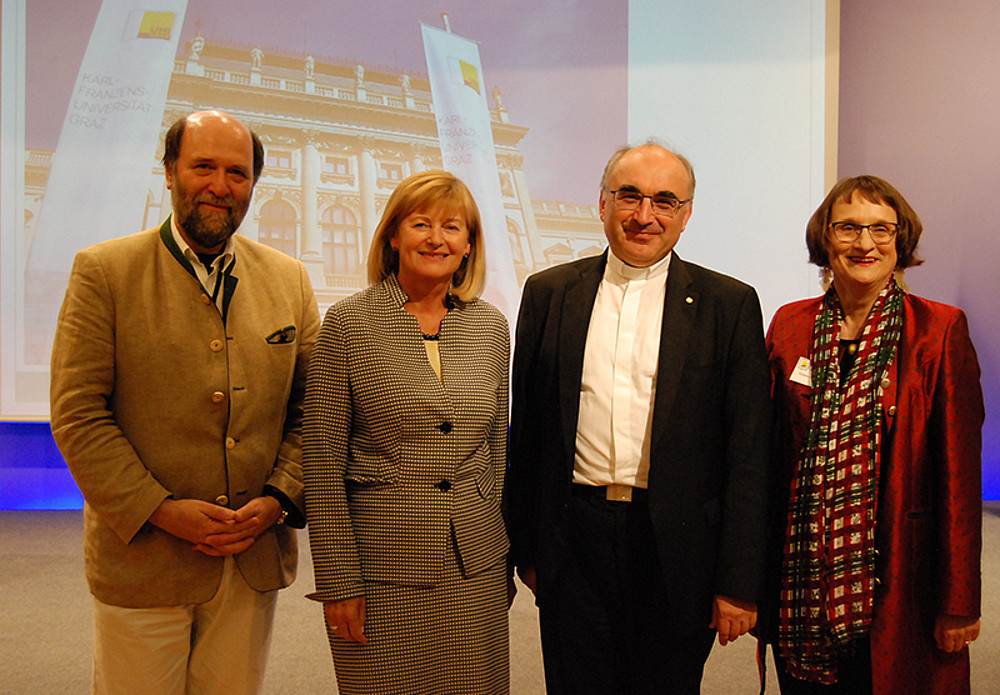
Stellvertretender COMECE-Generalsekretär Michael Kuhn, Rektorin Christa Neuper, Bischof Wilhelm Krautwaschl und Roberta Maierhofer, Leiterin der Summer School, eröffneten GUSEGG 2017. Alle Fotos: BIB.

Stellvertretender COMECE-Generalsekretär Michael Kuhn, Rektorin Christa Neuper, Bischof Wilhelm Krautwaschl und Roberta Maierhofer, Leiterin der Summer School, eröffneten GUSEGG 2017. Alle Fotos: BIB.

Studierende und Vortragende aus über 23 Ländern diskutierten bei der Graz International Summer School Seggau

Die interdisziplinäre und internationale Sommerschule „Graz International Summer School Seggau“ fand heuer bereits zum 12. Mal im Schloss Seggau in Leibnitz, diesmal unter dem Titel „Radical Definitions: State – Society – Religion“ statt. Die Graz International Summer School Seggau unter der akademischen Leitung von Ao. Univ.-Prof. Dr. Roberta Maierhofer, MA, ist eine Kooperation der Universität Graz, der Diözese Graz-Seckau und der COMECE (Kommission der Bischofskonferenzen der Europäischen Gemeinschaft). Am 2. Juli eröffneten Rektorin Christa Neuper, Michael Kuhn, stellvertretender Generalsekretär der COMECE und Bischof Wilhelm Krautwaschl die beliebte, vierzehntägige Sommerschule.


58 Studierende und rund 20 Lehrende aus über 23 Nationen und von mehr als 31 Universitäten nahmen an der Graz International Summer School teil und erörterten gesellschaftspolitische Herausforderungen. Besondere Höhepunkte waren die Lesung der mehrfach preisgekrönten chilenisch-amerikanischen Professorin Marjorie Agosín (Wellesley College, USA). Desweiteren fand, in Kooperation mit dem Alumni-Netzwerk der Uni Graz, am 5. Juli wieder ein Alumni-Tag statt, unter anderem mit einer Podiumsdiskussion zu Thema „Education in Troubled Times“ mit Bischof Wilhelm Krautwaschl, Daniel Mattern, US-Botschaft Wien, und Lukas Meyer, Dekan der Geisteswissenschaftlichen Fakultät der Uni Graz. Die zweite Woche wurde von der renommierten Meteorologin und Klimaforscherin O.Univ.Prof. Dr.phil. Helga Kromp-Kolb, Boku Wien, mit einer Keynote zum Thema Nachhaltigkeit, Klimawandel und globale Verantwortung eingeleitet. Weitere Programmpunkte waren die beliebte eintägige Graz Exkursion, die Präsentation von Studierenden-Postern unterschiedlichster Forschungsgebiete und der Science Slam, bei dem Studierende innerhalb kürzester Zeit auf individuelle und kreative Art und Weise die Ergebnisse ihrer Forschungen vorstellen konnten.


Auch heuer konnten wiederum Lehrende der Uni Graz mit Vorträgen wesentlich zum Programm beitragen: Dr. Stephan Hinghofer-Szalkay, Assoz.-Prof. Dr. Ulla Kriebernegg, Assoz.-Prof. Dr. Gerald Lamprecht, Ao.Univ.-Prof. Dr. Roberta Maierhofer, MA, Univ.-Prof. Dr. Manfred Prisching und Univ. Prof. Dr. Stefan Storr, Dekan der Rechtswissenschaftlichen Fakultät, hielten Vormittagsvorträge bzw. zum Teil auch Nachmittagsseminare.
    

created by Ulrike Grassberger & Gerhild Kastrun

Related news

AI in schools: Maria Bertel drafts legal guidelines for teachers

The legal expert and her team analysed the legal situation regarding the use of artificial intelligence in education as part of an EU project and answered open questions from practice.

Cosmetics in the environment: University of Graz proves danger to ants

Titanium dioxide, which is found in cosmetics, for example, is increasingly entering the environment in the form of nanoparticles. This could also put insects at risk. If ants ingest the substance in combination with the pesticide glyphosate, it disturbs the development of their offspring. Scientists at the University of Graz are drawing attention to the negative consequences of this toxic cocktail.

Varied and healthy: studies move

Exercise is the ideal way to balance out everyday stress, prevent illness and keep fit. Why this is the case, how to do it properly and what role human bodily functions and psychology play can be studied at the University of Graz.

Religious scholar Theresia Heimerl: Fasting as a spiritual boost

Fasting is not just a strategy for losing weight – it is a ritual dating back thousands of years with spiritual and evolutionary roots that has positive effects on the body. At the University of Graz, religious scholar Theresia Heimerl is investigating why fasting is a "spiritual boost".

Begin of page section:
Additional information:

University of Graz
Universitaetsplatz 3
8010 Graz
Austria
  • Contact
  • Web Editors
  • Moodle
  • UNIGRAZonline
  • Imprint
  • Data Protection Declaration
  • Accessibility Declaration
Weatherstation
Uni Graz

End of this page section. Go to overview of page sections

End of this page section. Go to overview of page sections

Begin of page section:

End of this page section. Go to overview of page sections