



Begin of page section:
Page sections:

  • Go to contents (Accesskey 1)
  • Go to position marker (Accesskey 2)
  • Go to main navigation (Accesskey 3)
  • Go to sub navigation (Accesskey 4)
  • Go to additional information (Accesskey 5)
  • Go to page settings (user/language) (Accesskey 8)
  • Go to search (Accesskey 9)

End of this page section. Go to overview of page sections

Begin of page section:
Page settings:

English en
Deutsch de
Search
Login

End of this page section. Go to overview of page sections

Begin of page section:
Search:

Search for details about Uni Graz
Close

End of this page section. Go to overview of page sections


Search

Begin of page section:
Main navigation:

Page navigation:

  • University

    University
    • About the University
    • Organisation
    • Faculties
    • Library
    • Working at University of Graz
    • Campus
    Developing solutions for the world of tomorrow - that is our mission. Our students and our researchers take on the great challenges of society and carry the knowledge out.
  • Research Profile

    Research Profile
    • Our Expertise
    • Research Questions
    • Research Portal
    • Promoting Research
    • Research Transfer
    • Ethics in Research
    • Commission for Scientific Integrity
    Scientific excellence and the courage to break new ground. Research at the University of Graz creates the foundations for making the future worth living.
  • Studies

    Studies
    • Prospective Students
    • Students
    • Post-registration Law
  • Community

    Community
    • International
    • Location
    • Research and Business
    • Alumni
    The University of Graz is a hub for international research and brings together scientists and business experts. Moreover, it fosters the exchange and cooperation in study and teaching.
Topics
  • Sustainable University
  • Researchers answer
  • Work for us
Close menu

End of this page section. Go to overview of page sections

Begin of page section:
You are here:

University of Graz News New measurements: University of Graz researchers show what causes Greenland's glaciers to melt

End of this page section. Go to overview of page sections

Thursday, 29 January 2026

New measurements: University of Graz researchers show what causes Greenland's glaciers to melt
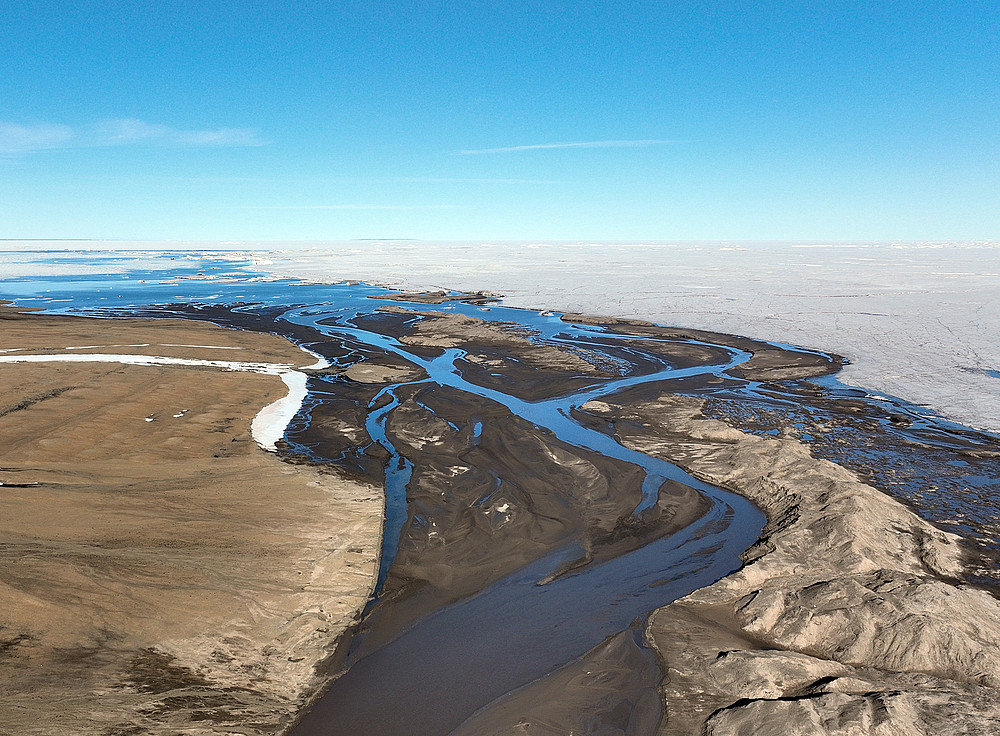
Aerial view of a glacier outflow on Flade Isblink

The glaciers on the Flade Isblink ice cap in northern Greenland are melting at an exceptionally rapid rate. A team from the University of Graz has collected initial data to investigate the phenomenon in more detail. Photo: University of Graz/Jonathan Fipper

Melting glaciers in the Arctic are causing sea levels to rise, threatening coastal regions. The meltwater flowing into the North Atlantic can change ocean currents such as the Gulf Stream, which have a significant influence on the climate in Europe. In order to better explain glacier retreat, a research team from the University of Graz has now analysed air temperature and weather conditions at the Flade Isblink ice cap in northern Greenland. This second-largest body of ice on the island has been increasingly losing thickness since 2008. The results have been published in the journal The Cryosphere.

"Our observations indicate that Flade Isblink is losing more and more ice and is therefore contributing to rising sea levels," reports Jonathan Fipper from the Department of Geography and Regional Science at the University of Graz. However, until now there have been few local measurements of air temperature at different altitudes to help better understand the glacier and climate changes. The scientists used uncrewed aerial vehicles to determine 130 vertical temperature profiles over various terrain surfaces. "Up to an altitude of around 100 metres, the surface cover type - i.e. ice, rock or water - has a significant influence on the air temperature," says Fipper, summarising the results. 
The team used the data collected to investigate the relationship between glacier melt and temperature conditions. "As the ice cap is comparatively flat, it can melt particularly strongly due to global warming," adds the researcher. The insights gained from the study are a first step towards better understanding the development. Further studies on the changing environmental conditions in the region are now needed.

Publication:
Jonathan Fipper, Jakob Abermann, Ingo Sasgen, Henrik Skov, Lise Lotte Sørensen, Wolfgang Schöner: The vertical structure of the troposphere and its connection to the surface mass balance of Flade Isblink in northeast Greenland

created by Dagmar Eklaude

Related news

#SaveOurUniversities #StopTheAusterity: Demonstration on 28 May in Graz

The Austrian Student Union and the universities are jointly calling for large rallies. The meeting point in Graz is on 28 May at 2 pm on Wilhelm-Fischer-Allee.

Graz to become centre for psychotherapy studies: 215 applications for the entrance exam

A total of 215 people who meet the entry requirements for the new Master’s programme in Psychotherapy have registered for the first entrance examination, which will take place on 6 July 2026 in Graz. They are applying for 140 places on the programme in Graz.

Between Myth and Crisis: The Hidden Stories of Rivers

Rivers connect landscapes, cities, people and identities. They form trade routes, preserve memories and mark boundaries. They shape the environment and provide habitats. At the same time, they lie at the heart of ecological, political and social crises. This is precisely where the “RIVERS IN CRISIS” research project at the Institute of Slavic Studies comes in

The future of Styria as a knowledge region is at risk

It is reported that 500 million euros are to be cut from Styrian universities. University vice-chancellors fear that this will sacrifice the development and competitiveness of the region as a centre for science, culture and business in favour of short-term cost-cutting targets.

Begin of page section:
Additional information:

University of Graz
Universitaetsplatz 3
8010 Graz
Austria
  • Contact
  • Web Editors
  • Moodle
  • UNIGRAZonline
  • Imprint
  • Data Protection Declaration
  • Accessibility Declaration
Weatherstation
Uni Graz

End of this page section. Go to overview of page sections

End of this page section. Go to overview of page sections

Begin of page section:

End of this page section. Go to overview of page sections