Begin of page section:
Page sections:

  • Go to contents (Accesskey 1)
  • Go to position marker (Accesskey 2)
  • Go to main navigation (Accesskey 3)
  • Go to sub navigation (Accesskey 4)
  • Go to additional information (Accesskey 5)
  • Go to page settings (user/language) (Accesskey 8)
  • Go to search (Accesskey 9)

End of this page section. Go to overview of page sections

Begin of page section:
Page settings:

English en
Deutsch de
Search
Login

End of this page section. Go to overview of page sections

Begin of page section:
Search:

Search for details about Uni Graz
Close

End of this page section. Go to overview of page sections


Search

Begin of page section:
Main navigation:

Page navigation:

  • University

    University
    • About the University
    • Organisation
    • Faculties
    • Library
    • Working at University of Graz
    • Campus
    Developing solutions for the world of tomorrow - that is our mission. Our students and our researchers take on the great challenges of society and carry the knowledge out.
  • Research Profile

    Research Profile
    • Our Expertise
    • Research Questions
    • Research Portal
    • Promoting Research
    • Research Transfer
    • Ethics in Research
    Scientific excellence and the courage to break new ground. Research at the University of Graz creates the foundations for making the future worth living.
  • Studies

    Studies
    • Prospective Students
    • Students
  • Community

    Community
    • International
    • Location
    • Research and Business
    • Alumni
    The University of Graz is a hub for international research and brings together scientists and business experts. Moreover, it fosters the exchange and cooperation in study and teaching.
  • Spotlight
Topics
  • Sustainable University
  • Researchers answer
  • Work for us
Close menu

End of this page section. Go to overview of page sections

Begin of page section:
You are here:

University of Graz News Neue Kulturgeographie

End of this page section. Go to overview of page sections

Friday, 29 January 2016

Neue Kulturgeographie
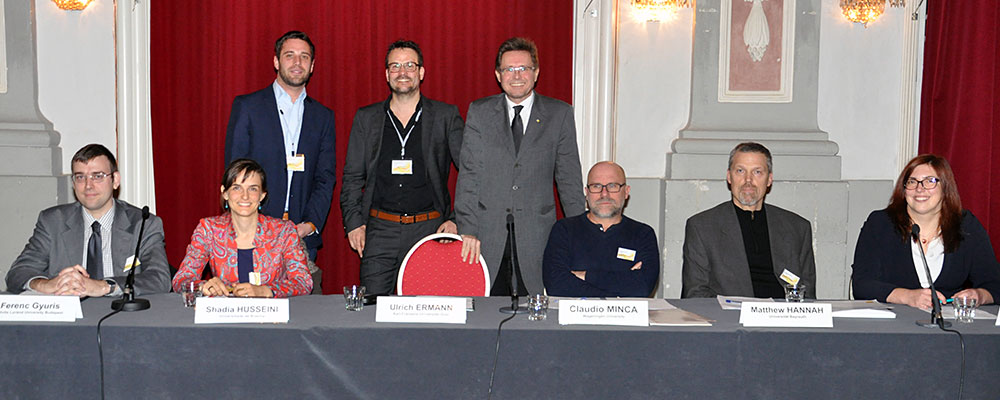
V.l.: Ferenc Gyuris, Shadia Husseini de Araújo, Marc Seebacher (Organisation), Ulrich Ermann, Vizerektor Martin Polaschek, Claudio Minca, Matthew Hannah, Heike Jöns. Foto: Uni Graz/Pichler

V.l.: Ferenc Gyuris, Shadia Husseini de Araújo, Marc Seebacher (Organisation), Ulrich Ermann, Vizerektor Martin Polaschek, Claudio Minca, Matthew Hannah, Heike Jöns. Foto: Uni Graz/Pichler

130 WissenschafterInnen tagen an der Uni Graz

Mit einem Vortrag von Claudio Minca, international renommierter Kulturgeograph an der Universität Wageningen in den Niederlanden, und einer anschließenden Podiumsdiskussion zur Internationalisierung geographischer Forschung und Mobilität von WissenschafterInnen wurde am 28. Jänner 2016 im Meerscheinschlössl die 13. Tagung zur Neuen Kulturgeographie eröffnet. Rund 130 TeilnehmerInnen aus dem In- und Ausland widmen sich zwei Tage lang verschiedenen Aspekten des Themas „Integrative Geographien. GeographInnen und Geographien in Bewegung“.

Vizerektor Martin Polaschek begrüßte die TeilnehmerInnen an der Uni Graz und verwies unter anderem auf die innovativen Forschungen des Instituts für Geographie und Raumforschung der Karl-Franzens-Universität: „Die Geographie ist in vielen interdisziplinären Bereichen tätig, etwa im Studium der Umweltsystemwissenschaften, oder auch im Rahmen von NAWI Graz, der österreichweit einzigartigen Kooperation der Karl-Franzens-Universität mit der TU Graz in den Naturwissenschaften.“

Die Tagungen der 2004 ins Leben gerufenen Reihe „Neue Kulturgeographie“ zählen zu den wichtigsten regelmäßigen Veranstaltungen im Bereich der Humangeographie und sind ein bedeutendes Forum vor allem für NachwuchswissenschaftlerInnen. Sie sind bekannt dafür, Raum für Innovationen und unkonventionelle Forschungsideen zu bieten. „Die Karl-Franzens-Universität Graz ist der erste Standort außerhalb Deutschlands, an dem eine Tagung zur Neuen Kulturgeographie ausgerichtet wird“, freut sich Univ.-Prof. Dr. Ulrich Ermann, unter dessen Leitung die aktuelle Veranstaltung organisiert wurde. Diese umfasst 14 Paper-Sessions zu verschiedenen Schwerpunkt-Themen mit insgesamt rund 50 Fachvorträgen.

>> nähere Informationen zum Programm

created by Gudrun Pichler

Related news

From Iowa to Graz: US researcher puts “angry” algorithms to the test

Researcher Hussam Habib is investigating how social media platforms use algorithms to evoke emotions, capture attention, and disseminate content in a targeted manner. Born in Pakistan, he came to the University of Graz on an APART-USA scholarship from the Austrian Academy of Sciences. Thanks to new EU regulations, the scientist hopes to gain deeper insight into the mechanisms behind YouTube, Instagram, Reddit, and other platforms.

Lightbulb moments: How two young physicists are working for tomorrow

They shed light on unresolved questions – and use it in their work in physics. Diana Shakirova is using light to distinguish different chiral molecules, which can have both healing and toxic effects. Christoph Stockinger, on the other hand, uses light to develop high-precision sensors. But it is not only light that connects the two physicists. The doctoral students took part in the NanoGraz Careers & Ideas Days to prepare themselves in good time for the next steps in their careers as young scientists.

Rector Peter Riedler: Starting the year with confidence

In 2026, we will continue to work consistently on positioning the University of Graz as a relevant player in Europe, while at the same time focusing on a modern, sustainable and climate-friendly university campus. When new digital applications are rolled out in January, we will not only create a stable and secure IT environment, but also modern working and studying conditions for future generations. Peter Rielder, Rector of the University of Graz

Uni Vibes 2026: the campus festival that transcends borders again

On 29 May 2026, it's that time again: the University of Graz celebrates, dances and vibrates. The campus will become a stage for art, science and music.

Begin of page section:
Additional information:

University of Graz
Universitaetsplatz 3
8010 Graz
Austria
  • Contact
  • Web Editors
  • Moodle
  • UNIGRAZonline
  • Imprint
  • Data Protection Declaration
  • Accessibility Declaration
Weatherstation
Uni Graz

End of this page section. Go to overview of page sections

End of this page section. Go to overview of page sections

Begin of page section:

End of this page section. Go to overview of page sections