



Begin of page section:
Page sections:

  • Go to contents (Accesskey 1)
  • Go to position marker (Accesskey 2)
  • Go to main navigation (Accesskey 3)
  • Go to sub navigation (Accesskey 4)
  • Go to additional information (Accesskey 5)
  • Go to page settings (user/language) (Accesskey 8)
  • Go to search (Accesskey 9)

End of this page section. Go to overview of page sections

Begin of page section:
Page settings:

English en
Deutsch de
Search
Login

End of this page section. Go to overview of page sections

Begin of page section:
Search:

Search for details about Uni Graz
Close

End of this page section. Go to overview of page sections


Search

Begin of page section:
Main navigation:

Page navigation:

  • University

    University
    • About the University
    • Organisation
    • Faculties
    • Library
    • Working at University of Graz
    • Campus
    Developing solutions for the world of tomorrow - that is our mission. Our students and our researchers take on the great challenges of society and carry the knowledge out.
  • Research Profile

    Research Profile
    • Our Expertise
    • Research Questions
    • Research Portal
    • Promoting Research
    • Research Transfer
    • Ethics in Research
    • Commission for Scientific Integrity
    Scientific excellence and the courage to break new ground. Research at the University of Graz creates the foundations for making the future worth living.
  • Studies

    Studies
    • Prospective Students
    • Students
    • Registration for Study Programme (Winter semester 2026/27)
  • Community

    Community
    • International
    • Location
    • Research and Business
    • Alumni
    The University of Graz is a hub for international research and brings together scientists and business experts. Moreover, it fosters the exchange and cooperation in study and teaching.
Topics
  • Sustainable University
  • Researchers answer
  • Work for us
Close menu

End of this page section. Go to overview of page sections

Begin of page section:
You are here:

University of Graz News Migrationskompetenz sichtbar machen

End of this page section. Go to overview of page sections

Thursday, 03 December 2015

Migrationskompetenz sichtbar machen

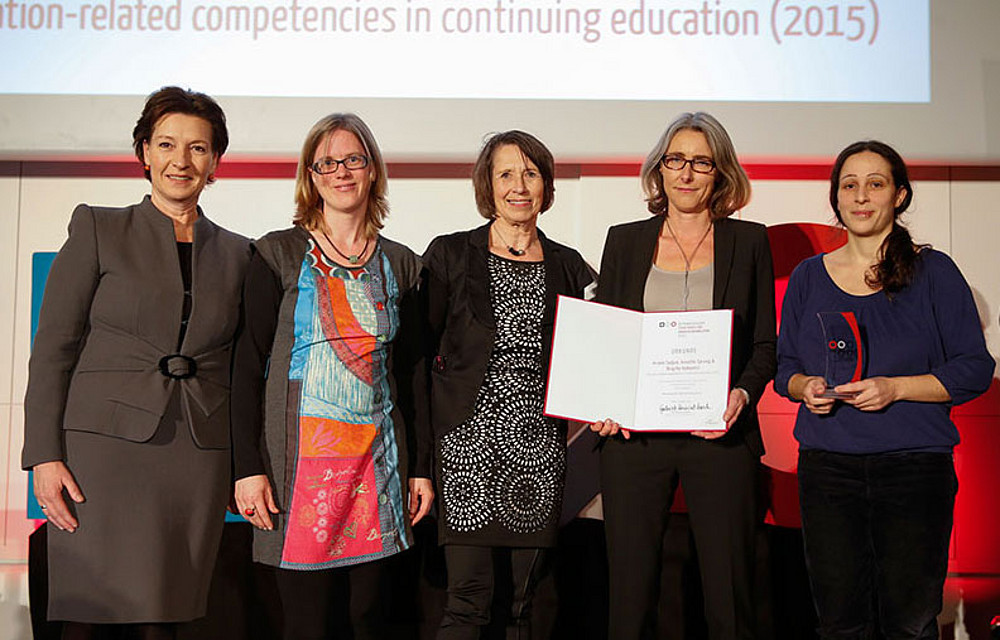
Bildungsministerin Gabriele Heinisch-Hosek, Studienautorin Brigitte Kukovetz, Jurymitglied und Laudatorin Monika Thum-Kraft sowie die Studienautorinnen Anette Sprung und Ariane Sadjed. Foto: BKA - Bundespressedienst/Hans Hofer.

Bildungsministerin Gabriele Heinisch-Hosek, Studienautorin Brigitte Kukovetz, Jurymitglied und Laudatorin Monika Thum-Kraft sowie die Studienautorinnen Anette Sprung und Ariane Sadjed. Foto: BKA - Bundespressedienst/Hans Hofer.

Annette Sprung erhielt mit zwei Co-Autorinnen den Staatspreis für Erwachsenenbildung

Der Österreichische Staatspreis für Erwachsenenbildung würdigt in drei Kategorien ExpertInnen aus Wissenschaft und Praxis, die sich im Bereich der Erwachsenenbildung engagieren. Ao.Univ.-Prof. Dr. Annette Sprung und und Dr. Brigitte Kukovetz vom Institut für Erziehungs- und Bildungswissenschaft der Uni Graz durften sich gemeinsam mit ihrer Kollegin Dr. Ariane Sadjed von der Universität Wien über den Preis in der Kategorie „Wissenschaft und Forschung 2015“ freuen. Bildungsministerin Gabriele Heinisch-Hosek überreichte den Forscherinnen gestern Abend im Großen Saal des AK Bildungszentrums in Wien den mit 4.000 Euro dotierten Preis für ihren Artikel "The use of migration-related competencies in continuing education. Individual strategies, social and institutional conditions".


Dieser basiert auf den Ergebnissen des Forschungsprojektes "Angehörige der 2. Generation von MigrantInnen als Fachkräfte in der Erwachsenenbildung", kurz mig2eb. Mehrere KooperationspartnerInnen beschäftigten sich darin gemeinsam mit der Frage, welche Strategien Personen mit Migrationsbiografie anwenden, um ihre Kompetenzen in der Erwachsenenbildung sichtbar zu machen und zu verwerten. Die Reaktionsweisen des Umfelds beeinflussen diese Strategien maßgeblich: "Manche AkteurInnen entscheiden sich beispielsweise bewusst dafür, ihre Migrationsbiografie zu verbergen, sofern dies möglich ist, weil sie sonst Diskriminierung befürchten oder auch weil sie damit eine permanente gesellschaftliche Zuschreibung des 'Anders-Seins' aktiv zurückweisen. Zum Teil haben sie auch die Erfahrung gemacht, dass sie seitens der ArbeitgeberInnen auf ihre Expertise zu Migration reduziert und ihre sonstigen Fähigkeiten dann nicht mehr gewürdigt werden", so Annette Sprung.


Außerdem unterstreichen die Autorinnen, dass Personen mit Migrationshintergrund im Bereich der Erwachsenenbildung, abgesehen von auf Migration/Integration spezialisierten Institutionen, meist unterrepräsentiert sind. Wichtig ist den Forscherinnen außerdem, den Anspruch einer kritischen Migrationsforschung einzulösen - das bedeutet unter anderem, eine kontinuierliche Auseinandersetzung über die Zuschreibung von Fremdheit zu führen. 


>> Mehr Informationen zum Staatspreis für Erwachsenenbildung 2015

created by Bianca Friesenbichler & Gerhild Kastrun

Related news

"Mathematics explains the world"

How can life be quantified? And what can science reveal that remains hidden from the naked eye? The 14th European Conference on Mathematical and Theoretical Biology at the University of Graz is dedicated to these questions. From 13 to 17 July, around 1,300 researchers from all over the world will gather on campus to discuss models, biological processes and the future of data-driven medicine. Klemens Fellner, Dean of the Faculty of Natural Sciences and Mathematics and a mathematician, talks about the language that explains the world

Internationally up-to-date: University of Graz offers new degree programmes in art studies

From the Old Masters to AI art – three newly designed degree programmes offer students at the University of Graz fresh perspectives on artistic production. In addition to historical art, the programmes place a greater emphasis on contemporary and global developments. The registration period is open.

The Nazi elite school Napola: Historian seeks memories and personal documents

They were to be brought up to become the future elite of National Socialism: boys and girls aged ten and over who, following the ‘Anschluss’ of Austria to the German Reich, attended a so-called Napola (short for Nationalpolitische Lehranstalt; also known as NPEA, Nationalpolitische Erziehungsanstalt). There were nine such institutions in what is now Austria between 1939 and 1945.

Heat-resistant: Eva Preinfalk explains how cities can protect their residents

Certain demographic and some occupational groups are particularly vulnerable to high temperatures. A range of measures is needed to provide relief for everyone, explains climate economist Eva Preinfalk.

Begin of page section:
Additional information:

University of Graz
Universitaetsplatz 3
8010 Graz
Austria
  • Contact
  • Web Editors
  • Moodle
  • UNIGRAZonline
  • Imprint
  • Data Protection Declaration
  • Accessibility Declaration
Weatherstation
Uni Graz

End of this page section. Go to overview of page sections

End of this page section. Go to overview of page sections

Begin of page section:

End of this page section. Go to overview of page sections