Begin of page section:
Page sections:

  • Go to contents (Accesskey 1)
  • Go to position marker (Accesskey 2)
  • Go to main navigation (Accesskey 3)
  • Go to sub navigation (Accesskey 4)
  • Go to additional information (Accesskey 5)
  • Go to page settings (user/language) (Accesskey 8)
  • Go to search (Accesskey 9)

End of this page section. Go to overview of page sections

Begin of page section:
Page settings:

English en
Deutsch de
Search
Login

End of this page section. Go to overview of page sections

Begin of page section:
Search:

Search for details about Uni Graz
Close

End of this page section. Go to overview of page sections


Search

Begin of page section:
Main navigation:

Page navigation:

  • University

    University
    • About the University
    • Organisation
    • Faculties
    • Library
    • Working at University of Graz
    • Campus
    Developing solutions for the world of tomorrow - that is our mission. Our students and our researchers take on the great challenges of society and carry the knowledge out.
  • Research Profile

    Research Profile
    • Our Expertise
    • Research Questions
    • Research Portal
    • Promoting Research
    • Research Transfer
    • Ethics in Research
    Scientific excellence and the courage to break new ground. Research at the University of Graz creates the foundations for making the future worth living.
  • Studies

    Studies
    • Prospective Students
    • Students
  • Community

    Community
    • International
    • Location
    • Research and Business
    • Alumni
    The University of Graz is a hub for international research and brings together scientists and business experts. Moreover, it fosters the exchange and cooperation in study and teaching.
  • Spotlight
Topics
  • Our digital Advent calendar
  • Sustainable University
  • Researchers answer
  • Work for us
Close menu

End of this page section. Go to overview of page sections

Begin of page section:
You are here:

University of Graz News Light micros and efficient e-cars: Doppler lab for novel sensors launches

End of this page section. Go to overview of page sections

Friday, 20 October 2023

Light micros and efficient e-cars: Doppler lab for novel sensors launches

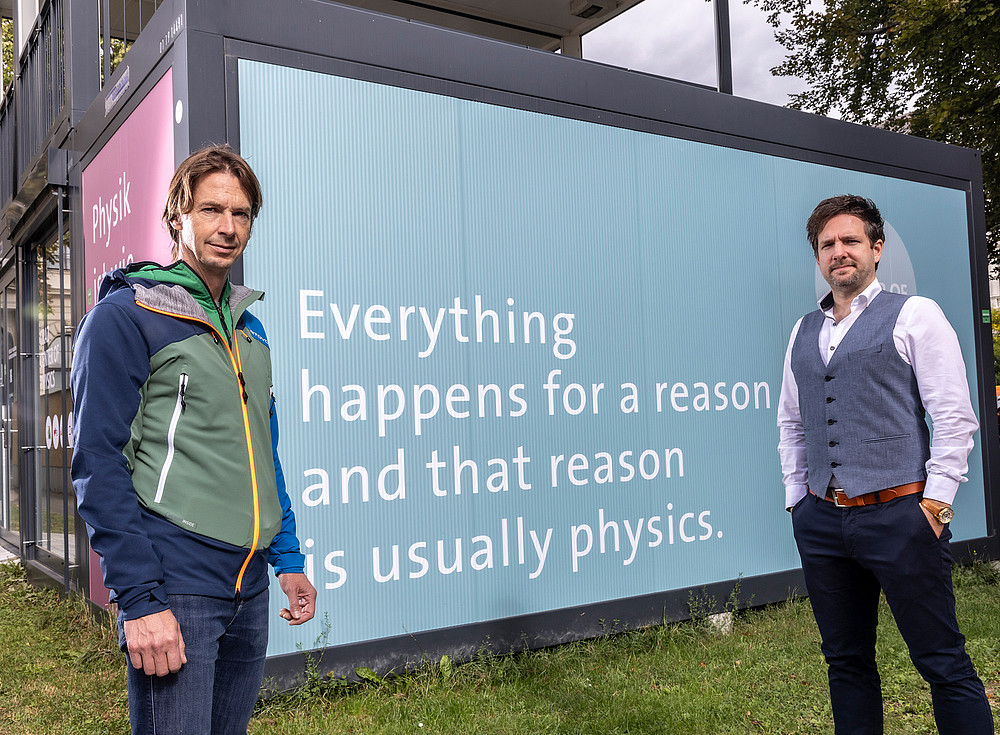
Alexander Bergmann and Peter Banzer in front of the info point for the emerging Graz Center of Physics with the inscription "Everything happens for a reason and that reason is usually physics". ©© Helmut Lunghammer

Together, a big step into the future: Alexander Bergmann (l.) and Peter Banzer head the new Christian Doppler Laboratory, which researches novel sensors. Photo: Jimmy Lunghammer

They use shaped light to measure sound and microwaves to spy on the torque in the e-car. Alexander Bergmann and Peter Banzer are working on completely new types of sensors in the Christian Doppler Laboratory, which opened today.

The University of Graz and TU Graz set another milestone for technologies of the future: Alexander Bergmann, head of the Institute of Electrical Measurement and Sensor Systems at TU Graz, and Peter Banzer, head of the Optics of Nano and Quantum Materials – Structured Light, Sound and Matter group at the University of Graz, operate the "Christian Doppler Laboratory for Structured Matter Based Sensing", which opened today. With their teams, the two are researching basic principles and further areas of application for so-called structured materials and light fields. The facility is funded by the Federal Ministry of Labour and Economy. "Research is the basis for entrepreneurial innovation, as our CD laboratories and their corporate partners demonstrate time and again," emphasises Martin Kocher, Federal Minister of Labour and Economy.

Building Set with Nanoparticles
"In a sense, we have a Lego box at our disposal with a great many building blocks that all have certain properties. In simple terms, this allows us to assemble structures that fulfill the desired functions," Peter Banzer describes. For example, the scientists want to develop microphones that are much smaller, distort less and wear out less easily than conventional microphones. "The sound waves thereby press the 'Lego bricks' together on the sensor material. As a result, these in turn reflect the light differently than before," Alexander Bergmann illustrates.

Manipulated Microwaves
Structured materials could also be used in e-cars and e-scooters to control the transmission of torque from the motor to the wheels. The new sensors are capable of controlling the drive-off much more efficiently and thus saving energy. "We use artificially produced crystals for this purpose. These function like antennas whose signal is received by specially manipulated microwave beams," Banzer describes. Torque "detunes" the antennas, and the change in the signal is read in real time. This makes the measurement faster, more robust and requires no cables.
"The same technology can be used in robotics to allow machines to carefully attack sensitive objects," Bergmann adds. "So there are an incredible number of applications for the materials, certainly ones we have no idea about now."

In the Christian Doppler Laboratory, the researchers cooperate with internationally renowned universities, such as Stanford, Cambridge or ETH Zürich as well as with the companies ams-Osram and Infineon, which co-finance the work. The most important public funding source is the Federal Ministry of Labour and Economy. "In this specific case, the corporate partners expect a wide range of possible applications from research into the physical principles of structured matter and structured light: from sensor technology and telemetry to more efficient vehicles and machines to medicine, where sensor technology for biomolecules could be realised. Research strengthens Austria as a business location," emphasises Minister Kocher.

In Christian Doppler Laboratories, application-oriented basic research is carried out at a high level, with outstanding scientists cooperating with innovative companies. The Christian Doppler Research Association is regarded internationally as a best-practice example for the promotion of this cooperation.

created by Dagmar Eklaude

Related news

Chemical Christmas show at the University of Graz: An explosive evening at the Schauspielh

At the beginning of December, the University of Graz transformed the theater into a laboratory: as part of “Chemical Life,” teacher training students staged a chemical Christmas show for Styrian school classes—complete with ethanol rockets, nitrogen snow, and glowing effects. An evening designed to inspire interest in studying chemistry.

Train by train: Koralm railway accelerates exchange between the Universities

Lectures at the University of Klagenfurt in the morning, seminars at the University of Graz in the afternoon: Austria's longest tunnel and a journey time of around 45 minutes make it easy. The Koralm railway increases the speed of networking between the two university locations. The collaboration builds on existing cooperation - for example in the areas of teacher training, Slavic studies and as employers, the universities are well coordinated.

On the trail of the Big Bang: University of Graz receives 1.5 million euros for doctoral programmes

The Austrian Science Fund FWF has selected the Doctoral Programme in Theoretical Particle Physics at the University of Graz for funding from the Doc.funds. Six young scientists will be funded for 3.5 years. They will gain fundamentally new insights into the origins of the world.

From trans women and knee prostheses: sports science prizes awarded

Walking better with a prosthesis, successfully getting rid of excess weight, training more effectively, more fairness for trans people in sport: these were the topics addressed by the students at the University of Graz who were awarded the sports science prizes for their Master's theses on 3 December 2025.

Begin of page section:
Additional information:

University of Graz
Universitaetsplatz 3
8010 Graz
Austria
  • Contact
  • Web Editors
  • Moodle
  • UNIGRAZonline
  • Imprint
  • Data Protection Declaration
  • Accessibility Declaration
Weatherstation
Uni Graz

End of this page section. Go to overview of page sections

End of this page section. Go to overview of page sections

Begin of page section:

End of this page section. Go to overview of page sections