Begin of page section:
Page sections:

  • Go to contents (Accesskey 1)
  • Go to position marker (Accesskey 2)
  • Go to main navigation (Accesskey 3)
  • Go to sub navigation (Accesskey 4)
  • Go to additional information (Accesskey 5)
  • Go to page settings (user/language) (Accesskey 8)
  • Go to search (Accesskey 9)

End of this page section. Go to overview of page sections

Begin of page section:
Page settings:

English en
Deutsch de
Search
Login

End of this page section. Go to overview of page sections

Begin of page section:
Search:

Search for details about Uni Graz
Close

End of this page section. Go to overview of page sections


Search

Begin of page section:
Main navigation:

Page navigation:

  • University

    University
    • About the University
    • Organisation
    • Faculties
    • Library
    • Working at University of Graz
    • Campus
    Developing solutions for the world of tomorrow - that is our mission. Our students and our researchers take on the great challenges of society and carry the knowledge out.
  • Research Profile

    Research Profile
    • Our Expertise
    • Research Questions
    • Research Portal
    • Promoting Research
    • Research Transfer
    • Ethics in Research
    Scientific excellence and the courage to break new ground. Research at the University of Graz creates the foundations for making the future worth living.
  • Studies

    Studies
    • Prospective Students
    • Students
  • Community

    Community
    • International
    • Location
    • Research and Business
    • Alumni
    The University of Graz is a hub for international research and brings together scientists and business experts. Moreover, it fosters the exchange and cooperation in study and teaching.
  • Spotlight
Topics
  • Our digital Advent calendar
  • Sustainable University
  • Researchers answer
  • Work for us
Close menu

End of this page section. Go to overview of page sections

Begin of page section:
You are here:

University of Graz News Licht im Luftloch

End of this page section. Go to overview of page sections

Thursday, 09 February 2023

Licht im Luftloch

Regenbogenfarben, vertikal nebeneinander, von Orange bis Grün

Vielen modernen Anwendungen liegt die Manipulation von Licht auf der Nanoskala zugrunde. Ein Team von Physiker:innen unter Beteiligung der Uni Graz hat eine Methode entwickelt, die einen breiteren Spektralbereich als bisher nutzbar macht. Foto: pixabay

Innovative Methode der Nano-Optik eröffnet neue Möglichkeiten für Sensorik und Halbleiter-Industrie

Ob Halbleiter-Chips oder optische Sensoren – vielen modernen Anwendungen liegt die Manipulation von Licht auf der Nanoskala zugrunde. Ein internationales Team von Physiker:innen unter Beteiligung der Universität Graz hat nun eine neuartige Methode entwickelt, die einen breiteren Spektralbereich als bisher nutzbar macht. Dazu sperren sie Licht in Luftlöcher. In diesen Hohlräumen lassen sich außergewöhnliche optische Eigenschaften nutzen. Die Forschungsergebnisse wurden im renommierten Fachjournal Nature Light, Science & Applications publiziert.

In Forschung und Technik werden Wechselwirkungen zwischen Licht und Materie gezielt manipuliert, um Schwingungen mit ganz bestimmten Wellenlängen – sogenannte Resonanzen – hervorzurufen oder zu verstärken. Dies geschieht mit Hilfe von Nanostrukturen aus Metallen oder Halbleitern wie Silizium. Da diese Materialien die Lichtwellen zum Teil absorbieren, können aber nicht alle Frequenzbereiche genutzt werden. Wissenschaftler:innen der Universitäten Graz und Stuttgart sowie der Australian National University in Canberra haben einen Weg gefunden, das Problem zu lösen. „Wir stellen durch lithografische Verfahren Luftlöcher in einem Würfel aus Silizium her und sperren Licht in diese Hohlräume. Da Luft die Schwingungen der Photonen nicht absorbiert, eröffnen sich viele neue Möglichkeiten in einem breiten Frequenzspektrum“, berichtet Thomas Weiss, Professor für Theoretische Nanophysik an der Uni Graz.

Mit diesem Verfahren lassen sich auch Metaoberflächen, also ultradünne Filme bestehend aus solchen Löchern, für den ultravioletten Bereich bauen, was für die Halbleiter-Industrie ebenfalls von enormer Bedeutung sein kann. Denn die Strukturen von Chips, die in fast allen modernen elektronischen Geräten zum Einsatz kommen, erfordern in der Herstellung Abbildungssysteme für sehr kurzwelliges Licht im ultravioletten Bereich. Auch für die Entwicklung optischer Sensoren sind die Forschungsergebnisse interessant. Viele Moleküle werden durch UV-Licht angeregt. Wenn es gelingt, diese Wechselwirkung entsprechend zu verstärken, können Sensoren selbst einzelne Moleküle detektieren. „Mie-Voids – so nennen wir die resonanten Hohlräume, in die wir das Licht sperren – werden den Betrieb funktionaler Metaoberflächen in den blauen und UV-Spektralbereich vorantreiben“, ist Thomas Weiss überzeugt.

Publikation:
Dielectric Mie Voids: Confining Light in Air
M. Hentschel, K. Koshelev, F. Sterl, S. Both, J. Karst, L. Shamsafar, T. Weiss, Y. Kivshar, and H. Giessen
Nature Light: Science & Applications, 1. Jänner 2023
https://doi.org/10.1038/s41377-022-01015-z
Nature Photonics, „News & Views", Februar 2023

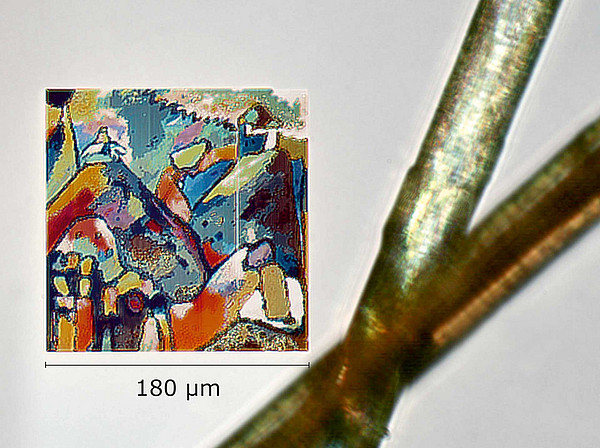
Eine 180 Mikrometer breite Reproduktion eines Gemäldes von Kandinsky, abgebildet neben einem menschlichen Haar
Durch optische Resonanzen von Löchern in Silizium entstand diese 180 Mikrometer breite Reproduktion eines Gemäldes von Kandinsky. Hier abgebildet neben einem menschlichen Haar. Foto: M. Hentschel
created by Gudrun Pichler

Related news

Chemical Christmas show at the University of Graz: An explosive evening at the Schauspielh

At the beginning of December, the University of Graz transformed the theater into a laboratory: as part of “Chemical Life,” teacher training students staged a chemical Christmas show for Styrian school classes—complete with ethanol rockets, nitrogen snow, and glowing effects. An evening designed to inspire interest in studying chemistry.

Train by train: Koralm railway accelerates exchange between the Universities

Lectures at the University of Klagenfurt in the morning, seminars at the University of Graz in the afternoon: Austria's longest tunnel and a journey time of around 45 minutes make it easy. The Koralm railway increases the speed of networking between the two university locations. The collaboration builds on existing cooperation - for example in the areas of teacher training, Slavic studies and as employers, the universities are well coordinated.

On the trail of the Big Bang: University of Graz receives 1.5 million euros for doctoral programmes

The Austrian Science Fund FWF has selected the Doctoral Programme in Theoretical Particle Physics at the University of Graz for funding from the Doc.funds. Six young scientists will be funded for 3.5 years. They will gain fundamentally new insights into the origins of the world.

From trans women and knee prostheses: sports science prizes awarded

Walking better with a prosthesis, successfully getting rid of excess weight, training more effectively, more fairness for trans people in sport: these were the topics addressed by the students at the University of Graz who were awarded the sports science prizes for their Master's theses on 3 December 2025.

Begin of page section:
Additional information:

University of Graz
Universitaetsplatz 3
8010 Graz
Austria
  • Contact
  • Web Editors
  • Moodle
  • UNIGRAZonline
  • Imprint
  • Data Protection Declaration
  • Accessibility Declaration
Weatherstation
Uni Graz

End of this page section. Go to overview of page sections

End of this page section. Go to overview of page sections

Begin of page section:

End of this page section. Go to overview of page sections