Begin of page section:
Page sections:

  • Go to contents (Accesskey 1)
  • Go to position marker (Accesskey 2)
  • Go to main navigation (Accesskey 3)
  • Go to sub navigation (Accesskey 4)
  • Go to additional information (Accesskey 5)
  • Go to page settings (user/language) (Accesskey 8)
  • Go to search (Accesskey 9)

End of this page section. Go to overview of page sections

Begin of page section:
Page settings:

English en
Deutsch de
Search
Login

End of this page section. Go to overview of page sections

Begin of page section:
Search:

Search for details about Uni Graz
Close

End of this page section. Go to overview of page sections


Search

Begin of page section:
Main navigation:

Page navigation:

  • University

    University
    • About the University
    • Organisation
    • Faculties
    • Library
    • Working at University of Graz
    • Campus
    Developing solutions for the world of tomorrow - that is our mission. Our students and our researchers take on the great challenges of society and carry the knowledge out.
  • Research Profile

    Research Profile
    • Our Expertise
    • Research Questions
    • Research Portal
    • Promoting Research
    • Research Transfer
    • Ethics in Research
    • Commission for Scientific Integrity
    Scientific excellence and the courage to break new ground. Research at the University of Graz creates the foundations for making the future worth living.
  • Studies

    Studies
    • Prospective Students
    • Students
    • Welcome Weeks for First Year Students
  • Community

    Community
    • International
    • Location
    • Research and Business
    • Alumni
    The University of Graz is a hub for international research and brings together scientists and business experts. Moreover, it fosters the exchange and cooperation in study and teaching.
Topics
  • Sustainable University
  • Researchers answer
  • Work for us
Close menu

End of this page section. Go to overview of page sections

Begin of page section:
You are here:

University of Graz News Licht am nächsten Level

End of this page section. Go to overview of page sections

Wednesday, 03 April 2013

Licht am nächsten Level

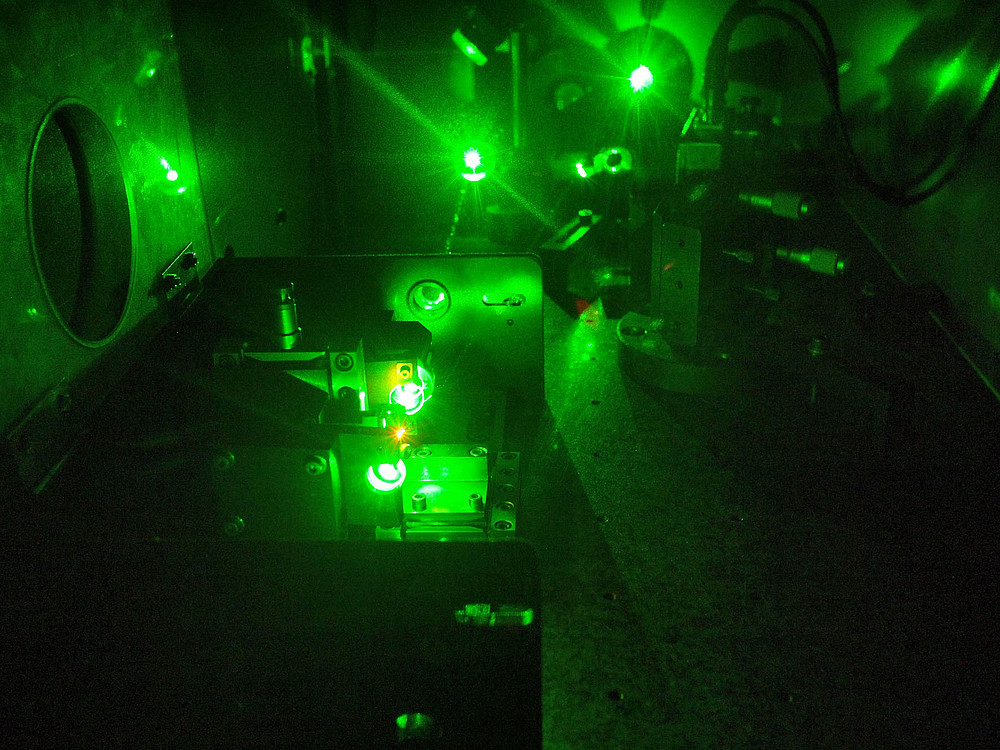
Lichtforschung auf dem nächsten Level an der Uni Graz: Ein Lasersystem erzeugt Femtosekunden-Laserpulse. Foto: Harald Ditlbacher, Institut für Physik.

Lichtforschung auf dem nächsten Level an der Uni Graz: Ein Lasersystem erzeugt Femtosekunden-Laserpulse. Foto: Harald Ditlbacher, Institut für Physik.

Spezialforschungsbereich der Uni Graz lotet die Grenzen der Physik aus

Einzelne Lichtteilchen einfangen, transportieren und mit Nanostrukturen wechselwirken lassen: Wo die physikalische Wissenschaft noch bis vor kurzem ihre Grenzen erreicht hatte, setzt ein mit März 2013 gestarteter Spezialforschungsbereich, kurz SFB, des österreichischen Wissenschaftsfonds FWF an: „Next Lite“ untersucht erstmals die Wechselwirkung von Materie und Licht auf den kürzesten aller räumlichen und zeitlichen Skalen – für PhysikerInnen ist das teilweise absolutes Neuland. Seitens der Karl-Franzens-Universität Graz sind zwei Arbeitsgruppen am Verbund „Next Lite“ beteiligt.


Ao.Univ.-Prof. Dr. Ulrich Hohenester und Univ.-Prof. Dr. Joachim Krenn vom Institut für Physik der Uni Graz erklären die winzigen Dimensionen, in denen sich ihre Forschungen bewegen – der Begriff „Nanoskala“ reicht hier nämlich längst nicht mehr aus: „‘Nano‘ bedeutet ein Milliardstel, und die Strukturen, die wir untersuchen, sind wenige Nanometer groß. Das entspricht der Länge von einigen aneinandergereihten Atomen. Auf der Zeitskala aber wären das 10-9 Sekunden. Wir beobachten mittlerweile Prozesse, die sich in Femto- und Attosekunden abspielen, also in 10-15 und 10-18 Sekunden“.


Der volle Titel des SFB – „Next Generation Light Synthesis and Interaction“ – verrät das Ziel der gemeinsam mit der TU Wien durchgeführten Experimente und Simulationen: „Es geht um die Erforschung einer neuen Generation von Lichtquellen und die gezielte Manipulation von einzelnen Lichtteilchen, den Photonen. Wenn wir verstehen, wie Licht mit Nanostrukturen auf dieser grundlegenden Ebene wechselwirkt, können diese Erkenntnisse enorme Auswirkungen auf verschiedenste, anwendungsorientierte Gebiete des Alltags haben, wie etwa die Sensorik, Photovoltaik oder Medizintechnik“, unterstreichen Krenn und Hohenester.


Zunächst stehen die Wissenschafter aber vor der Herausforderung, einzelne Photonen und Nanostrukturen miteinander in Verbindung zu bringen. Dabei spielen sogenannte Oberflächenplasmonen, also kollektive Anregungen von freien Elektronen in Metallen, eine wesentliche Rolle: „Elektronen beginnen zu schwingen, wenn sie mit Licht in Kontakt treten. Dieser Effekt, auch Resonanz genannt, erlaubt es uns, das Licht quasi zu fangen und einzusperren. Weil es nicht mehr entwischen kann, wird eine stärkere und häufigere Wechselwirkung mit der Materie, also den Nanostrukturen, möglich“, erklären Krenn und Hohenester. Das Ergebnis könnte sich zum Beispiel in sehr viel effektiveren Solarzellen widerspiegeln.


Weil Oberflächenplasmonen zudem extrem sensibel auf ihre Umgebung reagieren, sind sie gute Detektoren und könnten zum Beispiel bei hochpräzisen Biosensoren zum Einsatz kommen: „Diese Geräte messen sehr geringe Molekülmengen, zum Beispiel Proteine, extrem exakt“, so Krenn. So könnten bereits kleinste Veränderungen im Gewebe wahrgenommen werden, was völlig neue Möglichkeiten in der Früherkennung von beispielsweise Krebs eröffnen würde.


Die Lichtforschung auf dem nächsten Level ist in den universitätsweiten Forschungsschwerpunkt „Modelle und Simulation“ der Karl-Franzens-Universität Graz eingebunden.


created by Gerhild Kastrun

Related news

A fresh start, a calling, holidays: what draws people from other career paths to teaching

They used to develop software; now they teach maths in the classroom. Career changers are expected to help address the shortage of qualified teachers in Austria’s schools. In their doctoral theses at the Institute for Educational Research and Teacher Training at the University of Graz, Melanie Gürentz and Claudia Mair examined how these new teachers perceive their new professional roles.

Talent Talks bridge the gap in career guidance

The Styrian Chamber of Commerce (WKO Steiermark), the Styrian Chamber of Labour (AK Steiermark) and the AMS are joining forces when it comes to training young people and, through the “Talent Talks”, are creating a seamless pathway to career guidance. This takes preparation and follow-up support – just in time for the start of the term and the scheme’s tenth anniversary – to a whole new level. A new survey conducted by the Talent Centre among 2,687 former participants to mark the anniversary shows just how important this development is. Of the young people who received follow-up support from the Talent Report, 74.6 per cent stated that they had a good understanding of their own strengths and talents following the Talent Check. Without follow-up support, the figure was 66.5 per cent – a significant difference of 8.1 percentage points.

ERC Starting Grants: three million euros for two researchers at the University of Graz

Two researchers from the University of Graz have secured prestigious and generously funded grants from the EU. Starting Grants from the European Research Council (ERC), each worth 1.5 million euros, have been awarded to the human geographer Heide Bruckner and the social scientist Silvana Weiss.

Austria’s emissions rose in 2025: University of Graz researchers analyse the causes

The Environment Agency Austria has today published the figures for the country’s greenhouse gas emissions in 2025. While emissions fell sharply year on year from 2022 to 2024, they rose again by just under 0.7 per cent in 2025. Researchers at the University of Graz have analysed how much of this increase was due to structural changes in the economy and how much was attributable to external factors over which there is little control. “In 2025, the colder winter compared with 2024 increased emissions by 0.81 per cent, while the weak economy reduced them by 0.38 per cent. If we factor out these influences, we find an underlying increase of 0.26 per cent compared with the previous year,” reports economist Karl Steininger. “This clearly means that Austria is not on track to meet its climate targets, which require a substantial reduction in emissions by 2030.”

Begin of page section:
Additional information:

University of Graz
Universitaetsplatz 3
8010 Graz
Austria
  • Contact
  • Web Editors
  • Moodle
  • UNIGRAZonline
  • Imprint
  • Data Protection Declaration
  • Accessibility Declaration
Weatherstation
Uni Graz

End of this page section. Go to overview of page sections

End of this page section. Go to overview of page sections

Begin of page section:

End of this page section. Go to overview of page sections