Begin of page section:
Page sections:

  • Go to contents (Accesskey 1)
  • Go to position marker (Accesskey 2)
  • Go to main navigation (Accesskey 3)
  • Go to sub navigation (Accesskey 4)
  • Go to additional information (Accesskey 5)
  • Go to page settings (user/language) (Accesskey 8)
  • Go to search (Accesskey 9)

End of this page section. Go to overview of page sections

Begin of page section:
Page settings:

English en
Deutsch de
Search
Login

End of this page section. Go to overview of page sections

Begin of page section:
Search:

Search for details about Uni Graz
Close

End of this page section. Go to overview of page sections


Search

Begin of page section:
Main navigation:

Page navigation:

  • University

    University
    • About the University
    • Organisation
    • Faculties
    • Library
    • Working at University of Graz
    • Campus
    Developing solutions for the world of tomorrow - that is our mission. Our students and our researchers take on the great challenges of society and carry the knowledge out.
  • Research Profile

    Research Profile
    • Our Expertise
    • Research Questions
    • Research Portal
    • Promoting Research
    • Research Transfer
    • Ethics in Research
    Scientific excellence and the courage to break new ground. Research at the University of Graz creates the foundations for making the future worth living.
  • Studies

    Studies
    • Prospective Students
    • Students
  • Community

    Community
    • International
    • Location
    • Research and Business
    • Alumni
    The University of Graz is a hub for international research and brings together scientists and business experts. Moreover, it fosters the exchange and cooperation in study and teaching.
  • Spotlight
Topics
  • Our digital Advent calendar
  • Sustainable University
  • Researchers answer
  • Work for us
Close menu

End of this page section. Go to overview of page sections

Begin of page section:
You are here:

University of Graz News Team komplett

End of this page section. Go to overview of page sections

Friday, 05 July 2019

Team komplett

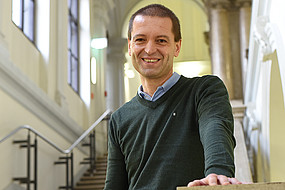
designierte Vizerektorin Petra Schaper-Rinkel Foto: Johannes Zinner ©x-default

designierte Vizerektorin Petra Schaper-Rinkel Foto: Johannes Zinner

Petra Schaper-Rinkel zur Vizerektorin für Digitalisierung gewählt

Am 1. Oktober 2019 übernimmt Martin Polaschek als Rektor die Leitung der Universität Graz. Sein Team wird sich aus vier VizerektorInnen zusammensetzen. Nach Catherine Walter-Laager, Vizerektorin für Studium und Lehre, Christof Gattringer, Vizerektor für Forschung und Nachwuchsförderung, und Peter Riedler, Vizerektor für Finanzen, Personal und Standortentwicklung, wählte der Universitätsrat am 5. Juli 2019 Petra Schaper-Rinkel zur Vizerektorin für Digitalisierung. Damit ist das Team der VizerektorInnen komplett. 

Petra Schaper-Rinkel, Vizerektorin für Digitalisierung
Petra Schaper-Rinkel ist Politikwissenschafterin und seit 2009 als Forscherin am AIT – Austrian Institute of Technology in Wien tätig. Ihre Schwerpunkte liegen im Bereich der Zukunftstechnologien. Am AIT leitet Schaper-Rinkel unter anderem Forschungsprojekte dazu und ist für die strategische Entwicklung des Forschungsfeldes „Societal Futures“ verantwortlich. Darüber hinaus koordiniert die 1966 in Deutschland geborene Wissenschafterin Forschungsrahmenverträge mit dem Österreichischen sowie Europäischen Parlament zu Foresight und Technikfolgenabschätzung. 

Catherine Walter-Laager, Vizerektorin für Studium und Lehre
Catherine Walter-Laager ist seit 2016 Professorin an der Universität Graz. Die Expertin für Erwachsenenbildung und Elementarpädagogik ist eine renommierte Erziehungswissenschafterin, die mit zahlreichen Aktivitäten ihr wissenschaftliches Know-how in die Praxis und Öffentlichkeit trägt. Zudem verfügt die gebürtige Schweizerin, Jahrgang 1969, aufgrund der Leitung eines großen Berliner Forschungsinstituts sowie von Drittmittelprojekten über entsprechende Erfahrung in Führung und Management. 

Christof Gattringer, Vizerektor für Forschung und Nachwuchsförderung
Der Professor für Theoretische Physik leitet seit 2015 als Dekan die Naturwissenschaftliche Fakultät der Universität Graz. Darüber hinaus fungierte der 1966 in Wien geborene Forscher zehn Jahre lang als Sprecher des vom österreichischen Wissenschaftsfonds FWF finanzierten Doktoratskollegs „Hadrons in Vacuum, Nuclei and Stars“. Neben mehr als 170 Publikationen kann Gattringer auf eine umfangreiche internationale Erfahrung verweisen. Unter anderem forschte der Teilchenphysiker am Massachusetts Institute of Technology (MIT) in Boston, an der University of British Columbia in Vancouver sowie an der University of Washington in Seattle. 

Peter Riedler, Vizerektor für Finanzen, Personal und Standortentwicklung
Peter Riedler, 1969 in Graz geboren, promovierte im Bereich Völkerrecht und Europarecht an der Universität Graz. Seine beruflichen Stationen führten ihn unter anderem ins Europäische Parlament in Brüssel, in die Steiermärkische Landesregierung, 2002 ins Bundeskanzleramt, mit den Schwerpunkten Wirtschaft und Forschung, sowie 2007 als Director of Public Affairs zur AVL List GmbH in Graz. Seit 2011 ist Riedler Vizerektor für Finanzen, Ressourcen und Standortentwicklung an der Universität Graz. 
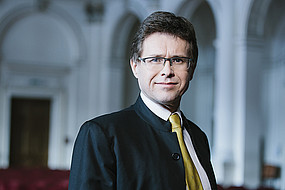
Martin Polaschek, designierter Rektor der Universität Graz. Foto: Uni Graz/Kanizaj ©KANIZAJ Marija-M. | 2016
©KANIZAJ Marija-M. | 2016
Martin Polaschek, designierter Rektor der Universität Graz. Foto: Uni Graz/Kanizaj
Christof Gattringer, Vizerektor für Forschung und Nachwuchsförderung ab 1. Oktober 2019. Foto: Uni Graz/Tzivanopoulos
Peter Riedler, Vizerektor für Finanzen, Personal und Standortentwicklung ab 1. Oktober 2019. Foto: Uni Graz/Kanizaj ©KANIZAJ Marija-M. | 2016
©KANIZAJ Marija-M. | 2016
Peter Riedler, Vizerektor für Finanzen, Personal und Standortentwicklung ab 1. Oktober 2019. Foto: Uni Graz/Kanizaj
Catherine Walter-Laager, Vizerektorin für Studium und Lehre ab 1. Oktober 2019. Foto: Walter-Laager
created by Andreas Schweiger

Related news

Semester abroad without barriers: University of Graz wins award for promoting inclusion

The University of Graz has been awarded the Internationalization Award for its new inclusion initiative. Students with fewer opportunities now also receive financial support for their semester abroad outside Europe.

Fair distribution: Researchers determine just greenhouse gas budgets for all EU regions

Ten years ago, on 12 December 2015, the Paris Climate Agreement was signed at the UN Climate Conference. In order to limit global warming to well below two degrees, only a certain amount of CO2 may be emitted worldwide. While the focus was originally on national emission targets, more than 200 subnational regions and almost 300 cities have now adopted their own targets. But how many emissions are they fairly entitled to? Researchers at the University of Graz have now developed transparent criteria for fair distribution at the subnational level for the first time and determined corresponding greenhouse gas budgets for all European regions. The paper was published today in the scientific journal Nature Communications.

Chemical Christmas show at the University of Graz: An explosive evening at the Schauspielh

At the beginning of December, the University of Graz transformed the theater into a laboratory: as part of “Chemical Life,” teacher training students staged a chemical Christmas show for Styrian school classes—complete with ethanol rockets, nitrogen snow, and glowing effects. An evening designed to inspire interest in studying chemistry.

Train by train: Koralm railway accelerates exchange between the Universities

Lectures at the University of Klagenfurt in the morning, seminars at the University of Graz in the afternoon: Austria's longest tunnel and a journey time of around 45 minutes make it easy. The Koralm railway increases the speed of networking between the two university locations. The collaboration builds on existing cooperation - for example in the areas of teacher training, Slavic studies and as employers, the universities are well coordinated.

Begin of page section:
Additional information:

University of Graz
Universitaetsplatz 3
8010 Graz
Austria
  • Contact
  • Web Editors
  • Moodle
  • UNIGRAZonline
  • Imprint
  • Data Protection Declaration
  • Accessibility Declaration
Weatherstation
Uni Graz

End of this page section. Go to overview of page sections

End of this page section. Go to overview of page sections

Begin of page section:

End of this page section. Go to overview of page sections