Begin of page section:
Page sections:

  • Go to contents (Accesskey 1)
  • Go to position marker (Accesskey 2)
  • Go to main navigation (Accesskey 3)
  • Go to sub navigation (Accesskey 4)
  • Go to additional information (Accesskey 5)
  • Go to page settings (user/language) (Accesskey 8)
  • Go to search (Accesskey 9)

End of this page section. Go to overview of page sections

Begin of page section:
Page settings:

English en
Deutsch de
Search
Login

End of this page section. Go to overview of page sections

Begin of page section:
Search:

Search for details about Uni Graz
Close

End of this page section. Go to overview of page sections


Search

Begin of page section:
Main navigation:

Page navigation:

  • University

    University
    • About the University
    • Organisation
    • Faculties
    • Library
    • Working at University of Graz
    • Campus
    Developing solutions for the world of tomorrow - that is our mission. Our students and our researchers take on the great challenges of society and carry the knowledge out.
  • Research Profile

    Research Profile
    • Our Expertise
    • Research Questions
    • Research Portal
    • Promoting Research
    • Research Transfer
    • Ethics in Research
    Scientific excellence and the courage to break new ground. Research at the University of Graz creates the foundations for making the future worth living.
  • Studies

    Studies
    • Prospective Students
    • Students
  • Community

    Community
    • International
    • Location
    • Research and Business
    • Alumni
    The University of Graz is a hub for international research and brings together scientists and business experts. Moreover, it fosters the exchange and cooperation in study and teaching.
  • Spotlight
Topics
  • Our digital Advent calendar
  • Sustainable University
  • Researchers answer
  • Work for us
Close menu

End of this page section. Go to overview of page sections

Begin of page section:
You are here:

University of Graz News Bringing museums to life

End of this page section. Go to overview of page sections

Friday, 06 March 2020

Bringing museums to life

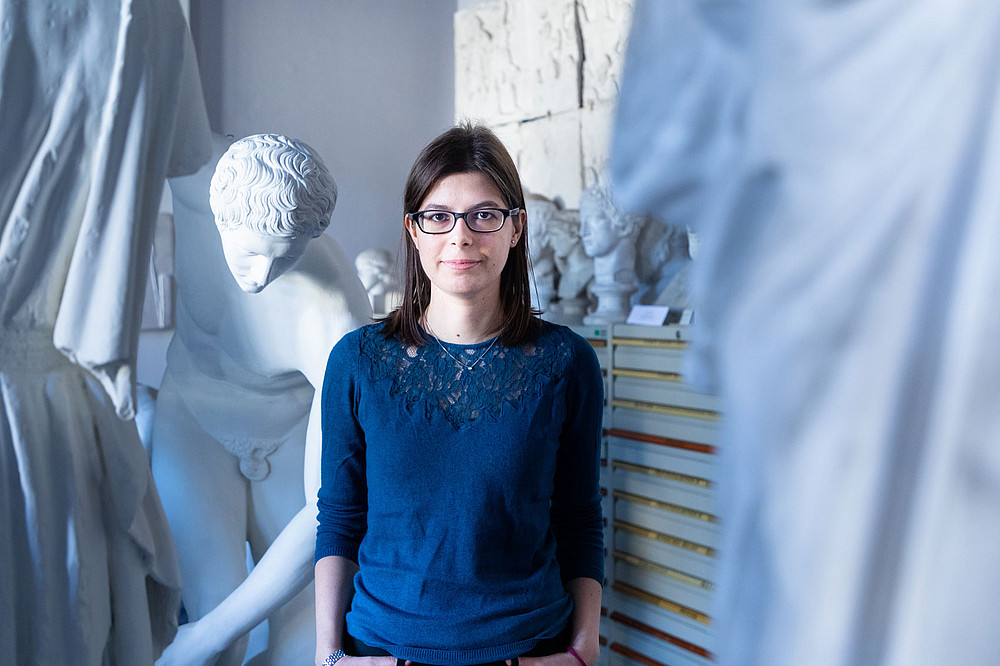
Seeing an exhibition is about more than just looking at objects, says Chiara Zuanni. Her vision: she wants to make a multi-media experience of objects and exhibitions possible, and to link them with one another.


For Chiara Zuanni, exhibits in a museum are of enormous value. Her primary interest, however, is not in the beauty of an object, but in the details recorded in its metadata. This is structured descriptive information that includes everything known about the artist, the content of paintings, and the place of origin for texts or objects. Only a small percentage of all exhibits in collections around the world are documented in digital form, the museologist estimates, and an even smaller proportion are publicly accessible, complete with the relevant metadata. Metadata make it possible to compare objects using digital technology. “If we have as much information as possible about objects, we can relate them to each other and find parallels,” explains Zuanni. It is important that this data is openly available, so that it can be accessed and reused by others. Since 2018 Italian-born Zuanni has conducted her research at the Centre for Information Modelling – Austrian Centre for Digital Humanities. She originally studied archaeology in Italy, then completed a doctorate in Museology in the UK. Her main interest is how knowledge is communicated in museums.


Virtual Reality
Today we can use digital methods to present the stories of objects in interactive ways. “Where we used to have audio guides,” says the researcher, “we can now use apps.” A statue from ancient Athens for example is set in stone in a museum somewhere in Europe. “Usually we look at objects in an exhibition hall. We can’t touch them, can’t move them around, and certainly can’t see them in their original context,” says Zuanni. Virtual or augmented reality can recreate these worlds for us. “Visitors use VR glasses to step into the relevant period or epoch in which the artwork was created.”


Visitors’ responses are influential
Museums use social media to communicate with the public. Understanding and enhancing these new possibilities and evaluating their effect on visitors is another aspect of Zuanni’s research work. People leave evidence of their impressions in social networks. And this is exactly what she wants to make use of. “When interested people share their opinions or images of exhibitions in social media posts, that gives us feedback on the collections.” Studying this interaction on social media platforms can help the museums to develop better communication strategies and to use participative approaches for structuring and disseminating knowledge about our cultural heritage.

created by Konstantin Tzivanopoulos

Related news

Fair distribution: Researchers determine just greenhouse gas budgets for all EU regions

Ten years ago, on 12 December 2015, the Paris Climate Agreement was signed at the UN Climate Conference. In order to limit global warming to well below two degrees, only a certain amount of CO2 may be emitted worldwide. While the focus was originally on national emission targets, more than 200 subnational regions and almost 300 cities have now adopted their own targets. But how many emissions are they fairly entitled to? Researchers at the University of Graz have now developed transparent criteria for fair distribution at the subnational level for the first time and determined corresponding greenhouse gas budgets for all European regions. The paper was published today in the scientific journal Nature Communications.

Chemical Christmas show at the University of Graz: An explosive evening at the Schauspielh

At the beginning of December, the University of Graz transformed the theater into a laboratory: as part of “Chemical Life,” teacher training students staged a chemical Christmas show for Styrian school classes—complete with ethanol rockets, nitrogen snow, and glowing effects. An evening designed to inspire interest in studying chemistry.

Train by train: Koralm railway accelerates exchange between the Universities

Lectures at the University of Klagenfurt in the morning, seminars at the University of Graz in the afternoon: Austria's longest tunnel and a journey time of around 45 minutes make it easy. The Koralm railway increases the speed of networking between the two university locations. The collaboration builds on existing cooperation - for example in the areas of teacher training, Slavic studies and as employers, the universities are well coordinated.

On the trail of the Big Bang: University of Graz receives 1.5 million euros for doctoral programmes

The Austrian Science Fund FWF has selected the Doctoral Programme in Theoretical Particle Physics at the University of Graz for funding from the Doc.funds. Six young scientists will be funded for 3.5 years. They will gain fundamentally new insights into the origins of the world.

Begin of page section:
Additional information:

University of Graz
Universitaetsplatz 3
8010 Graz
Austria
  • Contact
  • Web Editors
  • Moodle
  • UNIGRAZonline
  • Imprint
  • Data Protection Declaration
  • Accessibility Declaration
Weatherstation
Uni Graz

End of this page section. Go to overview of page sections

End of this page section. Go to overview of page sections

Begin of page section:

End of this page section. Go to overview of page sections