Begin of page section:
Page sections:

  • Go to contents (Accesskey 1)
  • Go to position marker (Accesskey 2)
  • Go to main navigation (Accesskey 3)
  • Go to sub navigation (Accesskey 4)
  • Go to additional information (Accesskey 5)
  • Go to page settings (user/language) (Accesskey 8)
  • Go to search (Accesskey 9)

End of this page section. Go to overview of page sections

Begin of page section:
Page settings:

English en
Deutsch de
Search
Login

End of this page section. Go to overview of page sections

Begin of page section:
Search:

Search for details about Uni Graz
Close

End of this page section. Go to overview of page sections


Search

Begin of page section:
Main navigation:

Page navigation:

  • University

    University
    • About the University
    • Organisation
    • Faculties
    • Library
    • Working at University of Graz
    • Campus
    Developing solutions for the world of tomorrow - that is our mission. Our students and our researchers take on the great challenges of society and carry the knowledge out.
  • Research Profile

    Research Profile
    • Our Expertise
    • Research Questions
    • Research Portal
    • Promoting Research
    • Research Transfer
    • Ethics in Research
    • Commission for Scientific Integrity
    Scientific excellence and the courage to break new ground. Research at the University of Graz creates the foundations for making the future worth living.
  • Studies

    Studies
    • Prospective Students
    • Students
  • Community

    Community
    • International
    • Location
    • Research and Business
    • Alumni
    The University of Graz is a hub for international research and brings together scientists and business experts. Moreover, it fosters the exchange and cooperation in study and teaching.
  • Spotlight
Topics
  • Sustainable University
  • Researchers answer
  • Work for us
Close menu

End of this page section. Go to overview of page sections

Begin of page section:
You are here:

University of Graz News Lass uns reden!

End of this page section. Go to overview of page sections

Thursday, 09 March 2017

Lass uns reden!

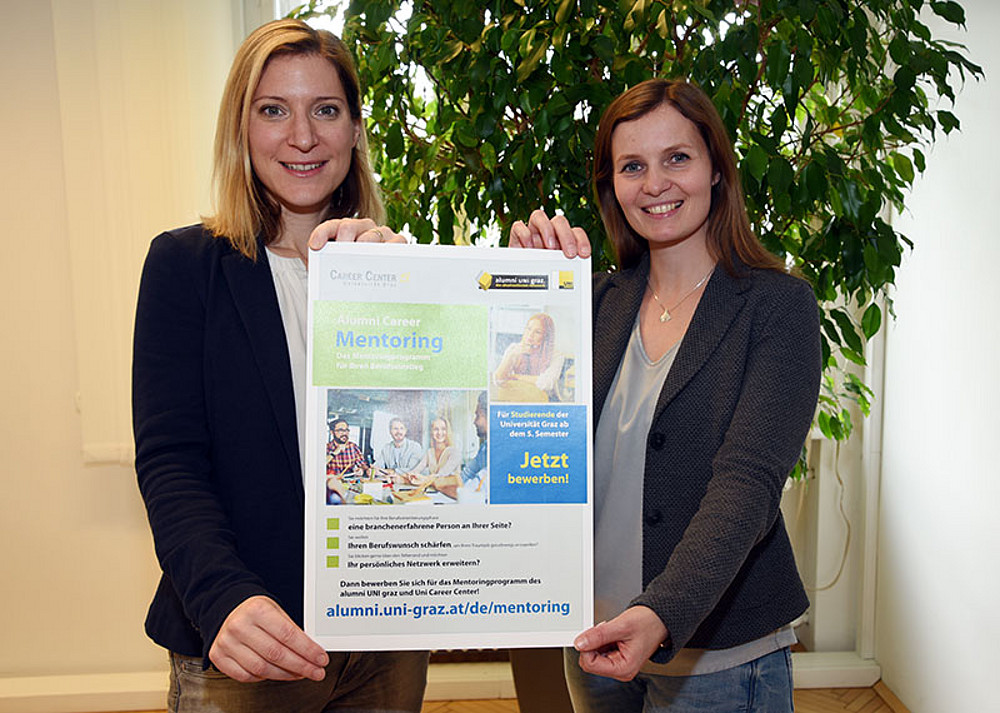
Sigrid Maxl-Studler (l.) und Tanja Baumgartner laden zum Alumni Career Mentoringprogramm ein. Foto: Uni Graz/Kastrun.

Sigrid Maxl-Studler (l.) und Tanja Baumgartner laden zum Alumni Career Mentoringprogramm ein. Foto: Uni Graz/Kastrun.

Das Mentoringprogramm von alumni und Career Center spannt Studierende und erfolgreiche Berufstätige als Tandems zusammen

Auf der einen Seite stehen Studierende, die sich auf ihren Einstieg in die Arbeitswelt vorbereiten, auf der anderen Seite AbsolventInnen, die erfolgreich in ihrem Job sind und ihr Wissen weiter geben möchten. Im „Alumni Career Mentoringprogramm“ treffen sich beide auf Augenhöhe zum produktiven Austausch. Bereits sehr gut angenommen in vergangenen Jahren, startet das Programm, das vom AbsolventInnen-Netzwerk alumni UNI graz und dem Career Center der Karl-Franzens-Universität organisiert wird, 2017 wieder in eine neue Runde. Der Unterschied: „Ab sofort können sich Interessierte das gesamte Jahr hindurch um einen Tandemplatz bewerben“, erklären Mag. Tanja Baumgartner und MMag. Sigrid Maxl-Studler, die Koordinatorinnen des Programms. Die Anmeldung erfolgt online.


Ziel des Programms ist es, Studierenden realistische Einblicke in die für sie interessanten Berufsbranchen zu ermöglichen – angereichert mit hilfreichen Tipps und Tricks aus erster Hand. Auch das persönliche Netzwerk bereits zum Karrierestart ausbauen zu können, ist ein Vorteil des Programms. Für die MentorInnen gibt es keine Vorgaben zu Dauer und Intensität ihres Mentorats. „Wir empfehlen aber, dieses im Rahmen von vier bis acht Monaten anzudenken. Ein bis zwei persönliche Treffen beziehungsweise Gespräche pro Monat haben sich ebenfalls als vorteilhaft erwiesen“, so Baumgartner und Maxl-Studler. Die endgültige Entscheidung trifft das Tandem aber gemeinsam.


„Der gegenseitige Austausch mit meinem Mentee hat mir neue Perspektiven eröffnet und mir die Möglichkeit geboten, meine Tätigkeiten aus einem frischen Blickwinkel zu sehen“, zeigt sich Mentorin Dr. Verena Reiter vom Universitätsverlag begeistert. Auch Mag. Julia Schirnhofer, Studentin der Transkulturellen Kommunikation, Romanistik und Germanistik, ist von den positiven Effekten des Programms überzeugt: „Ich kann jederzeit Fragen stellen –sei es zur beruflichen Tätigkeit oder zur persönlichen Meinung meiner Mentorin zu einem bestimmten Thema. Meine Mentorin geht stets auf diese Fragen ein und versucht, sie mir auch so verständlich wie möglich zu erklären, wofür ich sehr dankbar bin. In nächster Zeit werde ich im Rahmen eines Praktikums auch einen näheren Einblick in den Berufsalltag meiner Mentorin bekommen, worauf ich mich schon sehr freue.“


created by Gerhild Kastrun

Related news

Studying at the University of Graz: How to enrol

Ready for a new chapter in your life with the start of your studies at the University of Graz in the winter semester 2026/27? Here you will find information on deadlines, admission procedures, registration, and everything else you need to successfully start your studies in the fall.

Interpreting data: Why studies sometimes get it wrong

Hilmar Brohmer and Ziva Korda from the Institute of Psychology, together with 500 international colleagues, have re-evaluated a hundred scientific publications and have often come to different conclusions.

Crystal-clear: AI method revolutionises solar observation

The Sun makes life on Earth possible. However, its magnetic fields can also cause massive disruption. This makes it all the more important to gain a better understanding of the processes taking place on our nearest star. A research team from the University of Graz and the High Altitude Observatory in Boulder (USA) has succeeded in doing just that. The astrophysicists have developed an AI-supported method that makes even the smallest structures on the Sun visible. The scientists are convinced that this will bring about a lasting change in solar observation and that the new method can be used for the planned European Solar Telescope.

Long Night of Research: How many languages are there in the world?

From a linguistic perspective, there are worlds of difference between Bern, Berlin and Vienna. A dialect impersonator will demonstrate live just how varied German can sound. How many languages are there in the world? What are their distinctive features? Which of these are spoken in Austria? These and other questions will be answered during the Long Night of Research at the University of Graz: on Friday, 24 April 2025, from 5 pm to 11 pm, in the University Library. Visitors can immerse themselves in the diversity of languages without travelling far by taking part in a quiz at the station.

Begin of page section:
Additional information:

University of Graz
Universitaetsplatz 3
8010 Graz
Austria
  • Contact
  • Web Editors
  • Moodle
  • UNIGRAZonline
  • Imprint
  • Data Protection Declaration
  • Accessibility Declaration
Weatherstation
Uni Graz

End of this page section. Go to overview of page sections

End of this page section. Go to overview of page sections

Begin of page section:

End of this page section. Go to overview of page sections