Begin of page section:
Page sections:

  • Go to contents (Accesskey 1)
  • Go to position marker (Accesskey 2)
  • Go to main navigation (Accesskey 3)
  • Go to sub navigation (Accesskey 4)
  • Go to additional information (Accesskey 5)
  • Go to page settings (user/language) (Accesskey 8)
  • Go to search (Accesskey 9)

End of this page section. Go to overview of page sections

Begin of page section:
Page settings:

English en
Deutsch de
Search
Login

End of this page section. Go to overview of page sections

Begin of page section:
Search:

Search for details about Uni Graz
Close

End of this page section. Go to overview of page sections


Search

Begin of page section:
Main navigation:

Page navigation:

  • University

    University
    • About the University
    • Organisation
    • Faculties
    • Library
    • Working at University of Graz
    • Campus
    Developing solutions for the world of tomorrow - that is our mission. Our students and our researchers take on the great challenges of society and carry the knowledge out.
  • Research Profile

    Research Profile
    • Our Expertise
    • Research Questions
    • Research Portal
    • Promoting Research
    • Research Transfer
    • Ethics in Research
    • Commission for Scientific Integrity
    Scientific excellence and the courage to break new ground. Research at the University of Graz creates the foundations for making the future worth living.
  • Studies

    Studies
    • Prospective Students
    • Students
  • Community

    Community
    • International
    • Location
    • Research and Business
    • Alumni
    The University of Graz is a hub for international research and brings together scientists and business experts. Moreover, it fosters the exchange and cooperation in study and teaching.
  • Spotlight
Topics
  • Sustainable University
  • Researchers answer
  • Work for us
Close menu

End of this page section. Go to overview of page sections

Begin of page section:
You are here:

University of Graz News Kultureller Wandel

End of this page section. Go to overview of page sections

Friday, 03 February 2017

Kultureller Wandel

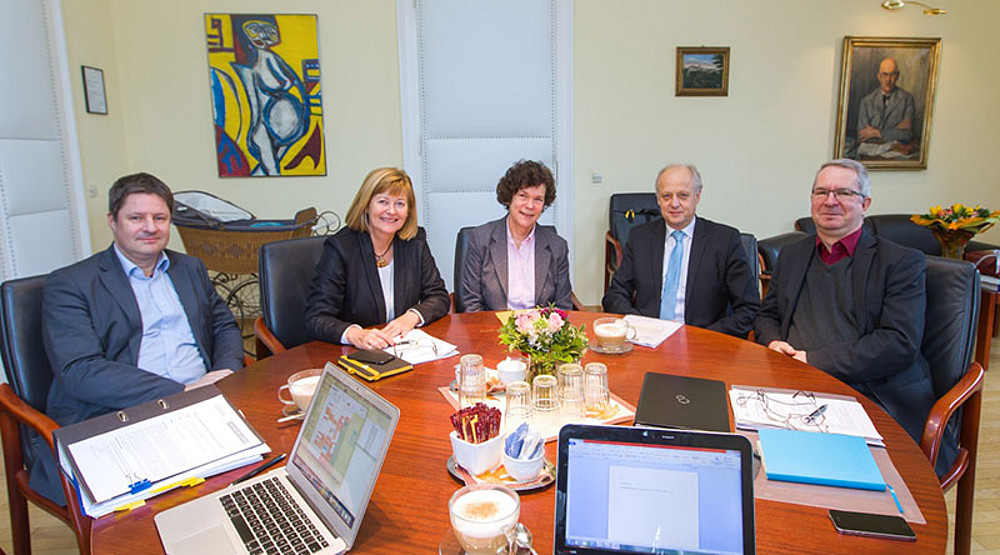
Rektorin Christa Neuper (2.v.l.) mit Leipziger KollegInnen: Matthias Schwarz, Prorektor für Forschung und Nachwuchsförderung, Rektorin Beate Schücking, Thomas Lenk, Prorektor für Entwicklung und Transfer und Thomas Hofsäss, Prorektor für Bildung und

Rektorin Christa Neuper (2.v.l.) mit Leipziger KollegInnen: Matthias Schwarz, Prorektor für Forschung und Nachwuchsförderung, Rektorin Beate Schücking, Thomas Lenk, Prorektor für Entwicklung und Transfer und Thomas Hofsäss, Prorektor für Bildung und Internationales. Fotos: Universität Leipzig/Swen Reichhold.

Stephan Moebius, Rektorin Beate Schücking, Rektorin Christa Neuper, Dirk Quadflieg und Andreas Langenohl von der Universität Gießen.

Stephan Moebius, Rektorin Beate Schücking, Rektorin Christa Neuper, Dirk Quadflieg und Andreas Langenohl von der Universität Gießen.

Gemeinsamer Workshop der Universitäten Leipzig und Graz

Am 2. und 3. Februar 2017 fand an der Universität Leipzig ein gemeinsamer Workshop zum Thema „Transformationen der Öffentlichkeit“ statt, der vom Kulturwissenschaftler Univ.-Prof. Dr. Dirk Quadflieg (Leipzig) zusammen mit dem Soziologen Univ.-Prof. Dr. Stephan Moebius (Graz) organisiert war. Der Workshop brachte TeilnehmerInnen beider Seiten zu gemeinsamen Vorträgen und Diskussionen zusammen und knüpfte an zwei parallel laufende Master-Seminare in Graz und Leipzig zu diesem Thema an.

„Im Zuge der neuen Kommunikationstechnologien und aufgrund zunehmender Globalisierungsprozesse verändern sich auch die Formen und Orte von Öffentlichkeit“, so der Kultursoziologe Stephan Moebius. „Wir haben es zum Beispiel vermehrt mit digitalen Öffentlichkeiten zu tun. Das birgt Chancen – jede/jeder kann potenziell daran teilnehmen – aber auch Risiken, wie wir sie derzeit in der Diskussion um Fake News sehen. Wir wollen diese Veränderung ans Licht bringen und ihren gesellschaftlichen, kulturellen, politischen, ökonomischen und rechtlichen Konsequenzen auf den Grund gehen.“


Dieser wissenschaftliche Austausch zwischen den Instituten Kulturwissenschaft (Leipzig) und Soziologie (Graz) setzt die Reihe gemeinsamer Aktivitäten zur Intensivierung der langjährigen Partnerschaft beider Universitäten fort. An der Eröffnung des Workshops nahmen auch die beiden Rektorinnen Beate Schücking und Christa Neuper teil. Die Rektorinnen nutzten zugleich das Treffen für weitere Kooperationsgespräche auf Leitungsebene. Zusammen mit Rektorin Neuper waren auch MitarbeiterInnen aus den Bereichen Wirtschaftspädagogik, Internationale Beziehungen sowie dem Forschungsmanagement und -service für Kooperationsgespräche, Erfahrungsaustausch und Wissenstransfer in Leipzig zu Gast.


Die beiden Universitäten haben in den vergangenen Jahren den Austausch von MitarbeiterInnen auf allen Ebenen intensiviert, unter anderem durch gemeinsame Tagungen und Workshops sowie fachliche Weiterbildungen zu aktuellen wissenschaftlichen und hochschulpolitischen Themen. Hierzu zählen die interdisziplinäre DoktorandInnenausbildung und Nachwuchsförderung sowie die PädagogInnenbildung und Forschungsaktivitäten in der Fachdidaktik.

created by Diana Afrashteh & Gerhild Kastrun

Related news

Studying at the University of Graz: How to enrol

Ready for a new chapter in your life with the start of your studies at the University of Graz in the winter semester 2026/27? Here you will find information on deadlines, admission procedures, registration, and everything else you need to successfully start your studies in the fall.

Interpreting data: Why studies sometimes get it wrong

Hilmar Brohmer and Ziva Korda from the Institute of Psychology, together with 500 international colleagues, have re-evaluated a hundred scientific publications and have often come to different conclusions.

Crystal-clear: AI method revolutionises solar observation

The Sun makes life on Earth possible. However, its magnetic fields can also cause massive disruption. This makes it all the more important to gain a better understanding of the processes taking place on our nearest star. A research team from the University of Graz and the High Altitude Observatory in Boulder (USA) has succeeded in doing just that. The astrophysicists have developed an AI-supported method that makes even the smallest structures on the Sun visible. The scientists are convinced that this will bring about a lasting change in solar observation and that the new method can be used for the planned European Solar Telescope.

Long Night of Research: How many languages are there in the world?

From a linguistic perspective, there are worlds of difference between Bern, Berlin and Vienna. A dialect impersonator will demonstrate live just how varied German can sound. How many languages are there in the world? What are their distinctive features? Which of these are spoken in Austria? These and other questions will be answered during the Long Night of Research at the University of Graz: on Friday, 24 April 2025, from 5 pm to 11 pm, in the University Library. Visitors can immerse themselves in the diversity of languages without travelling far by taking part in a quiz at the station.

Begin of page section:
Additional information:

University of Graz
Universitaetsplatz 3
8010 Graz
Austria
  • Contact
  • Web Editors
  • Moodle
  • UNIGRAZonline
  • Imprint
  • Data Protection Declaration
  • Accessibility Declaration
Weatherstation
Uni Graz

End of this page section. Go to overview of page sections

End of this page section. Go to overview of page sections

Begin of page section:

End of this page section. Go to overview of page sections