Begin of page section:
Page sections:

  • Go to contents (Accesskey 1)
  • Go to position marker (Accesskey 2)
  • Go to main navigation (Accesskey 3)
  • Go to sub navigation (Accesskey 4)
  • Go to additional information (Accesskey 5)
  • Go to page settings (user/language) (Accesskey 8)
  • Go to search (Accesskey 9)

End of this page section. Go to overview of page sections

Begin of page section:
Page settings:

English en
Deutsch de
Search
Login

End of this page section. Go to overview of page sections

Begin of page section:
Search:

Search for details about Uni Graz
Close

End of this page section. Go to overview of page sections


Search

Begin of page section:
Main navigation:

Page navigation:

  • University

    University
    • About the University
    • Organisation
    • Faculties
    • Library
    • Working at University of Graz
    • Campus
    Developing solutions for the world of tomorrow - that is our mission. Our students and our researchers take on the great challenges of society and carry the knowledge out.
  • Research Profile

    Research Profile
    • Our Expertise
    • Research Questions
    • Research Portal
    • Promoting Research
    • Research Transfer
    • Ethics in Research
    Scientific excellence and the courage to break new ground. Research at the University of Graz creates the foundations for making the future worth living.
  • Studies

    Studies
    • Prospective Students
    • Students
  • Community

    Community
    • International
    • Location
    • Research and Business
    • Alumni
    The University of Graz is a hub for international research and brings together scientists and business experts. Moreover, it fosters the exchange and cooperation in study and teaching.
  • Spotlight
Topics
  • Our digital Advent calendar
  • Sustainable University
  • Researchers answer
  • Work for us
Close menu

End of this page section. Go to overview of page sections

Begin of page section:
You are here:

University of Graz News Artificial intelligence: Technology Impact Summit highlighted opportunities and challenges

End of this page section. Go to overview of page sections

Monday, 21 October 2024

Artificial intelligence: Technology Impact Summit highlighted opportunities and challenges

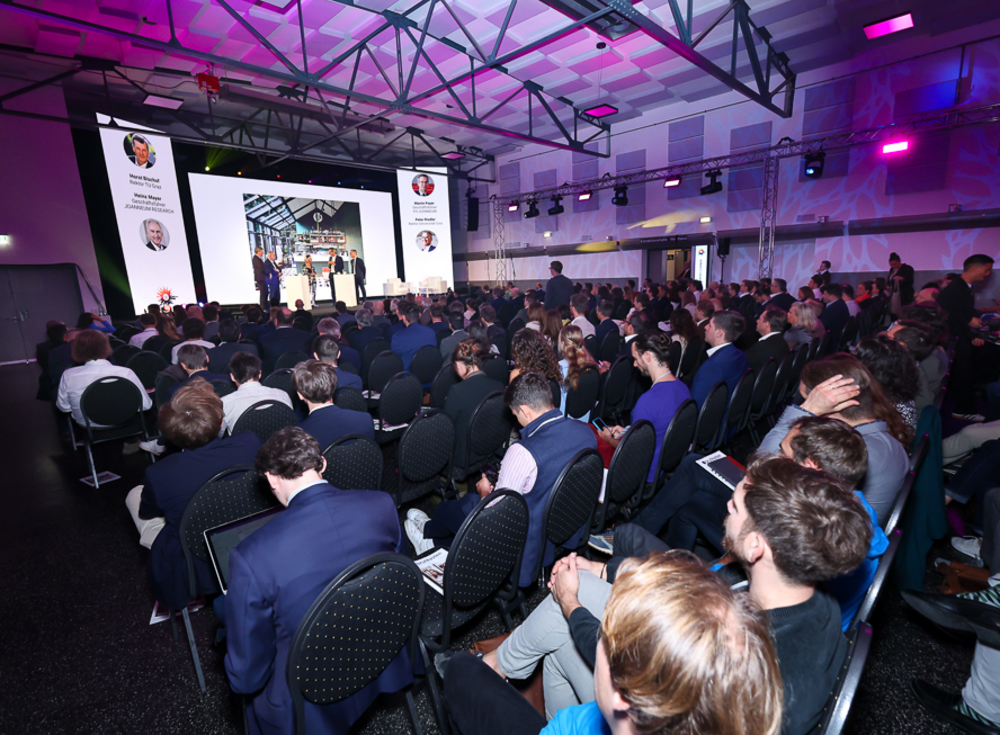
The main stage of the conference featured a young audience in suits, sitting and standing. Screens displayed images about business innovation in the field of AI. The large hall had modern architecture and was illuminated by purple lights.

A full house at the TIS in the Graz Seifenfabrik. The hosts, TU Rector Horst Bischof, Joanneum Research Managing Director Heinz Mayer, FH Joanneum Managing Director Martin Payer and Uni Graz Rector Peter Riedler on stage. Photo: Hankus3sixty/ Christian Mikes

The first Technology Impact Summit in Graz brought together leading minds from science, business and politics to discuss Austria's role in AI development. While experts emphasised the necessity of AI, the EU's regulatory approach sparked controversial debates about innovation barriers versus safety standards.

The speakers at the first Technology Impact Summit in Graz at the beginning of October agreed that artificial intelligence is necessary for Austria and Europe. Opinions differed, however, on whether the cautious approach and strong focus on security in the field would help or harm Europe.

The summit was organised by the University of Graz, Graz University of Technology, Joanneum Research and the FH Joanneum. In his welcoming address, Peter Riedler, rector of the University of Graz, called for a commitment to science and education, similar to that in Scandinavia. Horst Bischof, rector of Graz University of Technology, and Heinz Mayer, managing director of Joanneum Research, pointed out the great expertise in the areas of cybersecurity and the development of digital twins. Martin Payer, CEO of FH Joanneum, emphasised that highly qualified talent is a clear location advantage for Styria.

Martin Kocher, Minister of Economic Affairs, explained which trends will shape the future. These include AI, digitalisation, demography, automation, decarbonisation and (de)globalisation. He said that AI can make work more efficient, but it is not yet known exactly how much. So far, digitisation has contributed little to productivity, in contrast to automation in the 1960s. Kocher emphasised that more needs to be invested in AI research. Austria should focus on applications where it is not competing with the big tech companies.

Afterwards, the philosopher Konrad Paul Liessmann and the technology lawyer Viktor Mayer-Schönberger discussed the advantages and disadvantages of the new algorithms. Liessmann says that only those people have to be afraid of AI who are satisfied with average. Mayer-Schönberger emphasised that not all people are creative and original. Liessmann believes that AI has no motivation and therefore only delivers mediocre results. Mayer-Schönberger sees AI as a tool for accessing knowledge. He calls for a learning legal system that can react to negative developments.

From theory to practice

The afternoon session focused on practical applications. Experts discussed the legal rules for AI, Europe's role in the development of AI and the ethical issues that arise in the process. Jana Lasser from the University of Graz believes that Europe has a chance if it specialises in certain market segments and uses high-quality data as a basis for AI applications. Markus Kneer highlights the ethical questions raised by the technology. He says that we need to think carefully about how to allow AI systems to access sensitive data and decisions.

In this context, Jeannette Gorzala from the European AI Forum defends the EU's AI Act and emphasises the advantages of a uniform legal framework. Thomas Burri from the University of St. Gallen, on the other hand, criticises the AI Act, saying that it could harm the European economy.

The first Technology Impact Summit showed that there are no easy answers when it comes to artificial intelligence. It opens up many opportunities, but difficult challenges also await the economy and politics. The insights from the summit are an important building block for the responsible use of AI.

AI-generated audio summary (English)

In keeping with an AI conference, the day was summarised in an audio format using Google AI.

Listen to the audio


created by Roman Vilgut

Related news

Chemical Christmas show at the University of Graz: An explosive evening at the Schauspielh

At the beginning of December, the University of Graz transformed the theater into a laboratory: as part of “Chemical Life,” teacher training students staged a chemical Christmas show for Styrian school classes—complete with ethanol rockets, nitrogen snow, and glowing effects. An evening designed to inspire interest in studying chemistry.

Train by train: Koralm railway accelerates exchange between the Universities

Lectures at the University of Klagenfurt in the morning, seminars at the University of Graz in the afternoon: Austria's longest tunnel and a journey time of around 45 minutes make it easy. The Koralm railway increases the speed of networking between the two university locations. The collaboration builds on existing cooperation - for example in the areas of teacher training, Slavic studies and as employers, the universities are well coordinated.

On the trail of the Big Bang: University of Graz receives 1.5 million euros for doctoral programmes

The Austrian Science Fund FWF has selected the Doctoral Programme in Theoretical Particle Physics at the University of Graz for funding from the Doc.funds. Six young scientists will be funded for 3.5 years. They will gain fundamentally new insights into the origins of the world.

From trans women and knee prostheses: sports science prizes awarded

Walking better with a prosthesis, successfully getting rid of excess weight, training more effectively, more fairness for trans people in sport: these were the topics addressed by the students at the University of Graz who were awarded the sports science prizes for their Master's theses on 3 December 2025.

Begin of page section:
Additional information:

University of Graz
Universitaetsplatz 3
8010 Graz
Austria
  • Contact
  • Web Editors
  • Moodle
  • UNIGRAZonline
  • Imprint
  • Data Protection Declaration
  • Accessibility Declaration
Weatherstation
Uni Graz

End of this page section. Go to overview of page sections

End of this page section. Go to overview of page sections

Begin of page section:

End of this page section. Go to overview of page sections