Begin of page section:
Page sections:

  • Go to contents (Accesskey 1)
  • Go to position marker (Accesskey 2)
  • Go to main navigation (Accesskey 3)
  • Go to sub navigation (Accesskey 4)
  • Go to additional information (Accesskey 5)
  • Go to page settings (user/language) (Accesskey 8)
  • Go to search (Accesskey 9)

End of this page section. Go to overview of page sections

Begin of page section:
Page settings:

English en
Deutsch de
Search
Login

End of this page section. Go to overview of page sections

Begin of page section:
Search:

Search for details about Uni Graz
Close

End of this page section. Go to overview of page sections


Search

Begin of page section:
Main navigation:

Page navigation:

  • University

    University
    • About the University
    • Organisation
    • Faculties
    • Library
    • Working at University of Graz
    • Campus
    Developing solutions for the world of tomorrow - that is our mission. Our students and our researchers take on the great challenges of society and carry the knowledge out.
  • Research Profile

    Research Profile
    • Our Expertise
    • Research Questions
    • Research Portal
    • Promoting Research
    • Research Transfer
    • Ethics in Research
    Scientific excellence and the courage to break new ground. Research at the University of Graz creates the foundations for making the future worth living.
  • Studies

    Studies
    • Prospective Students
    • Students
  • Community

    Community
    • International
    • Location
    • Research and Business
    • Alumni
    The University of Graz is a hub for international research and brings together scientists and business experts. Moreover, it fosters the exchange and cooperation in study and teaching.
  • Spotlight
Topics
  • Our digital Advent calendar
  • Sustainable University
  • Researchers answer
  • Work for us
Close menu

End of this page section. Go to overview of page sections

Begin of page section:
You are here:

University of Graz News Trial of Strength

End of this page section. Go to overview of page sections

Thursday, 27 February 2020

Trial of Strength

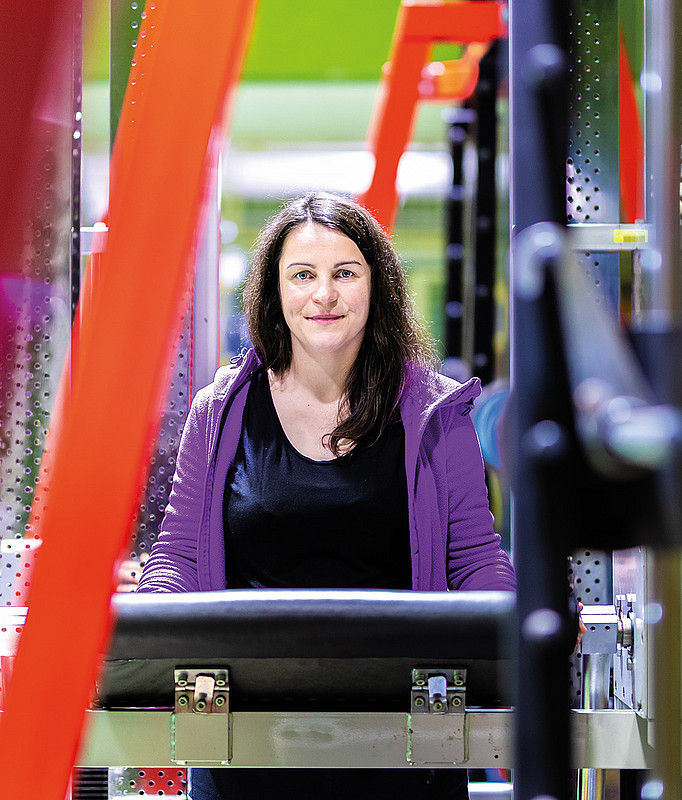
Barbara Frischling analysed fitness applications - also in a self attempt. Photo: Uni Graz/Konstantinov

[Translate to English:] Barbara Frischling analysed fitness applications - also in a self attempt. Photo: Uni Graz/Konstantinov

Barbara Frischling is studying the uses and dangers of fitness apps

We are so keen to connect and interact with the virtual world that our private lives have long become public property. Our desire to boost our self-confidence has entered a new dimension with the use of fitness apps: every step is tracked, our pulse rate is compared, our diet is documented. Who is using this technology? What do they get out of it? And why are they comparing notes about their health? Cultural anthropologist Barbara Frischling has been investigating these questions. She has tried these fitness apps herself and has analysed their use, in interviews and by observation, with the aim of discovering their benefits – and where there are potential pitfalls lurking.
Practically every smartphone has, at the very least, a step counter installed, and there are innumerable applications that will track your route, calculate the calories you have burned or generate exercise goals for you. “In principle, these tools can be very positive, because they motivate people to engage in sport and do more for their health,” says Frischling. But the researcher goes on to state that this all depends on their personal life circumstances and needs. However much comparison with the community can be an incentive, there is no doubt in her mind that, under certain circumstances, it can also be dangerous: “It is important to consider what ideals the users are striving towards. If a young person is susceptible to eating disorders, the continual motivation to burn more calories and intensify their training can in fact have a problematical effect.”

The tyranny of numbers
Norms established by others come to be regarded as the be-all and end-all for one's own body. One example is the current recommendation that it is good for your health to do 10,000 steps a day. Many apps give positive feedback when this target is achieved. “But the users don’t ask themselves whether these numbers are actually appropriate for them in their own life situations,” Frischling points out. And her research has identified yet another problem with the intensive use of fitness apps: Many of those who enjoy sport as a hobby don't just track their pulse rate and steps, they record the number of calories eaten, maintain online food diaries and even monitor their sleep. “All this data is stored centrally, where it is available to large corporations.” What happens to it there and whether it is sold on, is difficult to establish, particularly outside Europe, where different data protection policies apply.
Some insurance companies are quite unabashed in their use of the intimate particulars of their clients. They encourage them to use fitness armbands, enticing them with preferential premiums for behaviour which is supposed to prevent illness. Even businesses hand out gadgets to their employees to motivate them to engage in health-promoting activities. “This is intruding quite drastically into people’s private lives, especially when their sleep is monitored as well,” comments Frischling disapprovingly.
As with all smart technologies, we should weigh up whether the convenience they offer is really worthwhile, given the highly personal information which we share in return – free, gratis and for nothing – with commercial enterprises for them potentially to misuse.

There is a detailed report of Barbara Frischling's research in the current issue of current issue of UNIZEIT.


created by Dagmar Eklaude

Related news

Semester abroad without barriers: University of Graz wins award for promoting inclusion

The University of Graz has been awarded the Internationalization Award for its new inclusion initiative. Students with fewer opportunities now also receive financial support for their semester abroad outside Europe.

Fair distribution: Researchers determine just greenhouse gas budgets for all EU regions

Ten years ago, on 12 December 2015, the Paris Climate Agreement was signed at the UN Climate Conference. In order to limit global warming to well below two degrees, only a certain amount of CO2 may be emitted worldwide. While the focus was originally on national emission targets, more than 200 subnational regions and almost 300 cities have now adopted their own targets. But how many emissions are they fairly entitled to? Researchers at the University of Graz have now developed transparent criteria for fair distribution at the subnational level for the first time and determined corresponding greenhouse gas budgets for all European regions. The paper was published today in the scientific journal Nature Communications.

Chemical Christmas show at the University of Graz: An explosive evening at the Schauspielh

At the beginning of December, the University of Graz transformed the theater into a laboratory: as part of “Chemical Life,” teacher training students staged a chemical Christmas show for Styrian school classes—complete with ethanol rockets, nitrogen snow, and glowing effects. An evening designed to inspire interest in studying chemistry.

Train by train: Koralm railway accelerates exchange between the Universities

Lectures at the University of Klagenfurt in the morning, seminars at the University of Graz in the afternoon: Austria's longest tunnel and a journey time of around 45 minutes make it easy. The Koralm railway increases the speed of networking between the two university locations. The collaboration builds on existing cooperation - for example in the areas of teacher training, Slavic studies and as employers, the universities are well coordinated.

Begin of page section:
Additional information:

University of Graz
Universitaetsplatz 3
8010 Graz
Austria
  • Contact
  • Web Editors
  • Moodle
  • UNIGRAZonline
  • Imprint
  • Data Protection Declaration
  • Accessibility Declaration
Weatherstation
Uni Graz

End of this page section. Go to overview of page sections

End of this page section. Go to overview of page sections

Begin of page section:

End of this page section. Go to overview of page sections