Begin of page section:
Page sections:

  • Go to contents (Accesskey 1)
  • Go to position marker (Accesskey 2)
  • Go to main navigation (Accesskey 3)
  • Go to sub navigation (Accesskey 4)
  • Go to additional information (Accesskey 5)
  • Go to page settings (user/language) (Accesskey 8)
  • Go to search (Accesskey 9)

End of this page section. Go to overview of page sections

Begin of page section:
Page settings:

English en
Deutsch de
Search
Login

End of this page section. Go to overview of page sections

Begin of page section:
Search:

Search for details about Uni Graz
Close

End of this page section. Go to overview of page sections


Search

Begin of page section:
Main navigation:

Page navigation:

  • University

    University
    • About the University
    • Organisation
    • Faculties
    • Library
    • Working at University of Graz
    • Campus
    Developing solutions for the world of tomorrow - that is our mission. Our students and our researchers take on the great challenges of society and carry the knowledge out.
  • Research Profile

    Research Profile
    • Our Expertise
    • Research Questions
    • Research Portal
    • Promoting Research
    • Research Transfer
    • Ethics in Research
    • Commission for Scientific Integrity
    Scientific excellence and the courage to break new ground. Research at the University of Graz creates the foundations for making the future worth living.
  • Studies

    Studies
    • Prospective Students
    • Students
    • Registration for Study Programme (Winter semester 2026/27)
    • Welcome Weeks for First Year Students
  • Community

    Community
    • International
    • Location
    • Research and Business
    • Alumni
    The University of Graz is a hub for international research and brings together scientists and business experts. Moreover, it fosters the exchange and cooperation in study and teaching.
Topics
  • Sustainable University
  • Researchers answer
  • Work for us
Close menu

End of this page section. Go to overview of page sections

Begin of page section:
You are here:

University of Graz News Klimaforschung Graz – Australien

End of this page section. Go to overview of page sections

Friday, 02 November 2012

Klimaforschung Graz – Australien

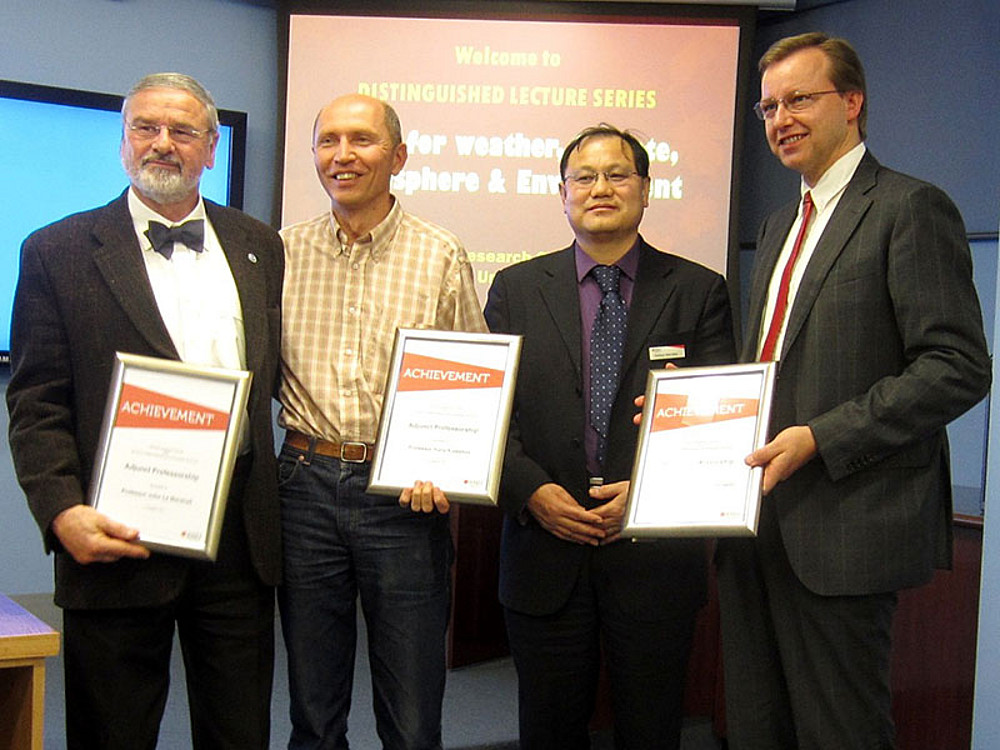
Gottfried Kirchengast (r.) bei der Feier zur Verleihung des "RMIT Adjunct Professor" mit Prof. Kefei Zhang (2.v.r.), Direktor des RMIT SPACE Research Centre, Prof. John Le Marshall (l.), einem führenden Wettersatelliten-Pionier, und Prof. Yuriy Kuleshov

Gottfried Kirchengast (r.) bei der Feier zur Verleihung des "RMIT Adjunct Professor" mit Prof. Kefei Zhang (2.v.r.), Direktor des RMIT SPACE Research Centre, Prof. John Le Marshall (l.), einem führenden Wettersatelliten-Pionier, und Prof. Yuriy Kuleshov (2.v.l.), einem Pionier der Eisforschung mit Satelliten. Foto: Bai/RMIT

Vertiefung der Kooperation des Wegener Zentrums mit dem RMIT SPACE Research Centre in Melbourne

Das Wegener Zentrum für Klima und Globalen Wandel der Karl-Franzens-Universität Graz leistet weltweit herausragende wissenschaftliche Arbeit in der Klimaforschung mit Satelliten. Internationale Kooperationen spielen dabei eine wichtige Rolle: „Hier in Graz bilden wir einen wissenschaftlich-intellektuellen Kern, für die Realisierung unserer Ziele braucht es aber systematische internationale Vernetzung und gute Partner,“ erklärt Zentrumsleiter Univ.-Prof. Dr. Gottfried Kirchengast.

Einer dieser Partner ist die „Royal Melbourne Institute of Technology“-Universität (RMIT) in Australien. Seit 2011 arbeitet Kirchengast mit dem „RMIT Satellite Positioning for Atmosphere, Climate and Environment (SPACE) Research Centre“ zusammen. Nun wurde diese Kooperation weiter ausgebaut. Im September und Oktober 2012 war Gottfried Kirchengast als „RMIT Foundation International Visiting Fellow“ eingeladen – eine prestigeträchtige Auszeichnung für den Grazer Wissenschafter, der gemeinsam mit seinem Team durch bahnbrechende Entwicklungen von neuen Satellitenmethoden zum Monitoring von Klimawandel und Treibhausgasen international Aufsehen erregt hat.

Darüber hinaus wurde Kirchengast auf Basis eines mehrstufigen Assessment-Verfahrens und internationaler Peer-Gutachten zum „RMIT Adjunct Professor“ ernannt, was für die Kooperation mit dem Wegener Zentrum weitere Vorteile bringt. Neben der Mitwirkung an Forschungsstrategien und der Betreuung von Dissertationen und Postdocs am RMIT stehen Kirchengast sämtliche Intranet- und Bibliotheksressourcen der australischen Universität, die auch mit Asien sehr eng verbunden ist, zur Verfügung. „Die Partnerschaft des Wegener Zentrums mit dem „RMIT SPACE Research Centre“, das im australisch-asiatischen Raum komplementär zum europäischen Forschungsraum operiert, ist für unsere Ziele im Bereich der Klimaforschung mittels Satelliten ein wichtiger strategischer Baustein“, betont Kirchengast.


Eine ähnliche Achse besteht in die USA durch die erfolgreiche Zusammenarbeit mit der „University Corporation for Atmospheric Research“ (UCAR) in Boulder/Colorado. Eine weitere wichtige Kooperation ist dort mit der University of Colorado in Aufbau. Diese beherbergt mit dem „Laboratory for Atmosphere and Space Physics“ das auf Universitätsebene weltweit führende Labor für Kleinsatellitenmissionen. „Wenn die richtigen Partner aus dem europäischen, amerikanischen und australisch-asiatischen Raum ihre Kräfte bündeln, ist die Realisierung von innovativen Satellitenprojekten vielleicht doch schneller und günstiger zu bewerkstelligen als ausschließlich durch große Weltraumagenturen wie ESA oder NASA“, blickt Gottfried Kirchengast hoffnungsvoll in die Zukunft.
created by Gudrun Pichler

Related news

What is ‘Dr AI’ supposed to decide, Giovanni Rubeis?

Analysing X-rays, documenting diagnoses, searching through databases: artificial intelligence is already providing significant support with administrative and routine tasks in the healthcare sector. To what extent should it be involved in clinical matters – that is, in treatment recommendations or treatment decisions? How do we prevent built-in biases that could be detrimental to certain individuals?

Commissioned by NATO: University of Graz tests high-tech textiles

As part of an international project, antimicrobial and fire-resistant fabrics with UV protection are being developed in Zagreb. Pharmacists from the University of Graz are ensuring that these fabrics are skin-friendly.

The Arctic up close: ORF special feature on the University of Graz’s research station in S

Students from the University of Graz are spending two weeks conducting research at the Univerisity of Graz research station at the Sermilik Fjord in Greenland, which has been operational for three years. They are measuring glacial runoff, tracking ice melt in real time and installing weather stations. ORF is following the expedition and will be reporting on the special feature ‘Arctic Adventure’ across its various channels from 20 July.

Medicine for ants: Caffeine prolongs the life of infected insects

Black coffee stimulates us and acts against bacteria. So, can caffeine also be good for insects? Yes, confirm biologists of the University of Graz. When ants suffer from a fungal disease, they consume more caffeine and remain active for longer.

Begin of page section:
Additional information:

University of Graz
Universitaetsplatz 3
8010 Graz
Austria
  • Contact
  • Web Editors
  • Moodle
  • UNIGRAZonline
  • Imprint
  • Data Protection Declaration
  • Accessibility Declaration
Weatherstation
Uni Graz

End of this page section. Go to overview of page sections

End of this page section. Go to overview of page sections

Begin of page section:

End of this page section. Go to overview of page sections