Begin of page section:
Page sections:

  • Go to contents (Accesskey 1)
  • Go to position marker (Accesskey 2)
  • Go to main navigation (Accesskey 3)
  • Go to sub navigation (Accesskey 4)
  • Go to additional information (Accesskey 5)
  • Go to page settings (user/language) (Accesskey 8)
  • Go to search (Accesskey 9)

End of this page section. Go to overview of page sections

Begin of page section:
Page settings:

English en
Deutsch de
Search
Login

End of this page section. Go to overview of page sections

Begin of page section:
Search:

Search for details about Uni Graz
Close

End of this page section. Go to overview of page sections


Search

Begin of page section:
Main navigation:

Page navigation:

  • University

    University
    • About the University
    • Organisation
    • Faculties
    • Library
    • Working at University of Graz
    • Campus
    Developing solutions for the world of tomorrow - that is our mission. Our students and our researchers take on the great challenges of society and carry the knowledge out.
  • Research Profile

    Research Profile
    • Our Expertise
    • Research Questions
    • Research Portal
    • Promoting Research
    • Research Transfer
    • Ethics in Research
    • Commission for Scientific Integrity
    Scientific excellence and the courage to break new ground. Research at the University of Graz creates the foundations for making the future worth living.
  • Studies

    Studies
    • Prospective Students
    • Students
  • Community

    Community
    • International
    • Location
    • Research and Business
    • Alumni
    The University of Graz is a hub for international research and brings together scientists and business experts. Moreover, it fosters the exchange and cooperation in study and teaching.
  • Spotlight
Topics
  • Sustainable University
  • Researchers answer
  • Work for us
Close menu

End of this page section. Go to overview of page sections

Begin of page section:
You are here:

University of Graz News Klassisch und modern

End of this page section. Go to overview of page sections

Monday, 20 March 2017

Klassisch und modern

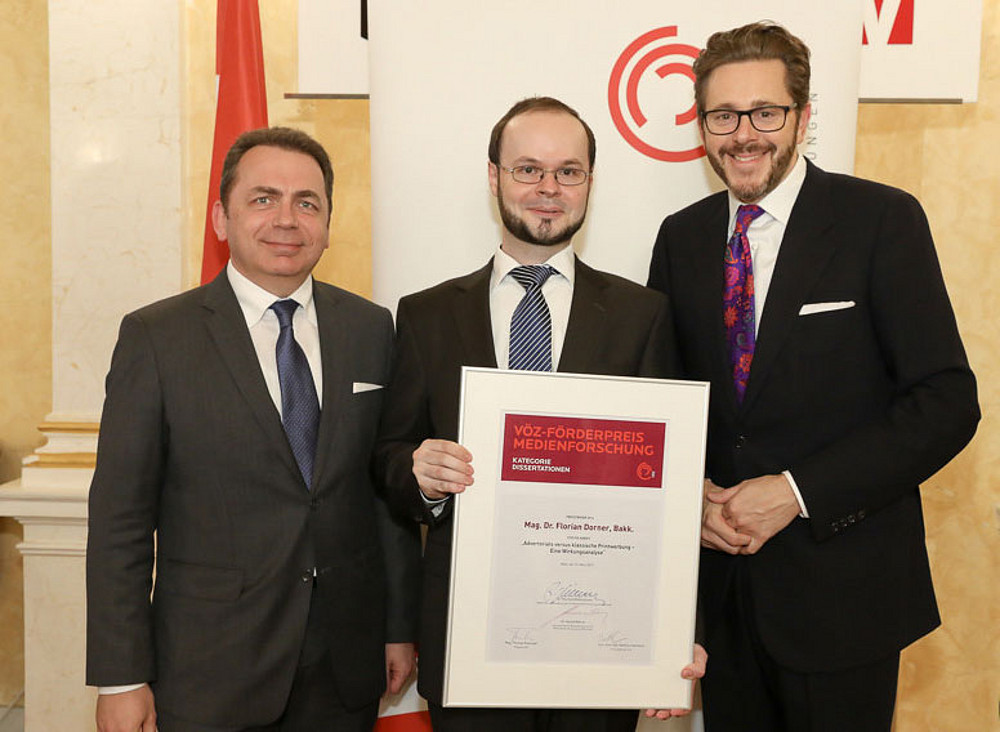
Florian Dorner (Mitte) erhielt den VÖZ-Förderpreis von Staatssekretär Harald Mahrer (r.). Dorners Dissertations-Betreuer Thomas Foscht gratulierte. Foto: Katharina Schiffl/leadersnet.at.

Florian Dorner (Mitte) erhielt den VÖZ-Förderpreis von Staatssekretär Harald Mahrer (r.). Dorners Dissertations-Betreuer Thomas Foscht gratulierte. Foto: Katharina Schiffl/leadersnet.at.

Absolvent Florian Dorner erhält VÖZ-Förderpreis Medienforschung für die beste Dissertation

Der Verband Österreichischer Zeitungen, kurz VÖZ, vergibt einmal jährlich den Förderpreis Medienforschung für hervorragende Master- und Diplomarbeiten sowie für Dissertationen und Habilitationen. Inhaltlich kann es dabei zum Beispiel um die Beziehung zwischen Medien/Journalismus und der Gesellschaft gehen, um Journalistik und Nachrichtenwesen oder um Medienmarken und -marketing. Letzterem Thema widmete Dr. Florian Dorner seine Dissertation mit dem Titel „Advertorials versus klassische Printwerbung – eine Wirkungsanalyse“, die er am Institut für Marketing der Uni Graz unter Betreuung von Univ.-Prof. Dr. Thomas Foscht verfasst hatte. Am 15. März 2017 erhielt er dafür den mit 4.000 Euro dotierten VÖZ-Förderpreis Medienforschung in der Kategorie Dissertationen im Audienzsaal des Bundesministeriums für Wissenschaft und Forschung von Staatssekretär Harald Mahrer und VÖZ-Präsident Thomas Kralinger. Der Preis wurde zum insgesamt siebten Mal vergeben.


In seiner Dissertation befasste sich Dorner mit der Frage, welche Unterschiede es zwischen klassischer Printwerbung und modernen Advertorials, also Einschaltungen, die redaktionell bearbeitete Texte und Werbung kombinieren, gibt. Im Speziellen beleuchtete Dorner Printwerbung und Advertorials zum Thema „Regionalität von Lebensmitteln“. „Bei einer Gegenüberstellung beider Formate zeigte sich, dass Advertorials drei Dinge viel stärker auf positive Weise beeinflussen können: Das Image des werbenden Unternehmens, die Produktbewertung sowie die Absicht zur Weiterempfehlung“, erklärt Dorner. „Das bedeutet aber nicht, dass gleichzeitig auch die Kaufkraft durch Advertorials steigt“, betont der Uni-Graz-Absolvent. Denn die klassische Printwerbung punktet bei den ProbandInnen mit einem weitaus höheren Wiederkennungswert. „Außerdem ist bewiesen, dass diese Form bei einmaliger Schaltung als glaub- und vertrauenswürdiger wahrgenommen wird“, so Dorner. Der 32-Jährige plädiert daher in seiner Arbeit für eine individuell ausgewogene sowie auf das Produkt abgestimmte Mischung aus beiden Werbeformaten.


Dorner, gebürtiger Grazer, studierte von 2008 bis 2009 Betriebswirtschaft (Management and International Business) an der Karl-Franzens-Universität, ein Studium, das er mit Auszeichnung abschloss. Nahtlos ging er in das Doktoratsstudium der Sozial- und Wirtschaftswissenschaften über, das er 2015 abschloss. Von 2010 bis 2014 war er auch Assistent am Institut für Marketing. Heute ist er dort nur mehr als externer Lektor tätig – hauptberuflich beschäftigt er sich mit dem strategischen Risikomanagement der Steiermärkischen Bank.


Bei der Preisverleihung wurden auch Bennet Thilo Dietrichs (Kategorie Master-/Diplomarbeiten) und Viktoria Tröscher (Hannes-Haas-Nachwuchspreis) mit jeweils mit 2.000 Euro dotierten Preisen ausgezeichnet.

created by Gerhild Kastrun

Related news

Studying at the University of Graz: How to enrol

Ready for a new chapter in your life with the start of your studies at the University of Graz in the winter semester 2026/27? Here you will find information on deadlines, admission procedures, registration, and everything else you need to successfully start your studies in the fall.

Interpreting data: Why studies sometimes get it wrong

Hilmar Brohmer and Ziva Korda from the Institute of Psychology, together with 500 international colleagues, have re-evaluated a hundred scientific publications and have often come to different conclusions.

Crystal-clear: AI method revolutionises solar observation

The Sun makes life on Earth possible. However, its magnetic fields can also cause massive disruption. This makes it all the more important to gain a better understanding of the processes taking place on our nearest star. A research team from the University of Graz and the High Altitude Observatory in Boulder (USA) has succeeded in doing just that. The astrophysicists have developed an AI-supported method that makes even the smallest structures on the Sun visible. The scientists are convinced that this will bring about a lasting change in solar observation and that the new method can be used for the planned European Solar Telescope.

Long Night of Research: How many languages are there in the world?

From a linguistic perspective, there are worlds of difference between Bern, Berlin and Vienna. A dialect impersonator will demonstrate live just how varied German can sound. How many languages are there in the world? What are their distinctive features? Which of these are spoken in Austria? These and other questions will be answered during the Long Night of Research at the University of Graz: on Friday, 24 April 2025, from 5 pm to 11 pm, in the University Library. Visitors can immerse themselves in the diversity of languages without travelling far by taking part in a quiz at the station.

Begin of page section:
Additional information:

University of Graz
Universitaetsplatz 3
8010 Graz
Austria
  • Contact
  • Web Editors
  • Moodle
  • UNIGRAZonline
  • Imprint
  • Data Protection Declaration
  • Accessibility Declaration
Weatherstation
Uni Graz

End of this page section. Go to overview of page sections

End of this page section. Go to overview of page sections

Begin of page section:

End of this page section. Go to overview of page sections