Begin of page section:
Page sections:

  • Go to contents (Accesskey 1)
  • Go to position marker (Accesskey 2)
  • Go to main navigation (Accesskey 3)
  • Go to sub navigation (Accesskey 4)
  • Go to additional information (Accesskey 5)
  • Go to page settings (user/language) (Accesskey 8)
  • Go to search (Accesskey 9)

End of this page section. Go to overview of page sections

Begin of page section:
Page settings:

English en
Deutsch de
Search
Login

End of this page section. Go to overview of page sections

Begin of page section:
Search:

Search for details about Uni Graz
Close

End of this page section. Go to overview of page sections


Search

Begin of page section:
Main navigation:

Page navigation:

  • University

    University
    • About the University
    • Organisation
    • Faculties
    • Library
    • Working at University of Graz
    • Campus
    Developing solutions for the world of tomorrow - that is our mission. Our students and our researchers take on the great challenges of society and carry the knowledge out.
  • Research Profile

    Research Profile
    • Our Expertise
    • Research Questions
    • Research Portal
    • Promoting Research
    • Research Transfer
    • Ethics in Research
    Scientific excellence and the courage to break new ground. Research at the University of Graz creates the foundations for making the future worth living.
  • Studies

    Studies
    • Prospective Students
    • Students
  • Community

    Community
    • International
    • Location
    • Research and Business
    • Alumni
    The University of Graz is a hub for international research and brings together scientists and business experts. Moreover, it fosters the exchange and cooperation in study and teaching.
  • Spotlight
Topics
  • Sustainable University
  • Researchers answer
  • Work for us
Close menu

End of this page section. Go to overview of page sections

Begin of page section:
You are here:

University of Graz News AI in schools: Maria Bertel drafts legal guidelines for teachers

End of this page section. Go to overview of page sections

Wednesday, 04 March 2026

AI in schools: Maria Bertel drafts legal guidelines for teachers

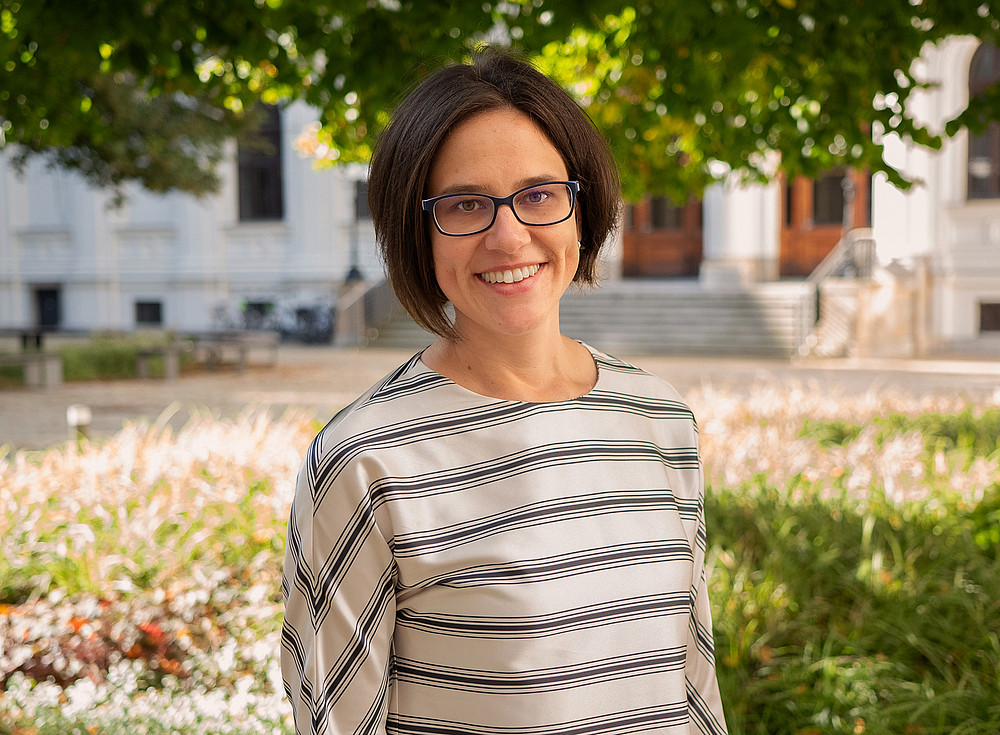
Portrait of Maria Bertel in the courtyard of the main building of the University of Graz

How can, may and should AI be used in schools? Legal expert Maria Bertel has compiled a guide with answers to legal questions on this topic. Photo: University of Graz/Radlinger

The legal expert and her team analysed the legal situation regarding the use of artificial intelligence in education as part of an EU project and answered open questions from practice.

Researching facts, compiling exercise material or even marking homework: there are many areas of application for AI in schools. Which of these are actually permitted? Where are the pitfalls? And what obligations do pupils and teachers have when using ChatGPT & Co.? Lawyer Maria Bertel and her team, supported by research manager Maddalena Vivona, have addressed these questions.

"There are several legal principles that must be taken into account when using AI in education: for example, the EU's AI Act, the General Data Protection Regulation and – something that is rarely considered – children's rights," summarises Maria Bertel from the Institute for Public Law and Political Science. Together with Evelyne Putz and Julian Priebsch, she has combed through the legal situation in the European Union as part of the EU-funded EducationalAI project and summarised the relevant points in a guide for teachers and managers in the education sector. "The AI Act already makes important provisions in this regard. Certain applications, such as assessing performance exclusively through artificial intelligence, are classified as high risk," the researcher clarifies. 

If Copilot, Gemini or other AI systems are used in class or for homework, the protection of personal data must be taken into account. Not everyone is aware of this. The fact that a German teacher can become the operator of an AI system when she sets a research task is hardly obvious without specialist legal knowledge. "So we have clarified many legal terms that teachers are usually not so familiar with," explains Bertel. The lawyers sought the expertise of ethicists, didacticians and educators in order to take into account the needs of everyday practice. The guide, which contains selected EU legal principles, is available for free download.

Together with Evelyne Putz, Maria Bertel is now creating a counterpart that focuses on Austrian law. This is expected to be completed in early summer this year. "We hope that this will help to reduce legal uncertainties surrounding the use of artificial intelligence in schools," says the lawyer. She recommends that individual educational institutions work with young people, parents and management to develop guidelines. The researcher has no doubt that the technology should be used in educational institutions. A chatbot, for example, could be a good learning tutor. However, it is important to accompany the children and make it clear to them that they are communicating with a machine. 

The researcher welcomes Education Minister Christoph Wiederkehr's initiative to introduce AI as a subject in schools: "Digital skills and knowledge about how these tools work should definitely be taught. This applies to all subjects. I don't want to judge whether a new subject needs to be introduced for this purpose."

created by Dagmar Eklaude

Related news

Cosmetics in the environment: University of Graz proves danger to ants

Titanium dioxide, which is found in cosmetics, for example, is increasingly entering the environment in the form of nanoparticles. This could also put insects at risk. If ants ingest the substance in combination with the pesticide glyphosate, it disturbs the development of their offspring. Scientists at the University of Graz are drawing attention to the negative consequences of this toxic cocktail.

Varied and healthy: studies move

Exercise is the ideal way to balance out everyday stress, prevent illness and keep fit. Why this is the case, how to do it properly and what role human bodily functions and psychology play can be studied at the University of Graz.

Religious scholar Theresia Heimerl: Fasting as a spiritual boost

Fasting is not just a strategy for losing weight – it is a ritual dating back thousands of years with spiritual and evolutionary roots that has positive effects on the body. At the University of Graz, religious scholar Theresia Heimerl is investigating why fasting is a "spiritual boost".

Does fasting make us younger, Tobias Eisenberg?

Not eating is currently on everyone's lips. It's Lent, and the next swimming season is just around the corner. This phase is equated with weight and calorie reduction. Biochemist and molecular biologist Tobias Eisenberg is investigating how short-term food deprivation – a very common occurrence for our ancestors – affects the organism.

Begin of page section:
Additional information:

University of Graz
Universitaetsplatz 3
8010 Graz
Austria
  • Contact
  • Web Editors
  • Moodle
  • UNIGRAZonline
  • Imprint
  • Data Protection Declaration
  • Accessibility Declaration
Weatherstation
Uni Graz

End of this page section. Go to overview of page sections

End of this page section. Go to overview of page sections

Begin of page section:

End of this page section. Go to overview of page sections