Begin of page section:
Page sections:

  • Go to contents (Accesskey 1)
  • Go to position marker (Accesskey 2)
  • Go to main navigation (Accesskey 3)
  • Go to sub navigation (Accesskey 4)
  • Go to additional information (Accesskey 5)
  • Go to page settings (user/language) (Accesskey 8)
  • Go to search (Accesskey 9)

End of this page section. Go to overview of page sections

Begin of page section:
Page settings:

English en
Deutsch de
Search
Login

End of this page section. Go to overview of page sections

Begin of page section:
Search:

Search for details about Uni Graz
Close

End of this page section. Go to overview of page sections


Search

Begin of page section:
Main navigation:

Page navigation:

  • University

    University
    • About the University
    • Organisation
    • Faculties
    • Library
    • Working at University of Graz
    • Campus
    Developing solutions for the world of tomorrow - that is our mission. Our students and our researchers take on the great challenges of society and carry the knowledge out.
  • Research Profile

    Research Profile
    • Our Expertise
    • Research Questions
    • Research Portal
    • Promoting Research
    • Research Transfer
    • Ethics in Research
    • Commission for Scientific Integrity
    Scientific excellence and the courage to break new ground. Research at the University of Graz creates the foundations for making the future worth living.
  • Studies

    Studies
    • Prospective Students
    • Students
  • Community

    Community
    • International
    • Location
    • Research and Business
    • Alumni
    The University of Graz is a hub for international research and brings together scientists and business experts. Moreover, it fosters the exchange and cooperation in study and teaching.
Topics
  • Sustainable University
  • Researchers answer
  • Work for us
Close menu

End of this page section. Go to overview of page sections

Begin of page section:
You are here:

University of Graz News Journalistische Verantwortung

End of this page section. Go to overview of page sections

Thursday, 18 May 2017

Journalistische Verantwortung

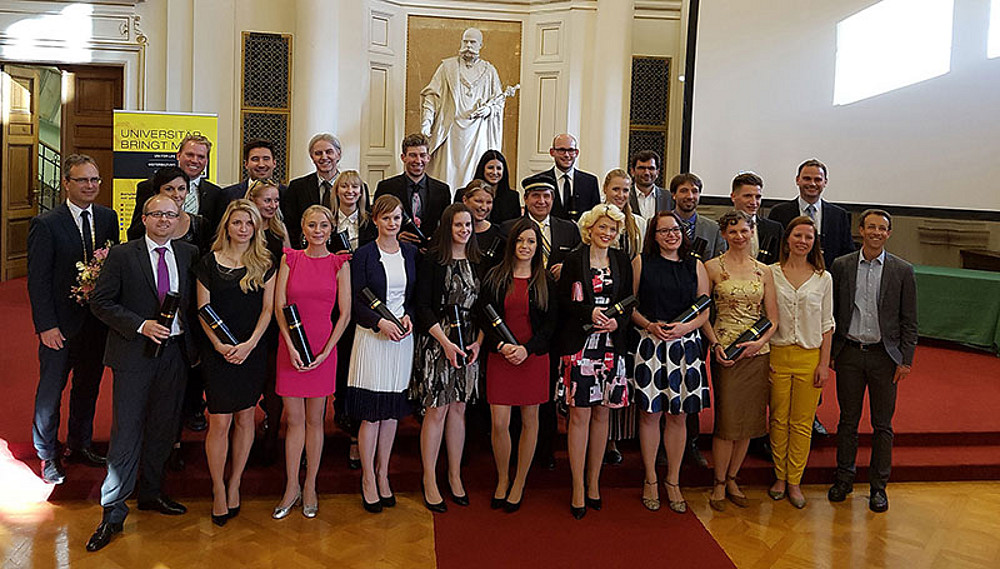
Die AbsolventInnen des letzten Medienlehrgangs dieser Art in der Aula der Uni Graz mit Vizerektor Peter Riedler (ganz links) und UNI for Life-Geschäftsführer Stephan Witzel (ganz rechts). Foto: UNI for LIFE/Meszaros.

Die AbsolventInnen des letzten Medienlehrgangs dieser Art in der Aula der Uni Graz mit Vizerektor Peter Riedler (ganz links) und UNI for Life-Geschäftsführer Stephan Witzel (ganz rechts). Foto: UNI for LIFE/Meszaros.

Abschlussfeier des letzten Medienlehrgangs dieser Art

Am 17. Mai 2017 fand der Medienlehrgang der Universität Graz, der letzte Medienlehrgang dieser Art, in der Aula der Karl-Franzens-Universität seinen feierlichen Abschluss. Die letzten 30 AbsolventInnen erhielten nach der Begrüßung durch Vizerektor Dr. Peter Riedler und den Festreden von Landesrat Mag. Christopher Drexler und Ö1-Journalmoderatorin Mag. Cornelia Vospernik im Rahmen der Abschlussveranstaltung ihre Zertifikate. In ihrer Schlussrede, der Showeinlage durch Einrad-WM-Medaillenträger Gerald Rosenkranz und einer Filmpräsentation, stellten die AbsolventInnen bereits ihr Talent als Medienprofis unter Beweis.


Der Medienlehrgang kann auf eine lange Tradition zurückblicken. Vor über 40 Jahren von Univ.-Prof. Dr. Hermann Baltl als Medienkundlicher Lehrgang begründet, entstand er aus der Überlegung heraus, den AbsolventInnen eine mediale Zusatzqualifikation zu geben. Unter den nachfolgenden Lehrgangsleitern Univ.-Prof. DDr. Gerald Schöpfer (1995-2004) und Univ.-Prof. Dr. Dr. h.c. Stefan Karner (2004-2017) wurde der Medienlehrgang nach und nach inhaltlich erweitert und konnte auf Wunsch der Studierenden schließlich mit einem Master abgeschlossen werden.
Namhafte ReferentInnen sorgten stets für hohe Qualität und Praxisbezug: etliche SpitzenjournalistInnen Österreichs, alle Chefredakteure der steirischen Tageszeitungen, wie Fritz Csoklich, Josef Riedler und Christoph Biro, des ORF, wie Gerhard Koch, der Antenne, die KorrespondentInnen der ARD und des FAZ, Susanne Glass und Reinhard Olt, AuslandskorrespondentInnen wie Christian Wehrschütz oder Sonja Sagmeister, ModeratorInnen wie Ingrid Thurnher oder Ernest Bornemann, Fernsehstars wie Hugo Portisch, viele führende RedakteurInnen und ExpertInnen, wie Martin Piaty, Stefan Schoeller, Wolfgang Lampert, Rudolf Bretschneider oder Manfred Prisching.


In den rund 40 Jahren haben rund 400 AbsolventInnen des Medienlehrgangs als Medienfachfrau oder Medienfachmann bzw. als Master abgeschlossen. Viele von ihnen arbeiten heute in Redaktionen, als JournalistInnen, als PressesprecherInnen oder KommunikatorInnen. Viele haben große Karrieren in Medienberufen gemacht, wie etwa Claudia Reiterer, Franz Neger, Gerald Schwaiger oder Thomas Cik.
Auf der Abschlussfeier des Medienlehrgangs wurde nochmal auf die journalistische Verantwortung hingewiesen, die in Zeiten von Fake-News größer denn je ist. Die AbsolventInnen sind sich dieser Verantwortung und Aufgabe bewusst und wollen in ihrer zukünftigen journalistischen Tätigkeit versuchen das "von der Öffentlichkeit verloren gegangene Vertrauen wieder aufzubauen".


Auch wenn dieser Medienlehrgang der letzte seiner Art war, so steht mit einem neuen Universitätskurs zum Themenfeld der Kommunikation schon ein Nachfolger in den Startlöchern, der von UNI for LIFE demnächst angeboten wird.

created by Christoph Meszaros & Gerhild Kastrun

Related news

Complying with the norm: Why Do Standards Shape Our Lives, Elisabeth Staudegger?

Standards determine whether a sheet of paper fits in a printer or whether a charging plug can power multiple devices. These standards shape our everyday lives. But who actually sets these standards? Where are the weaknesses, and how could science help to improve them? Elisabeth Staudegger, Head of the ‘Law and IT’ Department at the Institute for Legal Foundations at the University of Graz, host the Academic Standards Day on 16 June. Here she relays how sciences can contribute to the topic of standardisation and reveals her personal favourite standard.

More body awareness than a culture war

In Italy, sex education lessons will in future only be permitted with parental consent, and will be banned entirely in nurseries and primary schools. At the same time, Pride Month highlights why knowledge about the body, relationships, boundaries and diversity is important for young people. A study by the University of Graz shows how important knowledge about the body, contraception, relationship skills and protection against violence is

Will Austria win the World Cup? Mathematician reveals calculation method

Michael Fischer uses the football tournament as a practical example for highschool lessons.

Survival strategies: How plants respond to drought

According to Geosphere Austria, this spring was the driest in Austria since records began around 170 years ago. The low rainfall put particular pressure on the agricultural sector. And climate change is set to make the situation even worse in the coming decades. We asked Johannes Liesche, a professor at the Department of Biology at the University of Graz, how plants react to water shortages and how they survive periods of drought.

Begin of page section:
Additional information:

University of Graz
Universitaetsplatz 3
8010 Graz
Austria
  • Contact
  • Web Editors
  • Moodle
  • UNIGRAZonline
  • Imprint
  • Data Protection Declaration
  • Accessibility Declaration
Weatherstation
Uni Graz

End of this page section. Go to overview of page sections

End of this page section. Go to overview of page sections

Begin of page section:

End of this page section. Go to overview of page sections