Begin of page section:
Page sections:

  • Go to contents (Accesskey 1)
  • Go to position marker (Accesskey 2)
  • Go to main navigation (Accesskey 3)
  • Go to sub navigation (Accesskey 4)
  • Go to additional information (Accesskey 5)
  • Go to page settings (user/language) (Accesskey 8)
  • Go to search (Accesskey 9)

End of this page section. Go to overview of page sections

Begin of page section:
Page settings:

English en
Deutsch de
Search
Login

End of this page section. Go to overview of page sections

Begin of page section:
Search:

Search for details about Uni Graz
Close

End of this page section. Go to overview of page sections


Search

Begin of page section:
Main navigation:

Page navigation:

  • University

    University
    • About the University
    • Organisation
    • Faculties
    • Library
    • Working at University of Graz
    • Campus
    Developing solutions for the world of tomorrow - that is our mission. Our students and our researchers take on the great challenges of society and carry the knowledge out.
  • Research Profile

    Research Profile
    • Our Expertise
    • Research Questions
    • Research Portal
    • Promoting Research
    • Research Transfer
    • Ethics in Research
    • Commission for Scientific Integrity
    Scientific excellence and the courage to break new ground. Research at the University of Graz creates the foundations for making the future worth living.
  • Studies

    Studies
    • Prospective Students
    • Students
  • Community

    Community
    • International
    • Location
    • Research and Business
    • Alumni
    The University of Graz is a hub for international research and brings together scientists and business experts. Moreover, it fosters the exchange and cooperation in study and teaching.
  • Spotlight
Topics
  • Sustainable University
  • Researchers answer
  • Work for us
Close menu

End of this page section. Go to overview of page sections

Begin of page section:
You are here:

University of Graz News Insolvenzen im europäischen Binnenmarkt
End of this page section. Go to overview of page sections

Wednesday, 05 October 2016

Insolvenzen im europäischen Binnenmarkt

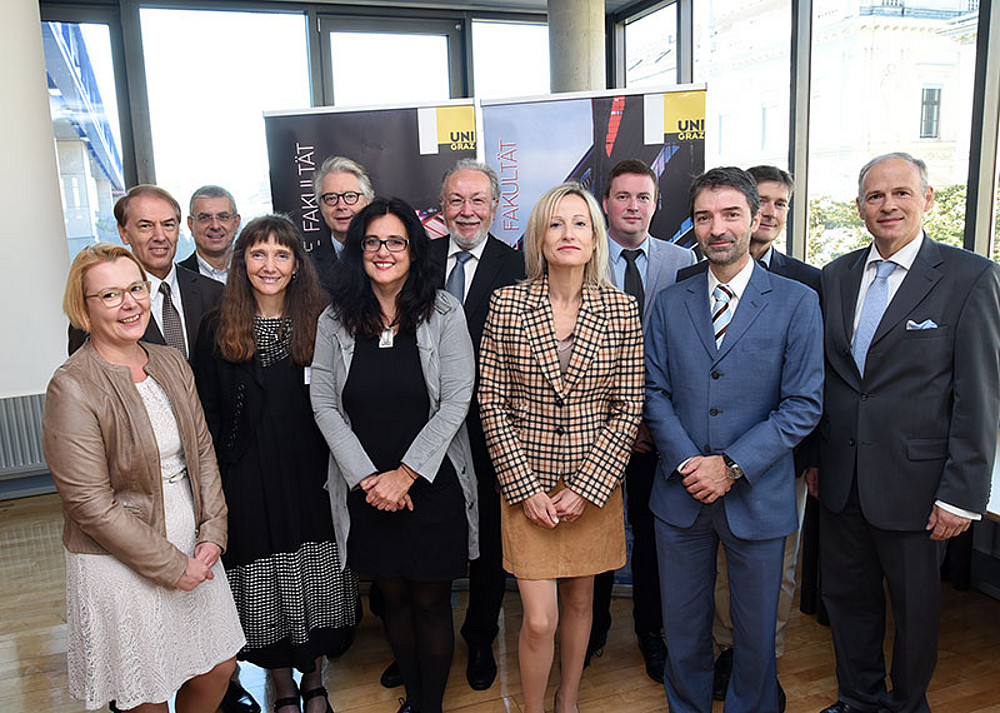
Birgit Scheider, Franz Mohr, Dr. Andreas Konecny, Jasnica Garasic, Hans-Georg Kantner, Kathrin Poltsch, Wolfgang Jelinek, Bettina Nunner-Krautgasser, Thomas Garber, Robert Hänel, Peter Dax und Axel Reckenzaun (v.l.). Foto: Uni Graz/Tzivanopoulos.

Birgit Scheider, Franz Mohr, Dr. Andreas Konecny, Jasnica Garasic, Hans-Georg Kantner, Kathrin Poltsch, Wolfgang Jelinek, Bettina Nunner-Krautgasser, Thomas Garber, Robert Hänel, Peter Dax und Axel Reckenzaun (v.l.). Foto: Uni Graz/Tzivanopoulos.

Das Grazer Forum zum Zivilverfahren ging in die vierte Runde

Zum Thema „Grenzüberschreitende Insolvenzen im europäischen Binnenmarkt – die neue EuInsVO“ fand am 29. Und 30. September 2016 das insgesamt vierte Grazer Forum zum Zivilverfahren an der Karl-Franzens-Universität statt. Die ab 26.6.2017 geltende Verordnung wurde von renommierten FachvertreterInnen aus Wissenschaft und Praxis ausführlich erörtert und analysiert. Untersucht wurden etwa die Zuständigkeit für die Durchführung eines Insolvenzverfahrens sowie Fragen im Zusammenhang mit Konzerninsolvenzen.

Zu den Vortragenden zählten:

Prof. Dr. Klaus Pannen, der die Vorarbeiten zur EuInsVO darstellte,
Ass.-Prof. Dr. Thomas Garber, der zum Anwendungsbereich der EuInsVO referierte,
Univ.-Prof. Dr. Andreas Konecny, der Fragen der Zuständigkeit und ihre Prüfung behandelte,
Univ.-Ass. Dr. Birgit Schneider, die zu Fragen der insolvenznahen Verfahren referierte,
Prof. Dr. Christian Berger, der zur Insolvenzmasse vortrug,
HR Univ.-Prof. Dr. Matthias Neumayr, der ausgewählte Fragen zum anwendbaren Recht behandelte,
Dr. Hans-Georg Kantner, der sich in seinem Vortrag der Unterrichtung der Gläubiger und der Anmeldung ihrer Forderungen widmete,
Prof. Dr. Jasnica Garasic, die die Aufrechnung in der Insolvenz behandelte,
Dr. Robert Hänel, der zu den Befugnissen der Insolvenzverwalters vortrug,
Ass.-Prof. Dr. Andreas Geroldinger, der sich der Kommunikation und Koordination widmete,
Dr. Franz Mohr, Hon.-Prof. Dr. Axel Reckenzaun und Mag. Kathrin Poltsch, die das Thema der Zusicherungen von Vermeidung von Sekundärinsolvenzverfahren darstellten,
Dr. Mario Leistentritt, der sich der Anerkennung von Insolvenzentscheidungen widmete,
Dr. Clemens Jaufer, der zu Fragen zu Konzerninsolvenzen vortrug,
und Prof. Dr. Christoph Paulus, der die Frage behandelte, was die EuInsVO von der Abwicklungsrichtlinie BRRD lernen kann.

Durch die Tagung führte Univ.-Prof. Dr. Bettina Nunner-Krautgasser, Em. Univ.-Prof. Dr. Wolfgang Jelinek sowie Dr. Gabriele Seyffertitz, Insolvenzrichterin des LGZ Graz. 

Die Ergebnisse werden in einem im Verlag Manz erscheinenden Tagungsband veröffentlicht. Die Veranstaltung fand in Kooperation zwischen dem Institut für Zivilverfahrensrecht und Insolvenzrecht unter der Leitung von Univ.-Prof. Dr. Bettina Nunner-Krautgasser und der Rechtsanwaltskanzlei Scherbaum Seebacher statt.


created by Thomas Garber & Gerhild Kastrun

Related news

Studying at the University of Graz: How to enrol

Ready for a new chapter in your life with the start of your studies at the University of Graz in the winter semester 2026/27? Here you will find information on deadlines, admission procedures, registration, and everything else you need to successfully start your studies in the fall.

Interpreting data: Why studies sometimes get it wrong

Hilmar Brohmer and Ziva Korda from the Institute of Psychology, together with 500 international colleagues, have re-evaluated a hundred scientific publications and have often come to different conclusions.

Crystal-clear: AI method revolutionises solar observation

The Sun makes life on Earth possible. However, its magnetic fields can also cause massive disruption. This makes it all the more important to gain a better understanding of the processes taking place on our nearest star. A research team from the University of Graz and the High Altitude Observatory in Boulder (USA) has succeeded in doing just that. The astrophysicists have developed an AI-supported method that makes even the smallest structures on the Sun visible. The scientists are convinced that this will bring about a lasting change in solar observation and that the new method can be used for the planned European Solar Telescope.

Long Night of Research: How many languages are there in the world?

From a linguistic perspective, there are worlds of difference between Bern, Berlin and Vienna. A dialect impersonator will demonstrate live just how varied German can sound. How many languages are there in the world? What are their distinctive features? Which of these are spoken in Austria? These and other questions will be answered during the Long Night of Research at the University of Graz: on Friday, 24 April 2025, from 5 pm to 11 pm, in the University Library. Visitors can immerse themselves in the diversity of languages without travelling far by taking part in a quiz at the station.

Begin of page section:
Additional information:

University of Graz
Universitaetsplatz 3
8010 Graz
Austria
  • Contact
  • Web Editors
  • Moodle
  • UNIGRAZonline
  • Imprint
  • Data Protection Declaration
  • Accessibility Declaration
Weatherstation
Uni Graz

End of this page section. Go to overview of page sections

End of this page section. Go to overview of page sections

Begin of page section:

End of this page section. Go to overview of page sections