Begin of page section:
Page sections:

  • Go to contents (Accesskey 1)
  • Go to position marker (Accesskey 2)
  • Go to main navigation (Accesskey 3)
  • Go to sub navigation (Accesskey 4)
  • Go to additional information (Accesskey 5)
  • Go to page settings (user/language) (Accesskey 8)
  • Go to search (Accesskey 9)

End of this page section. Go to overview of page sections

Begin of page section:
Page settings:

English en
Deutsch de
Search
Login

End of this page section. Go to overview of page sections

Begin of page section:
Search:

Search for details about Uni Graz
Close

End of this page section. Go to overview of page sections


Search

Begin of page section:
Main navigation:

Page navigation:

  • University

    University
    • About the University
    • Organisation
    • Faculties
    • Library
    • Working at University of Graz
    • Campus
    Developing solutions for the world of tomorrow - that is our mission. Our students and our researchers take on the great challenges of society and carry the knowledge out.
  • Research Profile

    Research Profile
    • Our Expertise
    • Research Questions
    • Research Portal
    • Promoting Research
    • Research Transfer
    • Ethics in Research
    Scientific excellence and the courage to break new ground. Research at the University of Graz creates the foundations for making the future worth living.
  • Studies

    Studies
    • Prospective Students
    • Students
  • Community

    Community
    • International
    • Location
    • Research and Business
    • Alumni
    The University of Graz is a hub for international research and brings together scientists and business experts. Moreover, it fosters the exchange and cooperation in study and teaching.
  • Spotlight
Topics
  • Our digital Advent calendar
  • Sustainable University
  • Researchers answer
  • Work for us
Close menu

End of this page section. Go to overview of page sections

Begin of page section:
You are here:

University of Graz News How much emotion does morality need? Ralf Lutz explores the psychological side of ethics

End of this page section. Go to overview of page sections

Wednesday, 06 November 2024

How much emotion does morality need? Ralf Lutz explores the psychological side of ethics

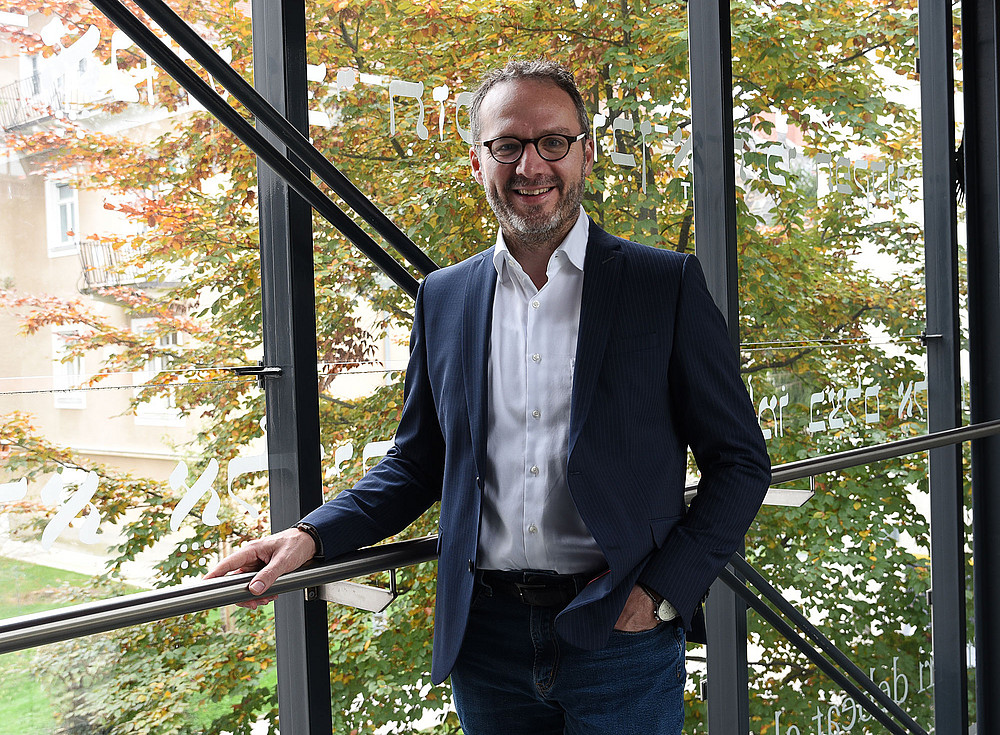
Ralf Lutz in front of a glass wall, behind it a tree with autumn leaves ©University of Graz/Pichler

The theologian Ralf Lutz also worked as a psychotherapist for many years. He is interested in the psychological side of ethics and morality. Photo: University of Graz/Pichler

What is good and what is bad? Due to our upbringing and our own insight, we usually know which values we should be guided by. But why do we still repeatedly fail to act accordingly? What role do our feelings play in this? Ralf Lutz deals with these questions in his research. The professor of moral theology and doctor of psychology wants to bring the two disciplines closer together. "Ethics helps us to find out what is right and wrong. But in order to understand how we can live according to these principles, we need moral psychology," Lutz is convinced.

"The idea that we always act accordingly when we know what we should do is psychologically and ethically naive," says Ralf Lutz, citing our environmental behaviour as an example: "This is often a motivational problem. For example, because it is more convenient to take the car instead of the bus. Emotions are also important. People love their vehicle because it gives them a sense of independence, among other things."
The theologian, who also worked as a psychotherapist for many years, is interested in the psychological side of ethics and morality. "We should ask ourselves what is necessary so that people can and want to do what they are supposed to do. How they can experience what is considered valuable in a society or personally as valuable. That is moral psychology," explains the researcher. "This also deals with whether a person who has committed a moral offence or even a crime can come to the realisation that they have become guilty, and whether they are capable of empathising with the victims," the scientist describes an example.

Feeling in order to learn morality
Do we first have to feel what we describe as valuable in order to realise it? This question has long been discussed in ethics. Ralf Lutz is particularly interested in it. He is convinced: "We need to feel in order to learn morality." This is particularly true when it comes to raising children. "If I don't think it's unfair for someone to take the seat of a physically disabled person on the bus, then I won't be able to act fairly in such a situation," explains the researcher.

Once moral duties have been internalised, people do not need to feel the need to act accordingly again and again. However, Lutz believes that emotions are becoming increasingly important as a motivation for ethical behaviour, especially in the present day, when traditional values are increasingly being questioned, be it due to the change in gender relations or the loss of religious convictions. "Today, we ask far fewer questions about God, but all people ask questions about meaning: How do I lead a good, valuable life? What standards do I use to orientate myself? This shows particularly well that we need to combine ethics and psychology," says the scientist. He would like to further develop and anchor this field of research, which he already pursued at the University of Tübingen, in Graz.

Dying of one's own free will
One topic that the theologian is currently looking at more closely is assisted suicide. In Austria, this form of euthanasia has been permitted to be used under certain conditions since the beginning of 2022. One condition is that the person who wishes to end their life must be able to act freely and responsibly. "But what does that actually mean?" asks Lutz, who knows from experience: "The heroic idea that we are completely free to decide in favour of a certain death is often a construct." Dying is often a passive process. "We ethicists simply assume that all people are free to decide. Lawyers, on the other hand, understand freedom to mean that others should not be allowed to control us. The effect is that we talk past each other in public debates," regrets the researcher. In practice, doctors and lawyers currently decide whether a person is free to act responsibly. "But what we actually need is psychology to check whether this is really the case, whether someone has a stable will and is capable of understanding and judgement," says Lutz. He wants to bring experts from the various disciplines and everyday clinical practice into dialogue with each other. "Ethics must learn from practice," Lutz is convinced.

On 21 November 2024, he will be bringing experts to the University of Graz. In the discussion series "Moraltheologie aktuell", Andreas Heller, Professor of Palliative Care and Organisational Ethics at the University of Graz, Alois Birklbauer, Professor of Medical Criminal Law at the University of Linz, and Gerold Muhri, Senior Physician at the palliative care unit of the Elisabethinen Hospital in Graz, will discuss what "the freedom to die" means in assisted suicide.

More information on the lecture and panel discussion "The freedom to die" (German only)


created by Gudrun Pichler

Related news

Chemical Christmas show at the University of Graz: An explosive evening at the Schauspielh

At the beginning of December, the University of Graz transformed the theater into a laboratory: as part of “Chemical Life,” teacher training students staged a chemical Christmas show for Styrian school classes—complete with ethanol rockets, nitrogen snow, and glowing effects. An evening designed to inspire interest in studying chemistry.

Train by train: Koralm railway accelerates exchange between the Universities

Lectures at the University of Klagenfurt in the morning, seminars at the University of Graz in the afternoon: Austria's longest tunnel and a journey time of around 45 minutes make it easy. The Koralm railway increases the speed of networking between the two university locations. The collaboration builds on existing cooperation - for example in the areas of teacher training, Slavic studies and as employers, the universities are well coordinated.

On the trail of the Big Bang: University of Graz receives 1.5 million euros for doctoral programmes

The Austrian Science Fund FWF has selected the Doctoral Programme in Theoretical Particle Physics at the University of Graz for funding from the Doc.funds. Six young scientists will be funded for 3.5 years. They will gain fundamentally new insights into the origins of the world.

From trans women and knee prostheses: sports science prizes awarded

Walking better with a prosthesis, successfully getting rid of excess weight, training more effectively, more fairness for trans people in sport: these were the topics addressed by the students at the University of Graz who were awarded the sports science prizes for their Master's theses on 3 December 2025.

Begin of page section:
Additional information:

University of Graz
Universitaetsplatz 3
8010 Graz
Austria
  • Contact
  • Web Editors
  • Moodle
  • UNIGRAZonline
  • Imprint
  • Data Protection Declaration
  • Accessibility Declaration
Weatherstation
Uni Graz

End of this page section. Go to overview of page sections

End of this page section. Go to overview of page sections

Begin of page section:

End of this page section. Go to overview of page sections