Begin of page section:
Page sections:

  • Go to contents (Accesskey 1)
  • Go to position marker (Accesskey 2)
  • Go to main navigation (Accesskey 3)
  • Go to sub navigation (Accesskey 4)
  • Go to additional information (Accesskey 5)
  • Go to page settings (user/language) (Accesskey 8)
  • Go to search (Accesskey 9)

End of this page section. Go to overview of page sections

Begin of page section:
Page settings:

English en
Deutsch de
Search
Login

End of this page section. Go to overview of page sections

Begin of page section:
Search:

Search for details about Uni Graz
Close

End of this page section. Go to overview of page sections


Search

Begin of page section:
Main navigation:

Page navigation:

  • University

    University
    • About the University
    • Organisation
    • Faculties
    • Library
    • Working at University of Graz
    • Campus
    Developing solutions for the world of tomorrow - that is our mission. Our students and our researchers take on the great challenges of society and carry the knowledge out.
  • Research Profile

    Research Profile
    • Our Expertise
    • Research Questions
    • Research Portal
    • Promoting Research
    • Research Transfer
    • Ethics in Research
    Scientific excellence and the courage to break new ground. Research at the University of Graz creates the foundations for making the future worth living.
  • Studies

    Studies
    • Prospective Students
    • Students
  • Community

    Community
    • International
    • Location
    • Research and Business
    • Alumni
    The University of Graz is a hub for international research and brings together scientists and business experts. Moreover, it fosters the exchange and cooperation in study and teaching.
  • Spotlight
Topics
  • Our digital Advent calendar
  • Sustainable University
  • Researchers answer
  • Work for us
Close menu

End of this page section. Go to overview of page sections

Begin of page section:
You are here:

University of Graz News Honigbienen

End of this page section. Go to overview of page sections

Thursday, 13 June 2019

Honigbienen

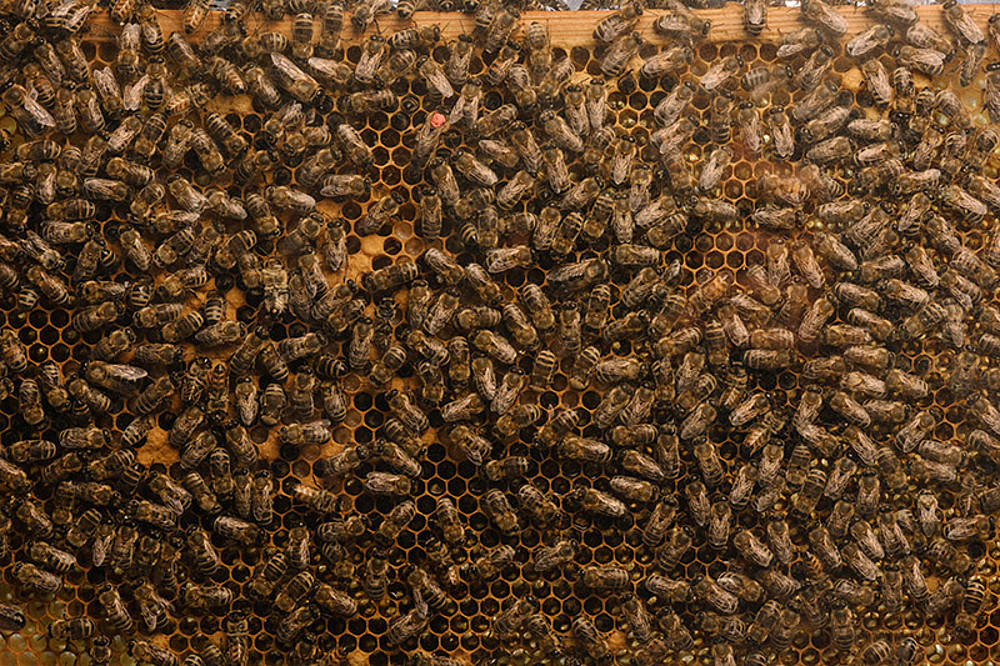
Die Bienenvölker in Österreich haben den letzten Winter im Schnitt recht gut überlebt. Foto: Uni Graz/Kernasenko

Die Bienenvölker in Österreich haben den letzten Winter im Schnitt recht gut überlebt. Foto: Uni Graz/Kernasenko

Forscher der Uni Graz melden durchschnittliche Verluste im vergangenen Winter

Hohe Verluste in Wien, geringe im Burgenland: regional sehr unterschiedlich haben die österreichischen Honigbienen den letzten Winter überdauert. Österreichweit fielen 15 Prozent der Völker aus, wie Robert Brodschneider und Karl Crailsheim vom Institut für Biologie der Universität Graz erhoben haben. Die beiden sammeln diese Daten seit 2007/08 nach international vergleichbaren Standards. „Die Anzahl der Honigbienenvölker, die den Winter nicht überleben, schwankt stark über die Jahre und Regionen“, so die Wissenschafter. Der langfristige Durchschnitt liegt bei 16,5 Prozent – „ein Wert, der in etwa den mittleren Verlusten vieler Europäischer Länder entspricht“, ergänzt Brodschneider.

Die Datenbasis für 2018/19 haben 1500 Imkereien mit mehr als 30 000 Bienenvölkern zur Verfügung gestellt. Hochgerechnet haben rund 15 Prozent der geschätzten 373 000 Völker in ganz Österreich den Winter nicht überlebt. Die geringste Sterblichkeit wurde aus dem Burgenland, Kärnten, Steiermark und Tirol gemeldet. Höhere Raten gab es in den nördlichen Bundesländern sowie in Vorarlberg. „Österreichs Imkerinnen und Imker werden in der Lage sein, die im Winter erlittenen Verluste in den nächsten Wochen auszugleichen und damit die für die Bestäubung so wichtige Honigbienenpopulation zu erhalten“, betont der Biologe.

Die Untersuchung wird auch 2020 im Rahmen des Projekts „Zukunft Biene“ durchgeführt, um langjährige Trends und etwaige neue Bedrohungen rechtzeitig erkennen zu können sowie genauere Ursachen zu identifizieren.


Wintersterblichkeit von Honigbienen 2018/19 (Stand: 11.6.2019):


Verlustrate %

Teilnehmende
Imkereien

Beteiligung der Imkereien (%)

Österreich

15,2

1534

5,5

Burgenland

9,9

35

5,5

Kärnten

11,5

147

4,9

Niederösterreich

17,0

387

8,4

Oberösterreich

17,5

276

3,4

Salzburg

16,2

74

2,9

Steiermark

13,0

218

5,4

Tirol

11,4

141

5,0

Vorarlberg

17,7

178

11,6

Wien

19,6

78

11,0


Wintersterblichkeit von Honigbienen in Österreich seit dem Winter 2007/08:

Jahr

Verlustrate %

2007/08

13,3

2008/09

9,3

2009/10

14,7

2010/11

16,4

2011/12

25,9

2012/13

17,3

2013/14

12,8

2014/15

28,4

2015/16

8,1

2016/17

23,0

2017/18

11,8

2018/19

15,2

Diese Untersuchung wurde nach Standards der internationalen Non-profit-Vereinigung COLOSS (Prevention of honey bee colony losses) durchgeführt. Eine eingehende wissenschaftliche Analyse der Ergebnisse der letztjährigen Studie ist soeben im Journal of Apicultural Research erschienen.

Entwicklung der Bienenhaltung in Österreich seit 1990 (Daten: Biene Österreich):

Jahr

Anzahl BienenhalterInnen

Anzahl Bienenvölker

1990

30.802

457.061

1995

28.447

393.723

2000

25.541

363.967

2003

24.421

327.346

2006

23.000

311.000

2010

24.451

367.583

2011

24.490

368.183

2012

25.099

376.485

2013

25.492

382.638

2014

25.277

376.121

2015

26.063

347.128

2016

26.609

354.080

2017

27.580

353.267

2018

29.745

372.889


Weiterführende Informationen:

www.zukunft-biene.at
www.bienenstand.at
www.coloss.org

Das Projekt „Zukunft Biene“ mit einer Laufzeit bis 2021 wird von der Universität Graz, der Österreichischen Agentur für Gesundheit und Ernährungssicherheit AGES und der Veterinärmedizinischen Universität Wien durchgeführt. Finanziert wird es vom Bundesministerium für Nachhaltigkeit und Tourismus, Biene Österreich, den Bundesländern und aus Eigenmitteln der durchführenden Institutionen.

created by Dagmar Eklaude

Related news

Semester abroad without barriers: University of Graz wins award for promoting inclusion

The University of Graz has been awarded the Internationalization Award for its new inclusion initiative. Students with fewer opportunities now also receive financial support for their semester abroad outside Europe.

Fair distribution: Researchers determine just greenhouse gas budgets for all EU regions

Ten years ago, on 12 December 2015, the Paris Climate Agreement was signed at the UN Climate Conference. In order to limit global warming to well below two degrees, only a certain amount of CO2 may be emitted worldwide. While the focus was originally on national emission targets, more than 200 subnational regions and almost 300 cities have now adopted their own targets. But how many emissions are they fairly entitled to? Researchers at the University of Graz have now developed transparent criteria for fair distribution at the subnational level for the first time and determined corresponding greenhouse gas budgets for all European regions. The paper was published today in the scientific journal Nature Communications.

Chemical Christmas show at the University of Graz: An explosive evening at the Schauspielh

At the beginning of December, the University of Graz transformed the theater into a laboratory: as part of “Chemical Life,” teacher training students staged a chemical Christmas show for Styrian school classes—complete with ethanol rockets, nitrogen snow, and glowing effects. An evening designed to inspire interest in studying chemistry.

Train by train: Koralm railway accelerates exchange between the Universities

Lectures at the University of Klagenfurt in the morning, seminars at the University of Graz in the afternoon: Austria's longest tunnel and a journey time of around 45 minutes make it easy. The Koralm railway increases the speed of networking between the two university locations. The collaboration builds on existing cooperation - for example in the areas of teacher training, Slavic studies and as employers, the universities are well coordinated.

Begin of page section:
Additional information:

University of Graz
Universitaetsplatz 3
8010 Graz
Austria
  • Contact
  • Web Editors
  • Moodle
  • UNIGRAZonline
  • Imprint
  • Data Protection Declaration
  • Accessibility Declaration
Weatherstation
Uni Graz

End of this page section. Go to overview of page sections

End of this page section. Go to overview of page sections

Begin of page section:

End of this page section. Go to overview of page sections