Begin of page section:
Page sections:

  • Go to contents (Accesskey 1)
  • Go to position marker (Accesskey 2)
  • Go to main navigation (Accesskey 3)
  • Go to sub navigation (Accesskey 4)
  • Go to additional information (Accesskey 5)
  • Go to page settings (user/language) (Accesskey 8)
  • Go to search (Accesskey 9)

End of this page section. Go to overview of page sections

Begin of page section:
Page settings:

English en
Deutsch de
Search
Login

End of this page section. Go to overview of page sections

Begin of page section:
Search:

Search for details about Uni Graz
Close

End of this page section. Go to overview of page sections


Search

Begin of page section:
Main navigation:

Page navigation:

  • University

    University
    • About the University
    • Organisation
    • Faculties
    • Library
    • Working at University of Graz
    • Campus
    Developing solutions for the world of tomorrow - that is our mission. Our students and our researchers take on the great challenges of society and carry the knowledge out.
  • Research Profile

    Research Profile
    • Our Expertise
    • Research Questions
    • Research Portal
    • Promoting Research
    • Research Transfer
    • Ethics in Research
    Scientific excellence and the courage to break new ground. Research at the University of Graz creates the foundations for making the future worth living.
  • Studies

    Studies
    • Prospective Students
    • Students
  • Community

    Community
    • International
    • Location
    • Research and Business
    • Alumni
    The University of Graz is a hub for international research and brings together scientists and business experts. Moreover, it fosters the exchange and cooperation in study and teaching.
  • Spotlight
Topics
  • Our digital Advent calendar
  • Sustainable University
  • Researchers answer
  • Work for us
Close menu

End of this page section. Go to overview of page sections

Begin of page section:
You are here:

University of Graz News Hochrangige OSZE-Konferenz

End of this page section. Go to overview of page sections

Wednesday, 15 November 2017

Hochrangige OSZE-Konferenz

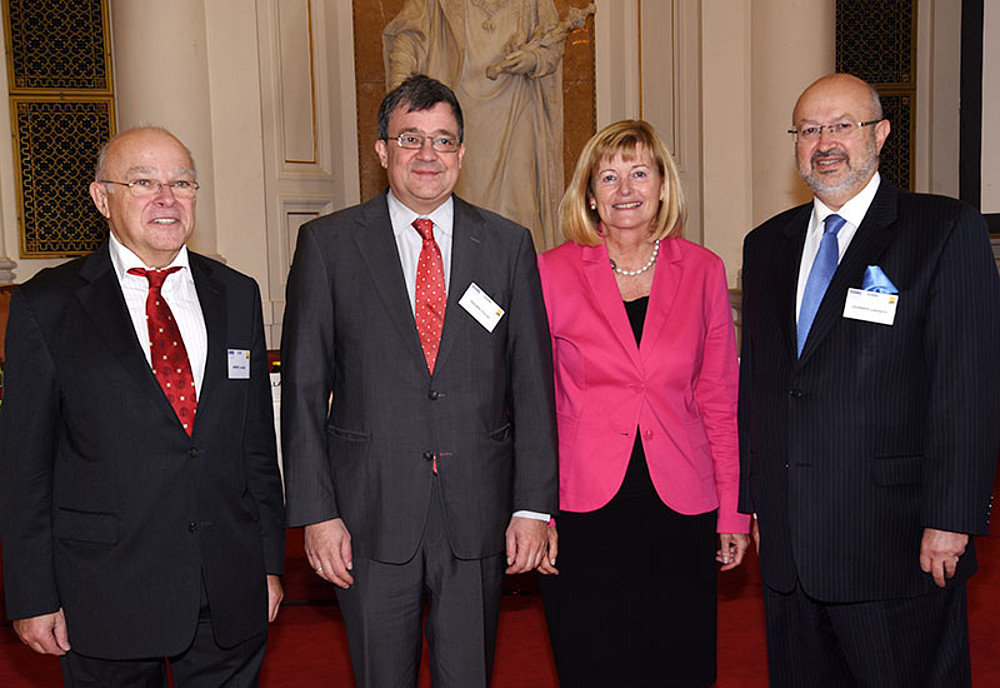
V.l.: Joseph Marko, Botschafter Florian Raunig, Rektorin Christa Neuper und OSZE-Hochkommissar Lamberto Zannier. Foto: Uni Graz/Pichler

V.l.: Joseph Marko, Botschafter Florian Raunig, Rektorin Christa Neuper und OSZE-Hochkommissar Lamberto Zannier bei der Eröffnung der OSZE-Konferenz in der Aula der Uni Graz. Foto: Uni Graz/Pichler

Hochkommissar Lamberto Zannier präsentiert Grazer Empfehlungen über den Zugang zum Recht für Nationale Minderheiten

Zum Schutz nationaler Minderheiten, insbesondere um deren Zugang zum Recht zu verbessern, hat die Organisation für Sicherheit und Zusammenarbeit in Europa (OSZE) neue Richtlinien entwickelt. Zur Erarbeitung dieser Empfehlungen waren international renommierte SpezialistInnen auf diesem Gebiet eingeladen, unter ihnen Univ.-Prof. Dr. Joseph Marko vom Institut für Öffentliches Recht und Politikwissenschaft der Uni Graz. Am 14. November 2017 präsentierte Lamberto Zannier, OSZE-Hochkommissar für Nationale Minderheiten an der Karl-Franzens-Universität die „Graz Recommendations on Access to Justice and National Minorities”.

„Ich freue mich sehr, dass die Universität Graz Gastgeberin dieser hochrangigen Konferenz ist“, unterstrich Rektorin Christa Neuper bei der Eröffnung in der Aula. „Die Grazer Empfehlungen über den Zugang zum Recht für Nationale Minderheiten sind zukunftweisende Richtlinien, die sich mit dem Engagement der Karl-Franzens-Universität für Menschenrechte und Demokratie treffen“, so Neuper.

Die neuen Richtlinien werden als „Grazer Empfehlungen“ bezeichnet, weil sie hier in einem Workshop von JuristInnen der Karl-Franzens-Universität gemeinsam mit dem OSZE-Hochkommissariat finalisiert wurden. Lamberto Zannier über die Gründe, warum sich dieser Ort für die Präsentation anbietet: „Die Universität Graz hat Studierende aus vielen verschiedenen Ländern und versammelt große Expertise, die den Empfehlungen zugrunde liegt.“

Joseph Marko war von 1999 bis 2001 Vizepräsident des Verfassungsgerichts von Bosnien und Herzegowina. Von 1998 bis 2002 und von 2006 bis 2008 gehörte er dem Beratenden Ausschuss des Ministerkomitees des Europarates nach der Rahmenkonvention zum Schutz der nationalen Minderheiten an. Seit 1998 ist Marko Direktor des Instituts für Minderheitenrecht der Europäischen Akademie Bozen und seit Juni 2016 zudem Rechtsberater des UN-Sondergesandten für Zypern.

Die Karl-Franzens-Universität Graz erhielt für ihr vielfältiges Engagement in den Bereichen Menschenrechte und Demokratie 2016 einen UNESCO-Lehrstuhl für Menschenrechte und Menschliche Sicherheit, angesiedelt am UNI-ETC (Europäisches Trainings- und Forschungszentrum für Menschenrechte und Demokratie).
Im „CPDC Konflikt – Frieden – Demokratie Cluster“, der ebenfalls seit 2016 an der Uni Graz beheimatet ist, arbeitet die Karl-Franzens-Universität mit dem Österreichischen Studienzentrum für Frieden und Konfliktlösung in Stadtschlaining, dem Institut für Konfliktforschung Wien und dem Demokratiezentrum Wien zusammen.

created by Gudrun Pichler

Related news

Chemical Christmas show at the University of Graz: An explosive evening at the Schauspielh

At the beginning of December, the University of Graz transformed the theater into a laboratory: as part of “Chemical Life,” teacher training students staged a chemical Christmas show for Styrian school classes—complete with ethanol rockets, nitrogen snow, and glowing effects. An evening designed to inspire interest in studying chemistry.

Train by train: Koralm railway accelerates exchange between the Universities

Lectures at the University of Klagenfurt in the morning, seminars at the University of Graz in the afternoon: Austria's longest tunnel and a journey time of around 45 minutes make it easy. The Koralm railway increases the speed of networking between the two university locations. The collaboration builds on existing cooperation - for example in the areas of teacher training, Slavic studies and as employers, the universities are well coordinated.

On the trail of the Big Bang: University of Graz receives 1.5 million euros for doctoral programmes

The Austrian Science Fund FWF has selected the Doctoral Programme in Theoretical Particle Physics at the University of Graz for funding from the Doc.funds. Six young scientists will be funded for 3.5 years. They will gain fundamentally new insights into the origins of the world.

From trans women and knee prostheses: sports science prizes awarded

Walking better with a prosthesis, successfully getting rid of excess weight, training more effectively, more fairness for trans people in sport: these were the topics addressed by the students at the University of Graz who were awarded the sports science prizes for their Master's theses on 3 December 2025.

Begin of page section:
Additional information:

University of Graz
Universitaetsplatz 3
8010 Graz
Austria
  • Contact
  • Web Editors
  • Moodle
  • UNIGRAZonline
  • Imprint
  • Data Protection Declaration
  • Accessibility Declaration
Weatherstation
Uni Graz

End of this page section. Go to overview of page sections

End of this page section. Go to overview of page sections

Begin of page section:

End of this page section. Go to overview of page sections