Begin of page section:
Page sections:

  • Go to contents (Accesskey 1)
  • Go to position marker (Accesskey 2)
  • Go to main navigation (Accesskey 3)
  • Go to sub navigation (Accesskey 4)
  • Go to additional information (Accesskey 5)
  • Go to page settings (user/language) (Accesskey 8)
  • Go to search (Accesskey 9)

End of this page section. Go to overview of page sections

Begin of page section:
Page settings:

English en
Deutsch de
Search
Login

End of this page section. Go to overview of page sections

Begin of page section:
Search:

Search for details about Uni Graz
Close

End of this page section. Go to overview of page sections


Search

Begin of page section:
Main navigation:

Page navigation:

  • University

    University
    • About the University
    • Organisation
    • Faculties
    • Library
    • Working at University of Graz
    • Campus
    Developing solutions for the world of tomorrow - that is our mission. Our students and our researchers take on the great challenges of society and carry the knowledge out.
  • Research Profile

    Research Profile
    • Our Expertise
    • Research Questions
    • Research Portal
    • Promoting Research
    • Research Transfer
    • Ethics in Research
    Scientific excellence and the courage to break new ground. Research at the University of Graz creates the foundations for making the future worth living.
  • Studies

    Studies
    • Prospective Students
    • Students
  • Community

    Community
    • International
    • Location
    • Research and Business
    • Alumni
    The University of Graz is a hub for international research and brings together scientists and business experts. Moreover, it fosters the exchange and cooperation in study and teaching.
  • Spotlight
Topics
  • Our digital Advent calendar
  • Sustainable University
  • Researchers answer
  • Work for us
Close menu

End of this page section. Go to overview of page sections

Begin of page section:
You are here:

University of Graz News Hitzepol Österreich

End of this page section. Go to overview of page sections

Tuesday, 23 February 2016

Hitzepol Österreich

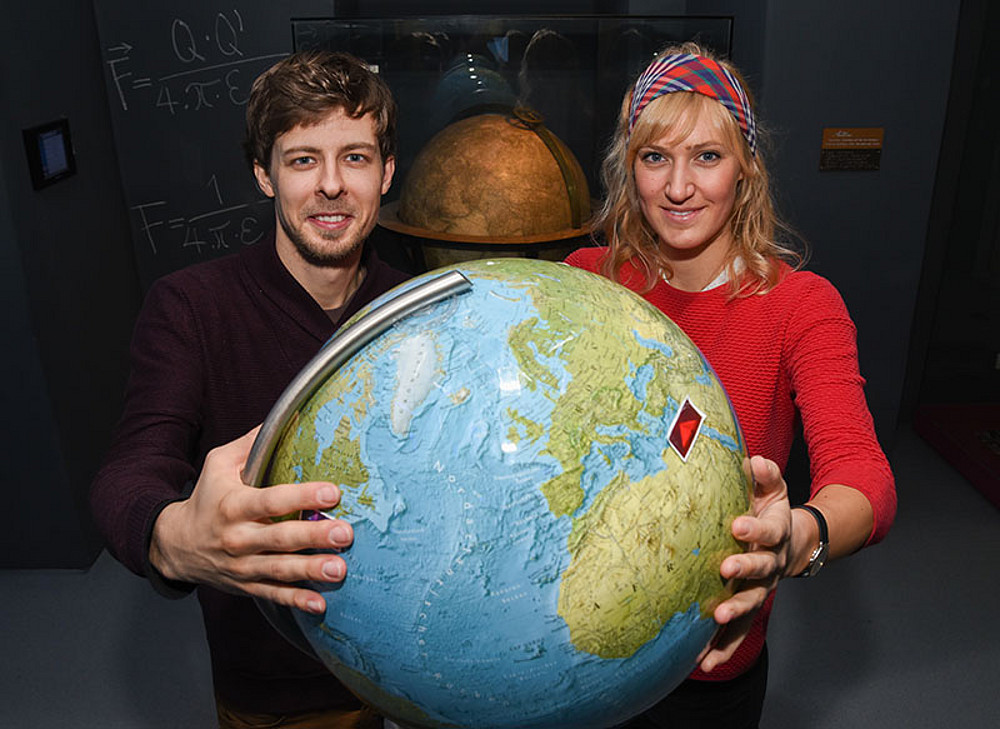
Die Doktoratsstudierenden Matthias Damert und Katharina Schröer laden zur Ausstellung „KliMacht|CliMatters“ ein. Foto: Uni Graz/Tzivanopoulos.

Die Doktoratsstudierenden Matthias Damert und Katharina Schröer laden zur Ausstellung „KliMacht|CliMatters“ ein. Foto: Uni Graz/Tzivanopoulos.

Ausstellung an der Uni Graz zeigt mögliche Konsequenzen des Klimawandels

„Das ist der wärmste Monat seit Beginn der Aufzeichnungen.“ Ein in Medienberichten oft gebrauchter und teilweise inflationär wahrgenommener Zusatz – doch diese Aussage ist ein deutlicher Hinweis auf den Klimawandel. Die Statistik zeigt: Seit der zweiten Hälfte des 19. Jahrhunderts ist die durchschnittliche Temperatur auf der Erdoberfläche um etwa ein Grad gestiegen. In Österreich war das Jahr 2014 sogar das wärmste in der 247-jährigen Messgeschichte. Und derzeit ist kein Ende der Hitzekurve in Sicht. Was bedeutet diese Entwicklung? Wie beeinflusst sie die Lebensumstände in Graz und Österreich? Was trägt jedeR Einzelne zum Klimawandel bei, wie könnte man ihn bremsen? Oder ist es schon zu spät dafür?


Antworten auf diese Fragen geben NachwuchsforscherInnen des vom österreichischen Wissenschaftsfonds FWF geförderten Doktoratskollegs „Climate Change“ der Uni Graz in der Ausstellung „KliMacht|CliMatters“. Mit interaktiven Spielen, Ausstellungsstücken und Postern erklären sie die Grundlagen, Ursachen und Folgen des Klimawandels anhand von zwei plausiblen Zukunftsszenarien bis 2100. Die Ausstellung wird am Donnerstag, 3. März 2016, um 19 Uhr im UniGraz@Museum im Hauptgebäude eröffnet. Der Eintritt ist bei der Eröffnung frei.


„Als roter Faden zieht sich das Thema der Verantwortung durch die Schau“, erklärt die Koordinatorin des Doktoratskollegs, Dr. Bettina Lackner, den Titel. „Wir zeigen auf, was auf unterschiedlichen Ebenen unternommen werden kann, damit unsere Welt auch in der Zukunft lebenswert bleibt. ‚KliMacht‘ steht dabei für jene Achtsamkeit, die wir diesem global so herausfordernden Thema entgegenbringen sollten.“ Welche Staaten beispielsweise für hohe Treibhausgas-Emissionen verantwortlich sind, wird ebenso thematisiert wie die Rolle, die jedeR Einzelne im Prozess des Klimawandels spielt. „Anhand eines einfachen Spiels können BesucherInnen erkennen, welche möglichen Auswirkungen ihr ganz persönliches Verhalten auf das Klima der Zukunft hat“, so Lackner. Bekannte Schlagworte wie etwa das 2-Grad-Ziel – damit ist die maximale globale Temperaturerhöhung gemeint, mit der sich die Auswirkungen der Erderwärmung auf ein erträgliches Maß einschränken ließen – sind ebenfalls Teil der Schau. Abschließend beschäftigen sich die JungforscherInnen mit Mythen zum Klimawandel sowie mit Initiativen, die versuchen, ihn zu vermeiden.

Ihre Kooperationspartner sind das Projekt Denkzeitraum 2016 „Wem gehört das Klima?“ des Arbeitsbereichs Praktische Philosophie der Uni Graz, der Grafiker Roman Klug der Abteilung Presse + Kommunikation der Uni Graz sowie der Ausstellungsmacher Jakob Pock.


>> Akustischer Vorgeschmack: Drei Studierende des Doktoratskollegs geben im Webradio der Grazer Universitäten Einblicke in die Ausstellung „KliMacht|CliMatters“


created by Gerhild Kastrun

Related news

Semester abroad without barriers: University of Graz wins award for promoting inclusion

The University of Graz has been awarded the Internationalization Award for its new inclusion initiative. Students with fewer opportunities now also receive financial support for their semester abroad outside Europe.

Fair distribution: Researchers determine just greenhouse gas budgets for all EU regions

Ten years ago, on 12 December 2015, the Paris Climate Agreement was signed at the UN Climate Conference. In order to limit global warming to well below two degrees, only a certain amount of CO2 may be emitted worldwide. While the focus was originally on national emission targets, more than 200 subnational regions and almost 300 cities have now adopted their own targets. But how many emissions are they fairly entitled to? Researchers at the University of Graz have now developed transparent criteria for fair distribution at the subnational level for the first time and determined corresponding greenhouse gas budgets for all European regions. The paper was published today in the scientific journal Nature Communications.

Chemical Christmas show at the University of Graz: An explosive evening at the Schauspielh

At the beginning of December, the University of Graz transformed the theater into a laboratory: as part of “Chemical Life,” teacher training students staged a chemical Christmas show for Styrian school classes—complete with ethanol rockets, nitrogen snow, and glowing effects. An evening designed to inspire interest in studying chemistry.

Train by train: Koralm railway accelerates exchange between the Universities

Lectures at the University of Klagenfurt in the morning, seminars at the University of Graz in the afternoon: Austria's longest tunnel and a journey time of around 45 minutes make it easy. The Koralm railway increases the speed of networking between the two university locations. The collaboration builds on existing cooperation - for example in the areas of teacher training, Slavic studies and as employers, the universities are well coordinated.

Begin of page section:
Additional information:

University of Graz
Universitaetsplatz 3
8010 Graz
Austria
  • Contact
  • Web Editors
  • Moodle
  • UNIGRAZonline
  • Imprint
  • Data Protection Declaration
  • Accessibility Declaration
Weatherstation
Uni Graz

End of this page section. Go to overview of page sections

End of this page section. Go to overview of page sections

Begin of page section:

End of this page section. Go to overview of page sections