Begin of page section:
Page sections:

  • Go to contents (Accesskey 1)
  • Go to position marker (Accesskey 2)
  • Go to main navigation (Accesskey 3)
  • Go to sub navigation (Accesskey 4)
  • Go to additional information (Accesskey 5)
  • Go to page settings (user/language) (Accesskey 8)
  • Go to search (Accesskey 9)

End of this page section. Go to overview of page sections

Begin of page section:
Page settings:

English en
Deutsch de
Search
Login

End of this page section. Go to overview of page sections

Begin of page section:
Search:

Search for details about Uni Graz
Close

End of this page section. Go to overview of page sections


Search

Begin of page section:
Main navigation:

Page navigation:

  • University

    University
    • About the University
    • Organisation
    • Faculties
    • Library
    • Working at University of Graz
    • Campus
    Developing solutions for the world of tomorrow - that is our mission. Our students and our researchers take on the great challenges of society and carry the knowledge out.
  • Research Profile

    Research Profile
    • Our Expertise
    • Research Questions
    • Research Portal
    • Promoting Research
    • Research Transfer
    • Ethics in Research
    Scientific excellence and the courage to break new ground. Research at the University of Graz creates the foundations for making the future worth living.
  • Studies

    Studies
    • Prospective Students
    • Students
  • Community

    Community
    • International
    • Location
    • Research and Business
    • Alumni
    The University of Graz is a hub for international research and brings together scientists and business experts. Moreover, it fosters the exchange and cooperation in study and teaching.
  • Spotlight
Topics
  • Our digital Advent calendar
  • Sustainable University
  • Researchers answer
  • Work for us
Close menu

End of this page section. Go to overview of page sections

Begin of page section:
You are here:

University of Graz News Planet vor der Linse

End of this page section. Go to overview of page sections

Monday, 09 May 2016

Planet vor der Linse
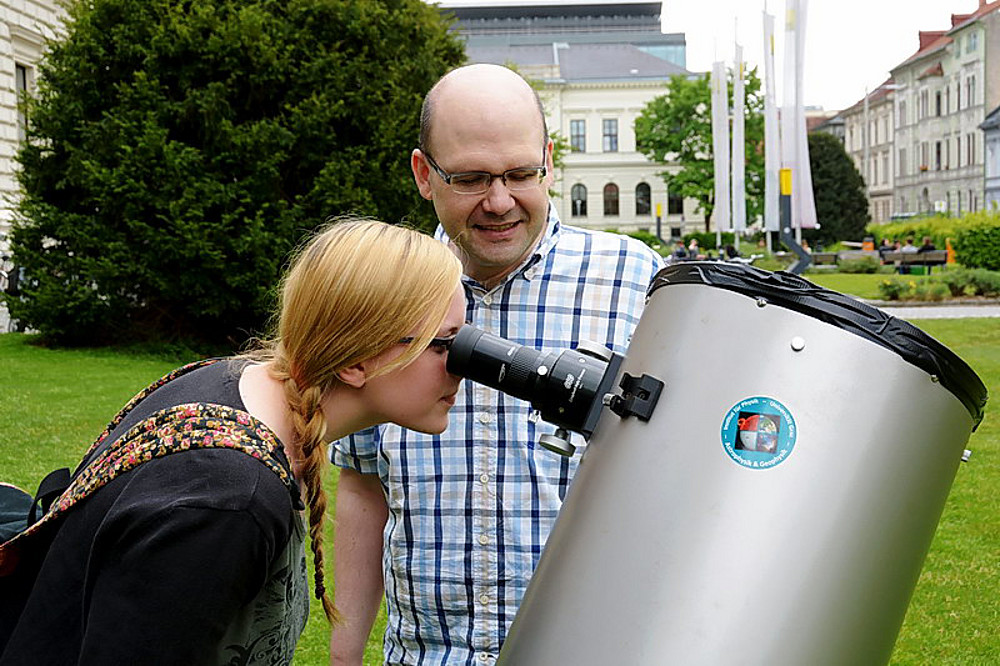
Thorsten Ratzka vom IGAM mit einer interessierten Besucherin. Fotos: Uni Graz/cp-pictures ©CP-PICTURES

Thorsten Ratzka vom IGAM mit einer interessierten Besucherin
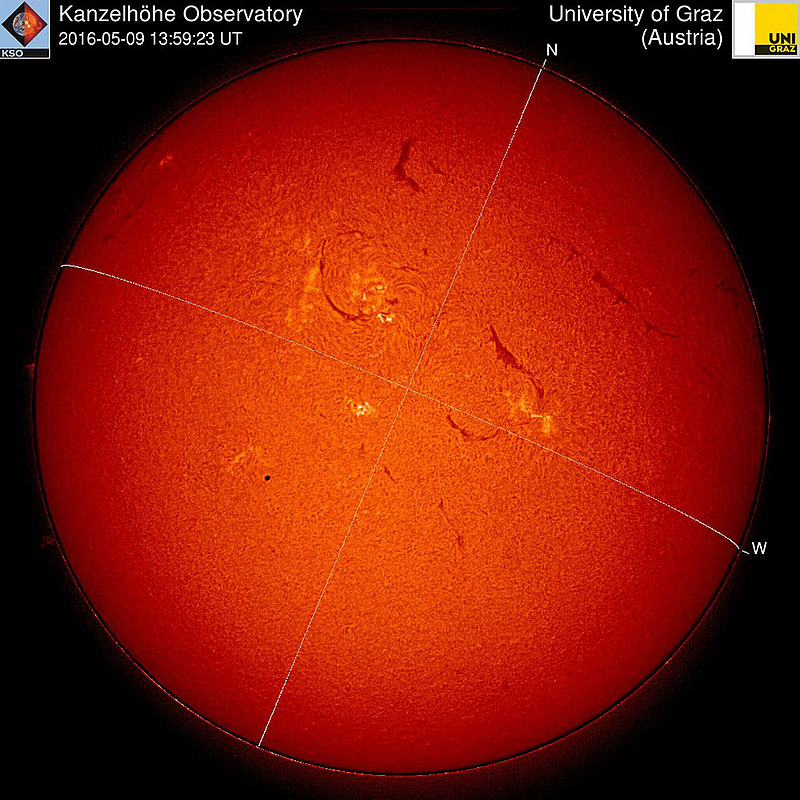
Live-Bild vom Sonnenobservatorium Kanzelhöhe: Merkur ist im Teleskop als kleiner schwarzer Punkt vor der Sonnenscheibe zu sehen. Foto: Uni Graz/IGAM, Kanzelhöhe ©Uni Graz/IGAM

Live-Bild vom Sonnenobservatorium Kanzelhöhe: Merkur ist im Teleskop als kleiner schwarzer Punkt vor der Sonnenscheibe zu sehen. Foto: Uni Graz/IGAM, Kanzelhöhe
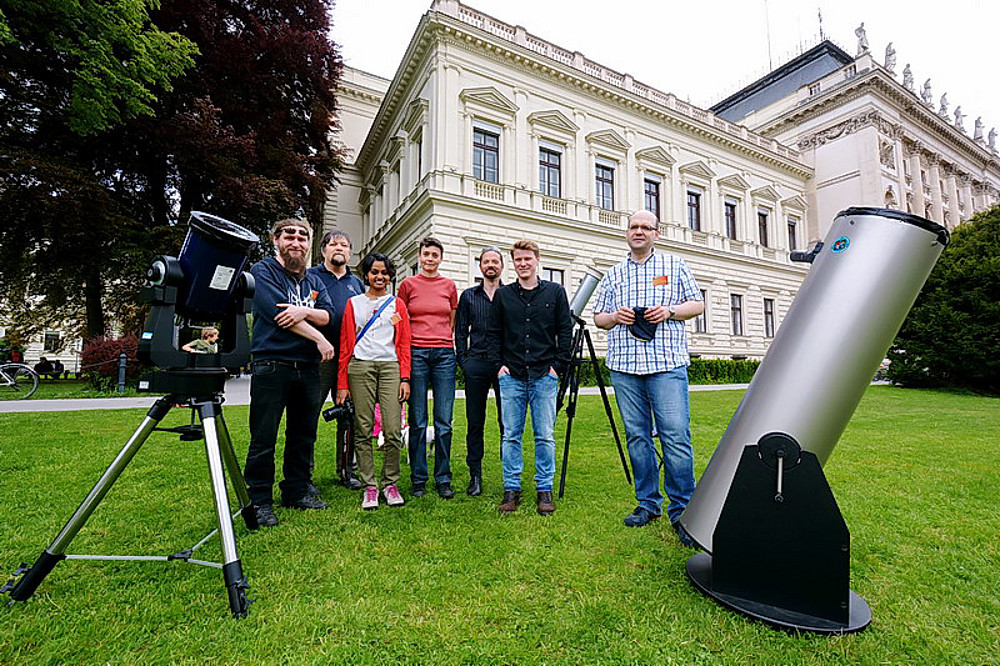
Die WissenschafterInnen des IGAM konnten auch mit Fragen gelöchert werden. Für weitere Fotos aufs Bild und dann auf die Bildleiste unten klicken! ©CP-PICTURES

Die WissenschafterInnen des IGAM konnten auch mit Fragen gelöchert werden. Für weitere Fotos aufs Bild und dann auf die Bildleiste unten klicken!
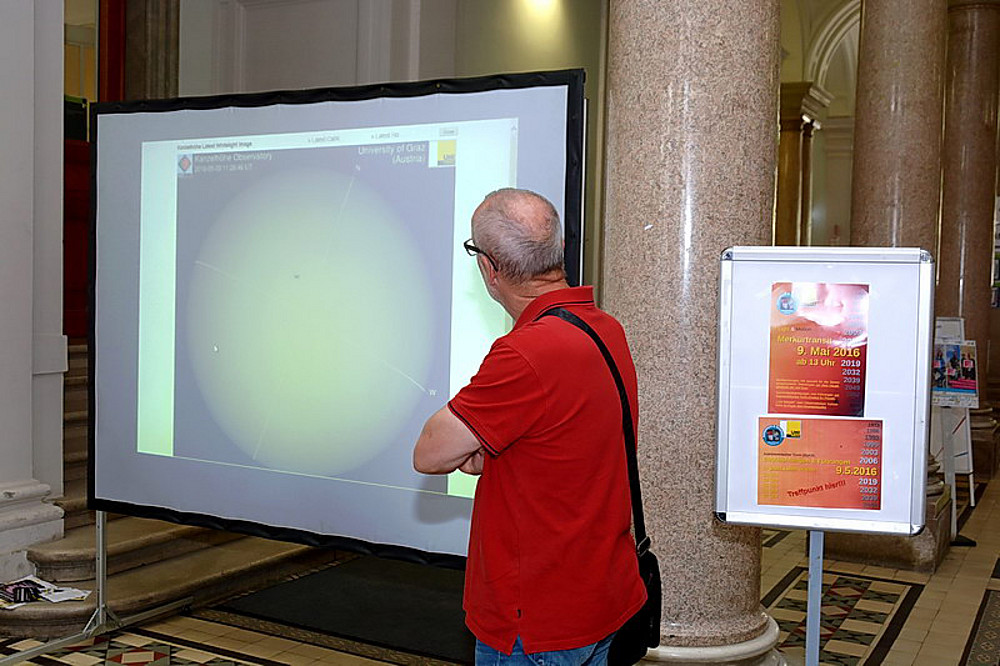
Indoor waren Aufnahmen vom Sonnenobservatorium Kanzelhöhe zu sehen ... ©CP-PICTURES
Indoor waren Aufnahmen vom Sonnenobservatorium Kanzelhöhe zu sehen ...

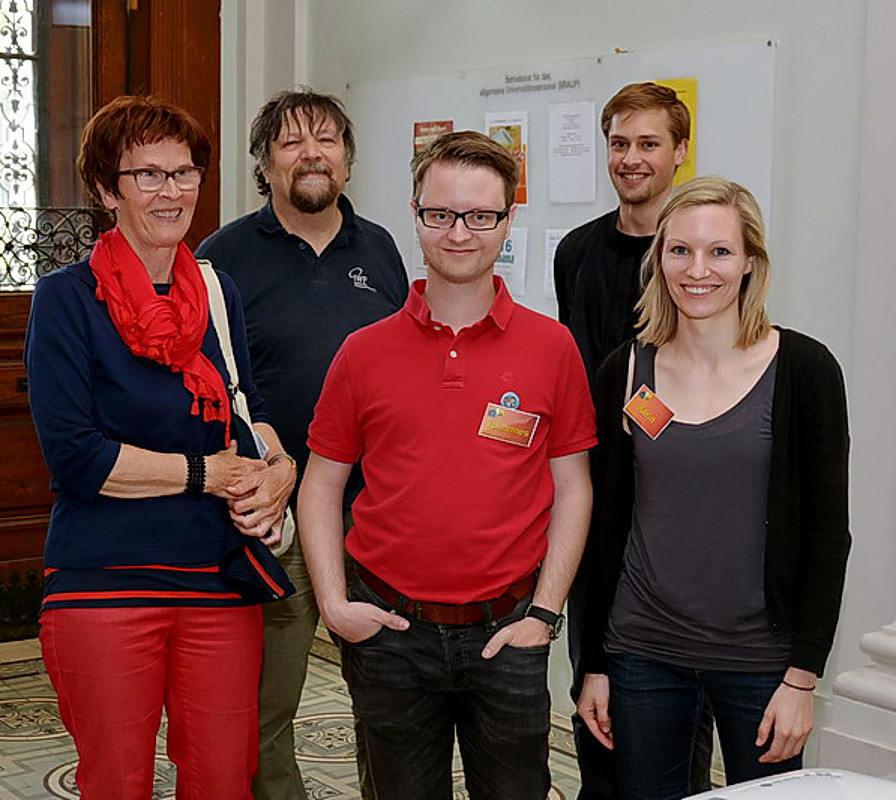
Auch hier gab's fachkundige Informationen. ©CP-PICTURES
Auch hier gab's fachkundige Informationen.

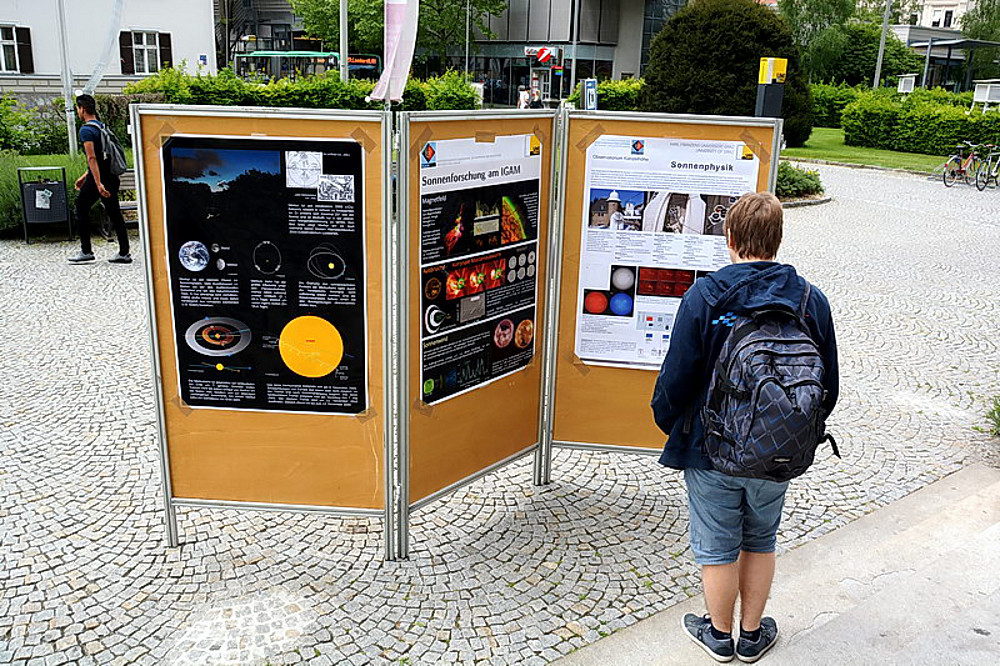
... ebenso auf den Postern vor dem Hauptgebäude. ©CP-PICTURES

... ebenso auf den Postern vor dem Hauptgebäude.

Astronomie-Begeisterte beobachten an der Uni Graz den Merkurtransit

Nach zehn Jahren ist es heute wieder soweit: Merkur, der kleinste Planet unseres Sonnensystems, schiebt sich - von Graz aus gesehen - seit 13.12 Uhr zwischen Sonne und Erde. Das als "Merkurtransit" bezeichnete Phänomen lockt Astronomie-Fans auf den Campus der Karl-Franzens-Universität, wo Teleskope mit speziellen Sonnenfiltern einen Blick auf das Ereignis ermöglichen, sofern es die immer wieder vorbeiziehenden Wolken erlauben. Im Foyer des Hauptgebäudes sind außerdem Live-Bilder vom Sonnenobservatorium auf der Kanzelhöhe in Kärnten zu sehen.
Und auch das Webradio der Grazer Universitäten berichtet über den Merkurtransit.

>> Um den Beitrag gleich anzuhören, klicken Sie bitte hier

created by Gerhild Kastrun & Gudrun Pichler

Related news

Setback: Austria's greenhouse gas emissions rise in 2025

Climate protection is currently facing an uphill battle. The United Nations have recently been unable to agree on a roadmap for phasing out fossil fuels, even though global warming continues to accelerate. Also Austria still does not have a national climate law with a clear target path for reducing emissions. This is evidently taking its toll: Austria’s greenhouse gas emissions rose again in 2025 for the first time in years, by around two and a half percent, according to calculations by researchers at the University of Graz. In addition to overly cautious climate action measures, this is due to somewhat colder winter months compared to 2024, which are driving up natural gas consumption.

Profound: Geoscientist Marko Bermanec deciphers processes of the Earth's plates

What happens deep down is very important to us above ground. Especially when hidden chemical processes between tectonic plates have serious consequences. Earth scientist Marko Bermanec investigates these processes in depth.

Kink in the curve: Eleonore Faber researches the "fuzzy" parts of algebra

How can the movements of robotic arms be described using maths? And what does a computer need to understand in order to function? The magic word to answer these questions is algebra. Eleonore Faber has been a professor of this branch of mathematics at the University of Graz for two years. She is particularly interested in complex phenomena that cannot be fully understood using conventional rules or laws - where algebra becomes "fuzzy".

Jurist Jürgen Pirker erhält den Wissenschaftspreises der Margaretha Lupac-Stiftung

Wie kann der Staat nationale Minderheiten schützen? Wie kann er darauf achten, dass Mitglieder einer bestimmten ethnischen oder religiösen Gruppe nicht gezwungen werden, ihre persönlichen Freiheiten aufgrund dieser Zugehörigkeit aufzugeben? Und wie ging Österreich in den vergangenen 180 Jahren mit dieser Frage um?

Begin of page section:
Additional information:

University of Graz
Universitaetsplatz 3
8010 Graz
Austria
  • Contact
  • Web Editors
  • Moodle
  • UNIGRAZonline
  • Imprint
  • Data Protection Declaration
  • Accessibility Declaration
Weatherstation
Uni Graz

End of this page section. Go to overview of page sections

End of this page section. Go to overview of page sections

Begin of page section:

End of this page section. Go to overview of page sections