Begin of page section:
Page sections:

  • Go to contents (Accesskey 1)
  • Go to position marker (Accesskey 2)
  • Go to main navigation (Accesskey 3)
  • Go to sub navigation (Accesskey 4)
  • Go to additional information (Accesskey 5)
  • Go to page settings (user/language) (Accesskey 8)
  • Go to search (Accesskey 9)

End of this page section. Go to overview of page sections

Begin of page section:
Page settings:

English en
Deutsch de
Search
Login

End of this page section. Go to overview of page sections

Begin of page section:
Search:

Search for details about Uni Graz
Close

End of this page section. Go to overview of page sections


Search

Begin of page section:
Main navigation:

Page navigation:

  • University

    University
    • About the University
    • Organisation
    • Faculties
    • Library
    • Working at University of Graz
    • Campus
    Developing solutions for the world of tomorrow - that is our mission. Our students and our researchers take on the great challenges of society and carry the knowledge out.
  • Research Profile

    Research Profile
    • Our Expertise
    • Research Questions
    • Research Portal
    • Promoting Research
    • Research Transfer
    • Ethics in Research
    Scientific excellence and the courage to break new ground. Research at the University of Graz creates the foundations for making the future worth living.
  • Studies

    Studies
    • Prospective Students
    • Students
  • Community

    Community
    • International
    • Location
    • Research and Business
    • Alumni
    The University of Graz is a hub for international research and brings together scientists and business experts. Moreover, it fosters the exchange and cooperation in study and teaching.
  • Spotlight
Topics
  • Sustainable University
  • Researchers answer
  • Work for us
Close menu

End of this page section. Go to overview of page sections

Begin of page section:
You are here:

University of Graz News Ehre, wem Ehre gebührt

End of this page section. Go to overview of page sections

Monday, 15 October 2018

Ehre, wem Ehre gebührt

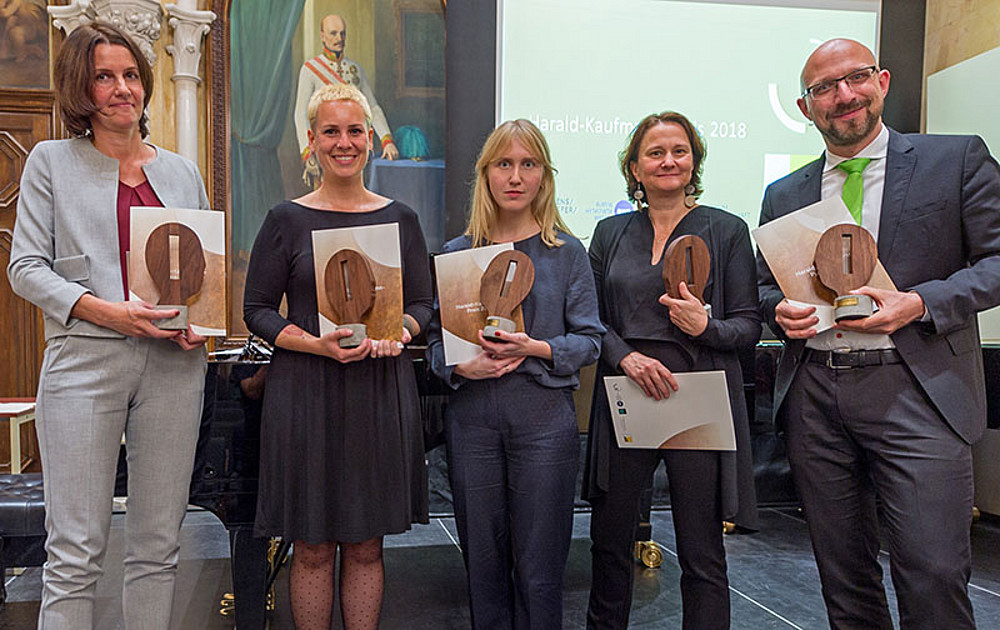
PreisträgerInnen: Barbara Bach-Hönig, Claudia Döffinger, Veronika Muchitsch sowie Susanne Scholz und Michael Hell (v.l.). Foto: Johannes Gellner. ©Johannes Gellner

PreisträgerInnen: Barbara Bach-Hönig, Claudia Döffinger, Veronika Muchitsch sowie Susanne Scholz und Michael Hell (v.l.). Foto: Johannes Gellner.

Harald-Kaufmann-Preis für Publikationen in den Geistes-, Sozial- und Kulturwissenschaften sowie künstlerische Publikationen vergeben

Mit dem neu geschaffenen, von Universität Graz und Kunstuniversität Graz initiierten Harald Kaufmann Preis werden herausragende Publikationen in den Geistes-, Sozial- und Kulturwissenschaften sowie auch künstlerische Publikationen ausgezeichnet. Am 12. Oktober 2018 wurde der Preis erstmals feierlich vergeben. Nicht zuletzt wird mit der nach Harald Kaufmann (1927-1970) benannten Auszeichnung einer prägenden Forscherpersönlichkeit gedacht, die mit beiden Universitäten eng verbunden war.

Zu den PreisträgerInnen:

Priv.-Doz. Dr. Barbara BACH-HÖNIG
promovierte in Soziologie an der Fakultät für Wirtschafts- und Sozialwissenschaften an der Universität Graz. Ihre hier ausgezeichnete Habilitationsschrift „Europe’s New Scientific Elite. Social Mechanisms of Science in the European Research Area“ an der Universität Innsbruck wurde 2017 im Routledge Verlag publiziert. Aktuell ist sie als Lektorin für die Universitäten in Graz, Linz und Göttingen tätig.

Claudia DÖFFINGER, MA MA

studiert derzeit Jazzkomposition und Arrangement an der Universität für Musik und darstellende Kunst Graz und vollendete ein Masterstudium in Jazzklavier/Pädagogik an der Musikhochschule Luzern. Ihre musikalische Arbeit umfasst Arrangements für verschiedene Orchester und eigene Kompositionen.

Veronika MUCHITSCH, MA
studierte Musikologie an der Universität Graz und der Universität für Musik und darstellende Kunst Graz. Nach ihrem Master-Abschluss ging sie an die Uppsala-Universitet in Schweden um dort am Institut für Musikwissenschaft zu promovieren. Ihr Artikel „Neoliberal Sounds? The Politics of Beyoncé’s Voice on ‚Run The World (Girls)‘“ erschien in der Reihe „PopScriptum Vol. 12: Sound, Sex und Sexismus“ der Humboldt-Universität Berlin.

Univ.-Prof. Susanne SCHOLZ und Univ.-Prof. Michael HELL
unterrichten beide am Institut für Alte Musik und Aufführungspraxis an der Universität für Musik und darstellende Kunst Graz. Beide verfolgen neben ihrem Lehrauftrag eine musikalische Karriere, die sich in reger Konzerttätigkeit und Mitwirkung bei verschiedensten Ensembles niederschlägt. Aus der Zusammenarbeit dieser beiden Persönlichkeiten ging die hier ausgezeichnete CD L‘immagine die Corelli hervor.


>> Hören Sie hier im AirCampus-Podcast mehr zu den Hintergründen des Preises


Harald Kaufmann (1927-1970)
studierte Philosophie und Musikwissenschaft sowie später auch Rechtswissenschaft an der Karl-Franzens-Universität Graz. Zu Studienzeiten war er am Aufbau des Grazer Bildungsvereins Urania und an der Gestaltung musikbildender Kurse beteiligt. Er arbeitete unter anderem als Musikkritiker der Grazer Neuen Zeit. 1967 gründete er schließlich das Institut für Wertungsforschung an der damaligen Akademie für Musik und darstellenden Kunst, der heutigen Universität für Musik und darstellende Kunst Graz. Kaufmann, nach dem 2. Weltkrieg einer der wenigen Verfechter der Neuen Musik in Österreich, war auch ein wichtiger Unterstützer des musikprotokoll im Rahmen des damals noch jungen Festivals steirischer herbst. Unmittelbar nach seiner Berufung verstarb er in Graz, mit 42 Jahren. Insbesondere von Kaufmanns der Soziologie und der Analyse von Musik gewidmeten Bänden Fingerübungen (1970) und Spurlinien (1969) gehen auch nach einem halben Jahrhundert noch Anregungen aus.


created by Hermann Götz/KUG & Gerhild Leljak

Related news

AI in schools: Maria Bertel drafts legal guidelines for teachers

The legal expert and her team analysed the legal situation regarding the use of artificial intelligence in education as part of an EU project and answered open questions from practice.

Cosmetics in the environment: University of Graz proves danger to ants

Titanium dioxide, which is found in cosmetics, for example, is increasingly entering the environment in the form of nanoparticles. This could also put insects at risk. If ants ingest the substance in combination with the pesticide glyphosate, it disturbs the development of their offspring. Scientists at the University of Graz are drawing attention to the negative consequences of this toxic cocktail.

Varied and healthy: studies move

Exercise is the ideal way to balance out everyday stress, prevent illness and keep fit. Why this is the case, how to do it properly and what role human bodily functions and psychology play can be studied at the University of Graz.

Religious scholar Theresia Heimerl: Fasting as a spiritual boost

Fasting is not just a strategy for losing weight – it is a ritual dating back thousands of years with spiritual and evolutionary roots that has positive effects on the body. At the University of Graz, religious scholar Theresia Heimerl is investigating why fasting is a "spiritual boost".

Begin of page section:
Additional information:

University of Graz
Universitaetsplatz 3
8010 Graz
Austria
  • Contact
  • Web Editors
  • Moodle
  • UNIGRAZonline
  • Imprint
  • Data Protection Declaration
  • Accessibility Declaration
Weatherstation
Uni Graz

End of this page section. Go to overview of page sections

End of this page section. Go to overview of page sections

Begin of page section:

End of this page section. Go to overview of page sections