Begin of page section:
Page sections:

  • Go to contents (Accesskey 1)
  • Go to position marker (Accesskey 2)
  • Go to main navigation (Accesskey 3)
  • Go to sub navigation (Accesskey 4)
  • Go to additional information (Accesskey 5)
  • Go to page settings (user/language) (Accesskey 8)
  • Go to search (Accesskey 9)

End of this page section. Go to overview of page sections

Begin of page section:
Page settings:

English en
Deutsch de
Search
Login

End of this page section. Go to overview of page sections

Begin of page section:
Search:

Search for details about Uni Graz
Close

End of this page section. Go to overview of page sections


Search

Begin of page section:
Main navigation:

Page navigation:

  • University

    University
    • About the University
    • Organisation
    • Faculties
    • Library
    • Working at University of Graz
    • Campus
    Developing solutions for the world of tomorrow - that is our mission. Our students and our researchers take on the great challenges of society and carry the knowledge out.
  • Research Profile

    Research Profile
    • Our Expertise
    • Research Questions
    • Research Portal
    • Promoting Research
    • Research Transfer
    • Ethics in Research
    Scientific excellence and the courage to break new ground. Research at the University of Graz creates the foundations for making the future worth living.
  • Studies

    Studies
    • Prospective Students
    • Students
    • Welcome Weeks for First Year Students
  • Community

    Community
    • International
    • Location
    • Research and Business
    • Alumni
    The University of Graz is a hub for international research and brings together scientists and business experts. Moreover, it fosters the exchange and cooperation in study and teaching.
  • Spotlight
Topics
  • Sustainable University
  • Researchers answer
  • Work for us
Close menu

End of this page section. Go to overview of page sections

Begin of page section:
You are here:

University of Graz News Greenery under the sun: how plants protect themselves from too much UV light

End of this page section. Go to overview of page sections

Friday, 26 July 2024

Greenery under the sun: how plants protect themselves from too much UV light

Ulli Grube

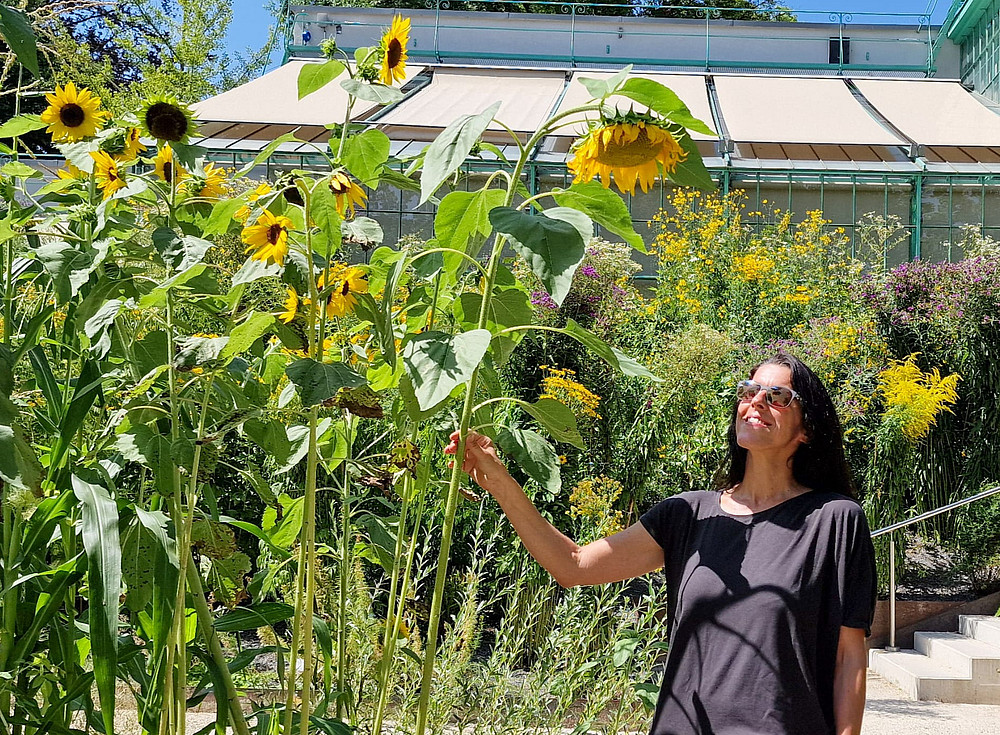
"Only young sunflowers orient themselves towards the sun in order to use the maximum amount of light for their growth," explains Ulli Grube. Photo: University of Graz/Elisabeth Helmberger

Plants can't grow without sun. But too much of it is not good either. This is why some flowers and trees have developed strategies to protect themselves from too much light. The Botanical Garden of the University of Graz invites you to do some research on site.

We put up a parasol. The silver lime tree (Tilia platyphyllos), on the other hand, turns the silvery hairs on the underside of its leaves upwards as soon as the sunlight becomes too strong for the tree. In addition, a strong "hairiness" can reflect light and thus protect the sensitive cells, says Ulli Grube from the Botanical Garden at the University of Graz: "This is clearly visible on the mullein (Verbascum sp.), which is considered a typical sun plant."
Hairs can also help to reduce evaporation and thus the plant's water loss, as numerous alpine plants prove. It also helps if the silverroot (Dryas octopetala), for example, reduces leaf areas. Succulent plants, i.e. those with water storage tissues, are particularly good at this strategy and are masters at adapting to drought.

Sunburn in plants

"Even plants can get sunburnt," says Grube. This can be seen, for example, in brown spots on the leaves. Grube reports on another green phenomenon: "If too much photosynthesis is carried out, reactive oxygen compounds are produced that can damage the light systems of the leaf cells. The plant can very quickly dissipate excess energy in the form of heat."
Other plants, on the other hand, turn towards the sun in a daily rhythm: the best-known example is the sunflower (Helianthus annuus). "However, only young plants do this in order to use the maximum amount of light for their growth," explains Ulli Grube.

Flora from the Mediterranean region

Jonathan Wilfling, Technical Manager at the Botanic Garden, confirms that the current heat and climate change are causing the plants problems. The trees have been watered for three years now. "Beech trees in particular are suffering from the high temperatures," explains Wilfling. The greenhouses are also becoming increasingly hot. In response to the climate change, attempts are currently being made to introduce more flora from south-eastern Europe and the Mediterranean in the open air. Wilfling: "The Botanic Garden's arboretum will certainly look different in 50 years' time than it does today, as the life expectancy of trees in the city is decreasing."

►Botanical Garden of the University of Graz

created by Andreas Schweiger

Related news

PFAS: Uni-Graz-Studie zeigt, dass Verbote von Ewigkeitschemikalien wirken

Forschende der Universität Graz zeigen: PFAS-Verbote senken die Belastung in der Natur nachweislich. Doch die Industrie weicht auf andere Verbindungen aus, die für Menschen ebenso gefährlich sind.

Neues Kapitel für das Graz Center of Physics: Fachwerkteile angeliefert

Architektonischer Meilenstein für das künftige Grazer Physik-Center: Die ersten Fachwerkteile wurden angeliefert und mit dem Kran auf die richtige Stelle im ersten Obergeschoß platziert. Bis Mai folgen 33 weitere Lkw-Transporte und bringen insgesamt 64 Stück. In Summe werden so 16 große Stahlfachwerke vor Ort zusammengeschraubt. Die acht Meter hohen und teilweise bis zu 30 Meter langen Fachwerke geben dem ganzen Gebäude eine notwendige Stabilität und dienen der Lastabtragung der oberen Geschoße.

New groundbreaking computation method for climate extremes

How much will heat, flooding, drought and storms increase as a result of human-induced climate change? In a groundbreaking study, climate researcher Gottfried Kirchengast and his team at the University of Graz have developed a new method for computing the hazards from extreme events: it can compute all relevant hazard metrics for events such as heat waves, floods and droughts in any region worldwide with unprecedented information content. Using it for Europe, the researchers found that anthropogenic climate change has caused a tenfold increase in extreme heat in recent decades. The study, published in the journal Weather and Climate Extremes, also provides a basis for better quantifying the damage to people, ecosystems and infrastructure.

How Wikipedia and open source are changing the world

From ancient irrigation systems to Wikipedia: common goods have shaped our society for thousands of years. Richard Sturn, professor of economics at the University of Graz, explains why common goods or commons such as open-source software do not work without clear rules and what balance between openness and structure is crucial.

Begin of page section:
Additional information:

University of Graz
Universitaetsplatz 3
8010 Graz
Austria
  • Contact
  • Web Editors
  • Moodle
  • UNIGRAZonline
  • Imprint
  • Data Protection Declaration
  • Accessibility Declaration
Weatherstation
Uni Graz

End of this page section. Go to overview of page sections

End of this page section. Go to overview of page sections

Begin of page section:

End of this page section. Go to overview of page sections