



Begin of page section:
Page sections:

  • Go to contents (Accesskey 1)
  • Go to position marker (Accesskey 2)
  • Go to main navigation (Accesskey 3)
  • Go to sub navigation (Accesskey 4)
  • Go to additional information (Accesskey 5)
  • Go to page settings (user/language) (Accesskey 8)
  • Go to search (Accesskey 9)

End of this page section. Go to overview of page sections

Begin of page section:
Page settings:

English en
Deutsch de
Search
Login

End of this page section. Go to overview of page sections

Begin of page section:
Search:

Search for details about Uni Graz
Close

End of this page section. Go to overview of page sections


Search

Begin of page section:
Main navigation:

Page navigation:

  • University

    University
    • About the University
    • Organisation
    • Faculties
    • Library
    • Working at University of Graz
    • Campus
    Developing solutions for the world of tomorrow - that is our mission. Our students and our researchers take on the great challenges of society and carry the knowledge out.
  • Research Profile

    Research Profile
    • Our Expertise
    • Research Questions
    • Research Portal
    • Promoting Research
    • Research Transfer
    • Ethics in Research
    Scientific excellence and the courage to break new ground. Research at the University of Graz creates the foundations for making the future worth living.
  • Studies

    Studies
    • Prospective Students
    • Students
  • Community

    Community
    • International
    • Location
    • Research and Business
    • Alumni
    The University of Graz is a hub for international research and brings together scientists and business experts. Moreover, it fosters the exchange and cooperation in study and teaching.
  • Spotlight
Topics
  • StudiGPT is here! Try it out!
  • Sustainable University
  • Researchers answer
  • Work for us
Close menu

End of this page section. Go to overview of page sections

Begin of page section:
You are here:

University of Graz News Graz Researchers discover what stiffens the Aorta

End of this page section. Go to overview of page sections

Wednesday, 03 September 2025

Graz Researchers discover what stiffens the Aorta

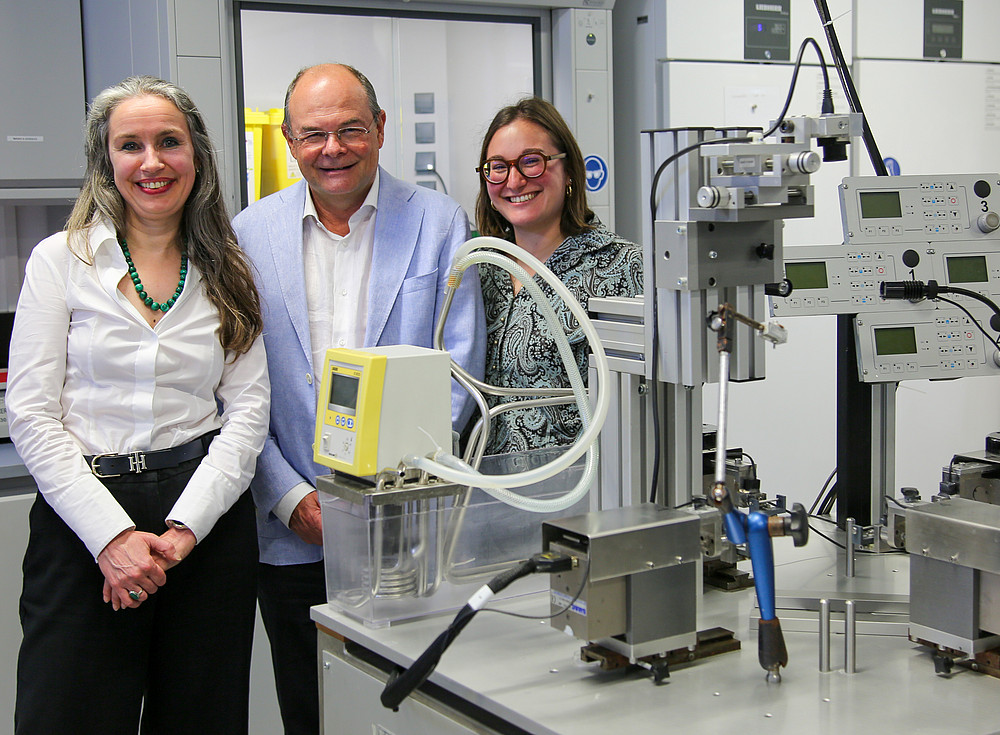
Zwei Frauen und ein Mann stehen in einem Labor ©TU Graz

Oksana Tehlivets, Gerhard Holzapfel und Francesca Bogoni (v.l.) haben mit Partner:innen der Med Uni Graz herausgefunden, dass hohe Werte der Aminosäure Homocystein im Blut die Hauptschlagader steifer und weniger elastisch werden lassen. Foto: TU Graz.

Cardiovascular diseases remain the most common cause of death worldwide. In Europe, they account for over 40 percent of all deaths. However, known risk factors such as high cholesterol levels or high blood pressure cannot fully explain the high mortality rate or the number of cardiovascular diseases. Scientists in Graz have now investigated a new factor that is closely linked to cardiovascular mortality. Elevated levels of the amino acid homocysteine in the blood led to a stiffer and less elastic aorta in an animal model. These findings contribute to the current understanding of the development of cardiovascular diseases such as atherosclerosis, in which the role of cholesterol has previously been more in focus.

Focus on the aorta

The aorta is the largest blood vessel in the human body. With each heartbeat, it must contract and expand to transport oxygen-rich blood from the heart to the organs. “Many cardiovascular diseases have their origin in aortic dysfunction,” explains Gerhard A. Holzapfel from the Institute of Biomechanics at Graz University of Technology (TU Graz). Together with Francesca Bogoni (TU Graz) and Oksana Tehlivets from the Institute of Molecular Biosciences (University of Graz), he is conducting research on the mechanical properties of the aorta.

In a recent publication, the scientists, together with partners from the Medical University of Graz, investigated the effects of homocysteine on the aorta. This “cell poison” is produced as an intermediate product during the metabolism of another amino acid, methionine. “If it is not broken down quickly, homocysteine accumulates. This is often observed in older people. A high-fat diet and lack of exercise may also contribute to an increase in homocysteine levels in the blood,” explains Oksana Tehlivets. 

Too much homocysteine makes the aorta stiff

The researchers focused their studies on the role of this amino acid. “We deliberately left out the influence of cholesterol, as we already know that too much of it thickens the blood vessels. However, the fact that elevated homocysteine levels make blood vessels stiffer and less elastic was previously less recognized as a risk factor,” explains Francesca Bogoni. 

The research findings lay the foundation for a better understanding of the mechanisms that cause atherosclerosis and cardiovascular disease in general. The research was funded by the Austrian Science Fund (FWF) and BioTechMed-Graz, the joint health research network of the University of Graz, the Medical University of Graz and the Graz University of Technology. 

Publications:

Bogoni et al. Homocysteine leads to aortic stiffening in a rabbit model of atherosclerosis. Acta Biomaterialia, 2025. DOI: 10.1016/j.actbio.2025.06.003

Tehlivets et al. Homocysteine contributes to atherogenic transformation of the aorta in rabbits in the absence of hypercholesterolemia. Biomedicine & Pharmacotherapy, 2024. DOI: 10.1016/j.biopha.2024.117244

Bogoni et al. On the experimental identification of equilibrium relations and the separation of inelastic effects of soft biological tissues. Journal of the Mechanics and Physics of Solids, 2024. DOI: 10.1016/j.jmps.2024.105868

created by Gerhild Leljak

Related news

Bio-plastics and baroque theatre: Awards for two researchers from the University of Graz

Chemist Katalin Barta Weissert received this year's "Forschungspreis des Landes Steiermark", while Germanist Christian Neuhuber received the "Erzherzog-Johann-Forschungspreis". The awards are endowed with 12,000 euros each and are presented for outstanding achievements in the field of science and research. Provincial Councillor Willibald Ehrenhöfer presented the awards on 7 November 2025 in the White Hall of Graz Castle.

EU supports team led by molecular biologist Brigitte Pertschy with around ten million euro

The European Research Council (ERC) is funding the snoOPERA project with around ten million euros to research the structure of cellular protein factories. The four researchers involved want to clarify how tiny RNA-protein complexes control the formation of ribosomes—a key to understanding diseases such as cancer and Alzheimer's.

Maths made easy: how gaming elements motivate children to practise

Where does the six belong on a number line from one to ten? This task is a challenge for children with dyscalculia. For fear of failure, many are reluctant to tackle the exercise in the first place. A playful approach can remove this obstacle and give the affected pupils more self-confidence, as psychologist Manuel Ninaus found out in a study.

How artificial intelligence is changing the digital future in Europe

On November 20, 2025, the Technology Impact Summit at the Seifenfabrik in Graz will bring together experts from politics, business, and science. The focus will be on how artificial intelligence is transforming our working world and which specific AI solutions are already being used successfully today.

Begin of page section:
Additional information:

University of Graz
Universitaetsplatz 3
8010 Graz
Austria
  • Contact
  • Web Editors
  • Moodle
  • UNIGRAZonline
  • Imprint
  • Data Protection Declaration
  • Accessibility Declaration
Weatherstation
Uni Graz

End of this page section. Go to overview of page sections

End of this page section. Go to overview of page sections

Begin of page section:

End of this page section. Go to overview of page sections