Begin of page section:
Page sections:

  • Go to contents (Accesskey 1)
  • Go to position marker (Accesskey 2)
  • Go to main navigation (Accesskey 3)
  • Go to sub navigation (Accesskey 4)
  • Go to additional information (Accesskey 5)
  • Go to page settings (user/language) (Accesskey 8)
  • Go to search (Accesskey 9)

End of this page section. Go to overview of page sections

Begin of page section:
Page settings:

English en
Deutsch de
Search
Login

End of this page section. Go to overview of page sections

Begin of page section:
Search:

Search for details about Uni Graz
Close

End of this page section. Go to overview of page sections


Search

Begin of page section:
Main navigation:

Page navigation:

  • University

    University
    • About the University
    • Organisation
    • Faculties
    • Library
    • Working at University of Graz
    • Campus
    Developing solutions for the world of tomorrow - that is our mission. Our students and our researchers take on the great challenges of society and carry the knowledge out.
  • Research Profile

    Research Profile
    • Our Expertise
    • Research Questions
    • Research Portal
    • Promoting Research
    • Research Transfer
    • Ethics in Research
    • Commission for Scientific Integrity
    Scientific excellence and the courage to break new ground. Research at the University of Graz creates the foundations for making the future worth living.
  • Studies

    Studies
    • Prospective Students
    • Students
  • Community

    Community
    • International
    • Location
    • Research and Business
    • Alumni
    The University of Graz is a hub for international research and brings together scientists and business experts. Moreover, it fosters the exchange and cooperation in study and teaching.
  • Spotlight
Topics
  • Sustainable University
  • Researchers answer
  • Work for us
Close menu

End of this page section. Go to overview of page sections

Begin of page section:
You are here:

University of Graz News Gesund geschlüpft

End of this page section. Go to overview of page sections

Wednesday, 08 March 2017

Gesund geschlüpft
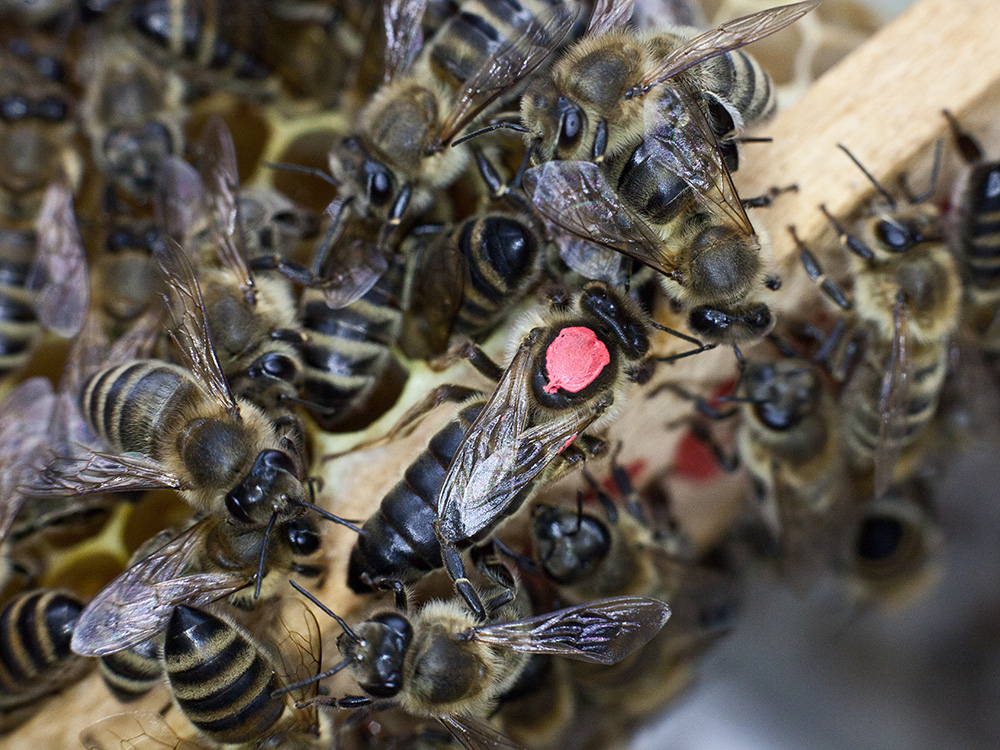
Die Bienenkönigin erschnüffelt an ihren Arbeiterinnen Krankheiten und reagiert darauf. Foto: Nikola Milatovic ©NikolaMilatovic.com

Die Bienenkönigin erschnüffelt an ihren Arbeiterinnen Krankheiten und reagiert darauf. Foto: Nikola Milatovic

ZoologInnen der Uni Graz fanden heraus, wie Bienenkönigin Nachwuchs vor Krankheiten schützt

Bedroht eine bestimmte Krankheit den Stock, kann die Königin entsprechende Immun-Gene aktivieren und bei der Eiablage den Schutz ihren Nachkommen vererben. Das haben Dr. Javier Hernández López, Dr. Ulrike Riessberger-Gallé und Dr. Wolfgang Schühly vom Team Bienengesundheit am Institut für Zoologie der Uni Graz herausgefunden. Wie dieser Mechanismus funktionieren könnte, haben die ForscherInnen im soeben erschienenen Fachmagazin Molecular Ecology beschrieben.
Die Königin kann „riechen“, gegen welche Bedrohung sie den Kampf aufnehmen muss. „Eine Krankheit verändert die Zusammensetzung des Kohlenwasserstoff-Profils, das Bienen auf ihrer Körperoberfläche haben und das für ihren spezifischen Geruch verantwortlich ist“, erklären die WissenschafterInnen. Diese Veränderung an den Arbeiterinnen nimmt die Königin wahr und schaltet die nötige Immunreaktion ein. „Das konnten wir in unserer Untersuchung erstmals zeigen“, freut sich Wolfgang Schühly. Und die Erkenntnisse sind bahnbrechend: „Vor wenigen Jahren waren Fachleute noch davon überzeugt, dass wirbellose Tiere überhaupt kein komplexes Immunsystem haben“, so der Zoologe.
Dass das bloße Erschnüffeln der Krankheit für den Schutz des Nachwuchses ausreichte, belegten zwei Versuche: Hatte die Königin mit einer infizierten Arbeiterin direkten Körperkontakt, fiel ihre Immunreaktion stärker aus. Außerdem aktivierte sie ihre Abwehr-Gene auch dann, wenn das Geruchsprofil von den Arbeiterinnen heruntergewaschen und separat auf einem Papierblättchen dargeboten wurde.
Bienen über eine „Duft-Impfung“ langfristig gegen Krankheiten zu wappnen, ist derzeit allerdings noch keine Option: „Der von uns beobachtete Mechanismus hält maximal wenige Tage an, weil die Königin ständig auf geänderte Bedingungen im Stock reagiert“, erklären die ForscherInnen.

Die Forschungsarbeit war Teil des Großprojekts „Zukunft Biene“, das Univ.-Prof. i.R. Dr. Karl Crailsheim leitet.

Publikation:
Javier Hernández López, Ulrike Riessberger-Gallé, Karl Crailsheim und Wolfgang Schühly: „Kutikulare Kohlenwasserstoffprofile von immunstimulierten Arbeiterinnen erzeugen eine Immunaktivierung in Bienenköniginnen“,
Molecular Ecology, DOI:10.1111/mec.14086

created by Dagmar Eklaude

Related news

Studying at the University of Graz: How to enrol

Ready for a new chapter in your life with the start of your studies at the University of Graz in the winter semester 2026/27? Here you will find information on deadlines, admission procedures, registration, and everything else you need to successfully start your studies in the fall.

Interpreting data: Why studies sometimes get it wrong

Hilmar Brohmer and Ziva Korda from the Institute of Psychology, together with 500 international colleagues, have re-evaluated a hundred scientific publications and have often come to different conclusions.

Crystal-clear: AI method revolutionises solar observation

The Sun makes life on Earth possible. However, its magnetic fields can also cause massive disruption. This makes it all the more important to gain a better understanding of the processes taking place on our nearest star. A research team from the University of Graz and the High Altitude Observatory in Boulder (USA) has succeeded in doing just that. The astrophysicists have developed an AI-supported method that makes even the smallest structures on the Sun visible. The scientists are convinced that this will bring about a lasting change in solar observation and that the new method can be used for the planned European Solar Telescope.

Long Night of Research: How many languages are there in the world?

From a linguistic perspective, there are worlds of difference between Bern, Berlin and Vienna. A dialect impersonator will demonstrate live just how varied German can sound. How many languages are there in the world? What are their distinctive features? Which of these are spoken in Austria? These and other questions will be answered during the Long Night of Research at the University of Graz: on Friday, 24 April 2025, from 5 pm to 11 pm, in the University Library. Visitors can immerse themselves in the diversity of languages without travelling far by taking part in a quiz at the station.

Begin of page section:
Additional information:

University of Graz
Universitaetsplatz 3
8010 Graz
Austria
  • Contact
  • Web Editors
  • Moodle
  • UNIGRAZonline
  • Imprint
  • Data Protection Declaration
  • Accessibility Declaration
Weatherstation
Uni Graz

End of this page section. Go to overview of page sections

End of this page section. Go to overview of page sections

Begin of page section:

End of this page section. Go to overview of page sections