Begin of page section:
Page sections:

  • Go to contents (Accesskey 1)
  • Go to position marker (Accesskey 2)
  • Go to main navigation (Accesskey 3)
  • Go to sub navigation (Accesskey 4)
  • Go to additional information (Accesskey 5)
  • Go to page settings (user/language) (Accesskey 8)
  • Go to search (Accesskey 9)

End of this page section. Go to overview of page sections

Begin of page section:
Page settings:

English en
Deutsch de
Search
Login

End of this page section. Go to overview of page sections

Begin of page section:
Search:

Search for details about Uni Graz
Close

End of this page section. Go to overview of page sections


Search

Begin of page section:
Main navigation:

Page navigation:

  • University

    University
    • About the University
    • Organisation
    • Faculties
    • Library
    • Working at University of Graz
    • Campus
    Developing solutions for the world of tomorrow - that is our mission. Our students and our researchers take on the great challenges of society and carry the knowledge out.
  • Research Profile

    Research Profile
    • Our Expertise
    • Research Questions
    • Research Portal
    • Promoting Research
    • Research Transfer
    • Ethics in Research
    Scientific excellence and the courage to break new ground. Research at the University of Graz creates the foundations for making the future worth living.
  • Studies

    Studies
    • Prospective Students
    • Students
  • Community

    Community
    • International
    • Location
    • Research and Business
    • Alumni
    The University of Graz is a hub for international research and brings together scientists and business experts. Moreover, it fosters the exchange and cooperation in study and teaching.
  • Spotlight
Topics
  • Sustainable University
  • Researchers answer
  • Work for us
Close menu

End of this page section. Go to overview of page sections

Begin of page section:
You are here:

University of Graz News Gesellschaftliche Verantwortung teilen
End of this page section. Go to overview of page sections

Monday, 04 June 2018

Gesellschaftliche Verantwortung teilen

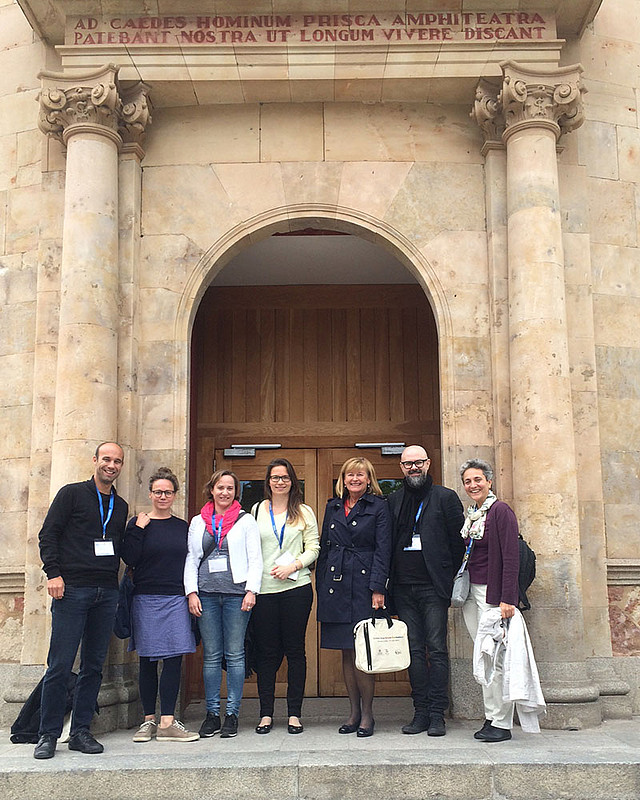
Die Grazer Delegation in Salamanca: Mario Müller, Judith Laister, Bernadette Biedermann, Alexandra Dorfer, Christa Neuper, Gerald Lind und Diana Afrashteh (v.l.). Foto: BIB.

Die Grazer Delegation in Salamanca: Mario Müller, Judith Laister, Bernadette Biedermann, Alexandra Dorfer, Christa Neuper, Gerald Lind und Diana Afrashteh (v.l.). Foto: BIB.

Jahrestagung der COIMBRA GROUP: Rektorin Neuper als Mitglied des Rectors‘ Advisory Group bestätigt

Vergangene Woche fand die Jahrestagung der COIMBRA GROUP statt, die diesmal unter dem Motto „Looking to the future, learning from the past“ von der Universität Salamanca anlässlich ihres 800-jährigen-Jubiläums veranstaltet wurde. Rektorin Christa Neuper wurde für eine zweite Periode als Mitglied des Rectors‘ Advisory Group bestätigt und stärkt somit weiter die Position der Uni Graz im Netzwerk.
Als Disputantin nach dem Vortrag von Lesley Wilson, Generalsekretärin der EUA, richtete Rektorin Neuper den Blick auf künftige Fragen und Herausforderungen, wie beispielsweise verstärkte Forschungszusammenarbeit in Zeiten knapper Ressourcen, Inklusion benachteiligter Studierendengruppen und die weitere Verbesserung des internationalen Austauschs. Sie betonte die Rolle der Universitäten als Akteure für positiven Wandel und deren Verantwortung, Antworten auf aktuelle gesellschaftsrelevante Fragen zu finden.

Die COIMBRA GROUP

Die COIMBRA GROUP umfasst 39 traditionsreiche europäische Universitäten mit starker Forschungsausrichtung und internationalem Profil. Der Fokus des Netzwerkes liegt in der Internationalisierung der Universitäten und multilateralen Kooperation in zahlreichen Projekten. Hierzu zählen unter anderem multidisziplinäre Seminare, Sommer-/Winterschulen, Workshops und Seminare zu hochschulpolitischen Themen, wissenschaftliche Fachtagungen, Stipendien für PostDocs aus Regionen außerhalb der EU, Nachwuchsförderung, EU-Drittmittelprojekte, Maßnahmen für geflüchtete Studierende und WissenschafterInnen, multidisziplinärer Studierendenaustausch, Konsultationen sowie Stellungnahmen zu EU-bildungs- und forschungspolitischen Themen wie zuletzt die aktuellen Positionspapiere zur künftigen EU Programme FP9 und Erasmus+ nach 2020.

Eine spannende Nachwuchsförderungsinitiative innerhalb des Netzwerks ist der „3MT: Three Minutes Thesis“ Wettbewerb, bei dem DoktorandInnen in maximal drei Minuten ihre Forschung einem breiten Publikum vorstellen. Die Universität Graz war dieses Jahr erneut dabei und kam unter die Top 10.

Aktuell ist die Universität Graz in acht fachspezifschen Arbeitsgruppen: Academic Exchange and Mobility, Doctoral Studies, Education Innovation, Employability, Heritage, Latin America, Research Support Officers, Social Science & Humanities. Ebenso gibt es regelmäßigen Austausch bei den Refugee -Aid Intiativen und im Öffentlichkeitsbereich. Das Büro für Internationale Beziehungen unterstützt im Rahmen der Förderrichtlinien Aktivitäten an Partneruniversitäten in den gesamtuniversitären Netzwerken, um die multidisziplinäre und multilaterale Zusammenarbeit zu fördern.

created by Diana Afrashteh & Gerhild Leljak

Related news

AI in schools: Maria Bertel drafts legal guidelines for teachers

The legal expert and her team analysed the legal situation regarding the use of artificial intelligence in education as part of an EU project and answered open questions from practice.

Cosmetics in the environment: University of Graz proves danger to ants

Titanium dioxide, which is found in cosmetics, for example, is increasingly entering the environment in the form of nanoparticles. This could also put insects at risk. If ants ingest the substance in combination with the pesticide glyphosate, it disturbs the development of their offspring. Scientists at the University of Graz are drawing attention to the negative consequences of this toxic cocktail.

Varied and healthy: studies move

Exercise is the ideal way to balance out everyday stress, prevent illness and keep fit. Why this is the case, how to do it properly and what role human bodily functions and psychology play can be studied at the University of Graz.

Religious scholar Theresia Heimerl: Fasting as a spiritual boost

Fasting is not just a strategy for losing weight – it is a ritual dating back thousands of years with spiritual and evolutionary roots that has positive effects on the body. At the University of Graz, religious scholar Theresia Heimerl is investigating why fasting is a "spiritual boost".

Begin of page section:
Additional information:

University of Graz
Universitaetsplatz 3
8010 Graz
Austria
  • Contact
  • Web Editors
  • Moodle
  • UNIGRAZonline
  • Imprint
  • Data Protection Declaration
  • Accessibility Declaration
Weatherstation
Uni Graz

End of this page section. Go to overview of page sections

End of this page section. Go to overview of page sections

Begin of page section:

End of this page section. Go to overview of page sections