Begin of page section:
Page sections:

  • Go to contents (Accesskey 1)
  • Go to position marker (Accesskey 2)
  • Go to main navigation (Accesskey 3)
  • Go to sub navigation (Accesskey 4)
  • Go to additional information (Accesskey 5)
  • Go to page settings (user/language) (Accesskey 8)
  • Go to search (Accesskey 9)

End of this page section. Go to overview of page sections

Begin of page section:
Page settings:

English en
Deutsch de
Search
Login

End of this page section. Go to overview of page sections

Begin of page section:
Search:

Search for details about Uni Graz
Close

End of this page section. Go to overview of page sections


Search

Begin of page section:
Main navigation:

Page navigation:

  • University

    University
    • About the University
    • Organisation
    • Faculties
    • Library
    • Working at University of Graz
    • Campus
    Developing solutions for the world of tomorrow - that is our mission. Our students and our researchers take on the great challenges of society and carry the knowledge out.
  • Research Profile

    Research Profile
    • Our Expertise
    • Research Questions
    • Research Portal
    • Promoting Research
    • Research Transfer
    • Ethics in Research
    • Commission for Scientific Integrity
    Scientific excellence and the courage to break new ground. Research at the University of Graz creates the foundations for making the future worth living.
  • Studies

    Studies
    • Prospective Students
    • Students
  • Community

    Community
    • International
    • Location
    • Research and Business
    • Alumni
    The University of Graz is a hub for international research and brings together scientists and business experts. Moreover, it fosters the exchange and cooperation in study and teaching.
  • Spotlight
Topics
  • Sustainable University
  • Researchers answer
  • Work for us
Close menu

End of this page section. Go to overview of page sections

Begin of page section:
You are here:

University of Graz News Achieving climate goals: Researchers highlight need for fair country shares in CO2

End of this page section. Go to overview of page sections

Thursday, 26 March 2026

Achieving climate goals: Researchers highlight need for fair country shares in CO2

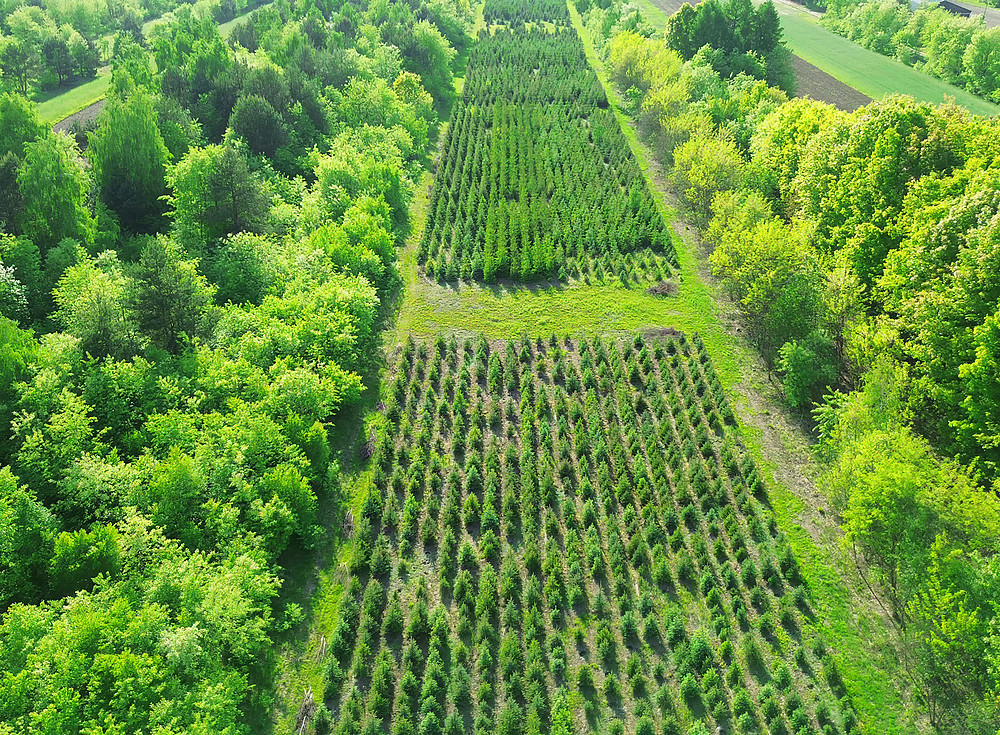
Reforestation saplings planted in neat rows

Reforestation is one way of sequestering CO₂ from the atmosphere. However, due to the slow growth of trees, this is only feasible for relatively small amounts. Researchers at the University of Graz are therefore calling for a fair distribution of CO₂ sinks across all countries. Photo: AlexGo/Adobe Stock

As the war in the Middle East is currently reminding us once again, many countries around the world are heavily reliant on oil and gas. Lax climate policy and limited options for removing CO₂ from the atmosphere could cement this dependence for future generations. Scientists at the University of Graz highlight this danger in a new study published in the journal Global Environmental Change. They find that rights to carbon dioxide removal should be distributed across countries just as fairly as emission budgets in order to halt global warming.

In order to limit the global temperature rise to 1.5 degrees above pre-industrial levels in the long term – as agreed in the Paris Climate Agreement – all emissions still being produced after 2050 must continually be offset by removing carbon dioxide from the atmosphere. Options for achieving this include afforestation, bioenergy plants with carbon capture, or machines that extract the greenhouse gas directly from the air. The carbon is then stored deep underground in former oil and gas reservoirs. “However, based on realistic calculations, the sustainable long-term annual capacity of all these natural and technological CO₂ sinks amounts to less than ten percent of current annual greenhouse gas emissions,” says Julia Danzer, summarizing one of the key findings of the new study she has published together with Gottfried Kirchengast from the Wegener Center and Institute of Physics at the University of Graz. In the study, the two also analyze how globally limited emission and removal budgets can be allocated across countries that individually, and collectively as a worldwide goal, want to achieve climate neutrality.

Gaming world exposes injustice 

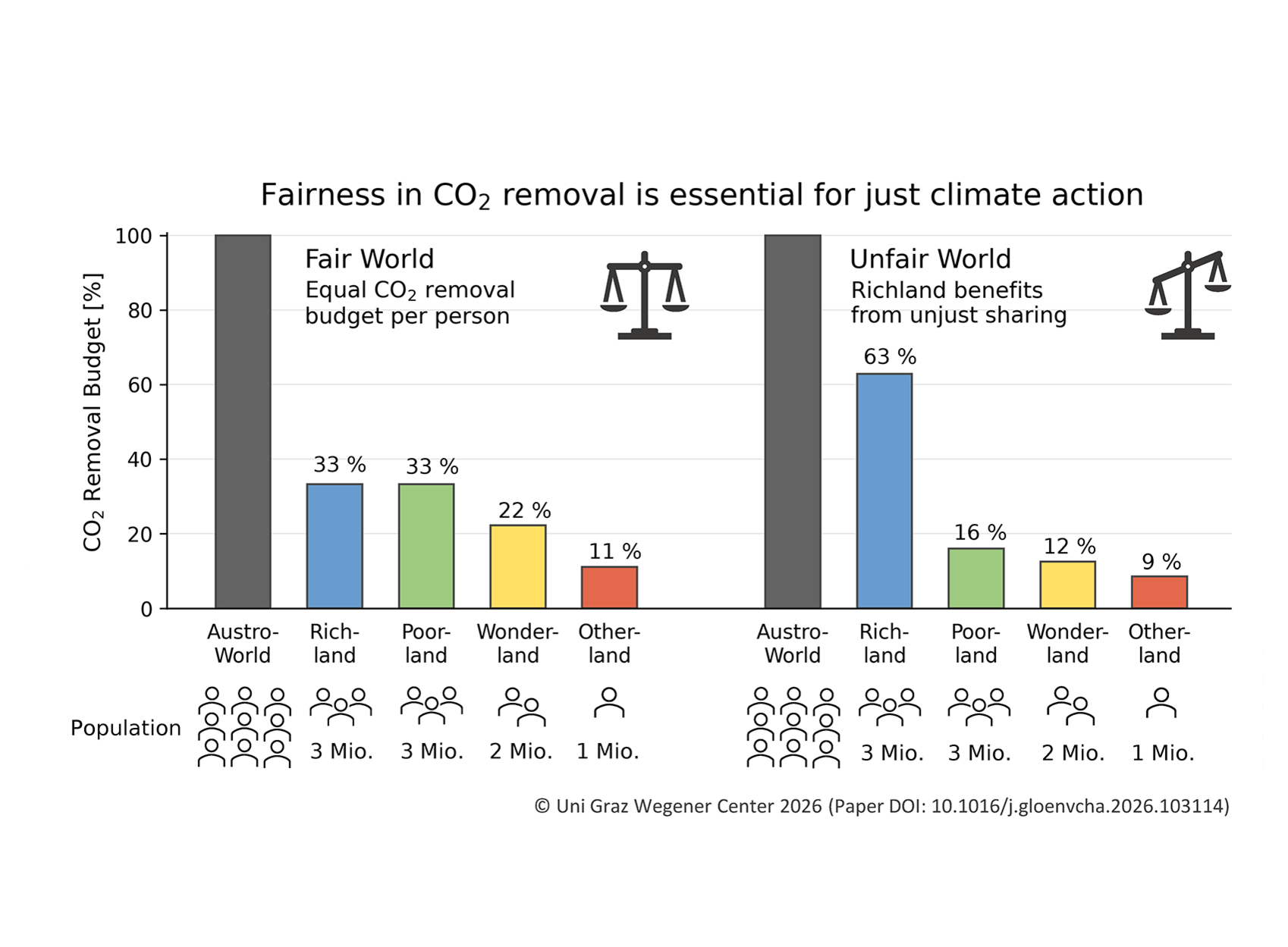
Kirchengast and Danzer have developed a simple yet instructive “computer game model” for this purpose, which they used to explore justice aspects in such budget allocations. In a fictional “Austro-World”, they placed four stylized countries: Richland and Poorland, each with a population of three million persons; Wonderland with two million persons; and Otherland with one million. The countries have two decades to individually and collectively achieve net-zero emissions. With a carbon removal budget of, say, 100 million tonnes of CO2 – which, in a fair world, is distributed with equal shares per person – the maths is simple: Richland and Poorland each receive around 33 million tonnes, Wonderland 22 million and Otherland 11 million tonnes.
Starting from such a fair world, the researchers have examined further plausible scenarios in which the game is getting unfair – such as Richland claiming a larger emission budget at the expense of Poorland and additionally exploiting advantages in CO2 sinks. “For example, an oil-producing country can make other countries depending on it once again, after the profit from oil sales before, by its control over the empty underground reservoirs now used for carbon storage,” explains Kirchengast. The result of an unfair scenario of this kind: Richland has a sharply raised carbon removal budget of 63 million tonnes of CO2, whilst Poorland is left with only 16 million.
“Our model is deliberately simple in this initial study, but it highlights the fundamental problem. In a next step, it can be applied to real-world country data,” emphasizes Kirchengast. “But even as it stands, it is clear just how much a lax climate policy is placing a huge and extremely unfair burden on the current generation of children, given the limited capacity of sustainable CO2 sinks.” “Scaling up carbon dioxide removal to billion-ton capacities also takes a long time, whether you’re planting trees or developing new technologies,” adds Julia Danzer. “Our study shows that fairness is just as important here as it is for the urgently needed reduction of greenhouse gases within the limited emission budget.”
Publication:
Julia Danzer, Gottfried Kirchengast: Bringing fairness also into carbon removal shares of countries is essential for a just transition. Global Environmental Change, Feber 2026.

Graphics depicting the gaming model described in the text
The share of countries in a limited budget for removing CO2 from the atmosphere is massively skewed in an unfair world (right) compared to a fair world (left). In the example scenario shown, in the unfair case, an equal removal amount per person is only achieved in the final year of the modeling period, and Richland exploits its economic dominance by claiming an excessive budget. As a result, its share almost doubles (from 33 to 63 percent), whilst Poorland’s share is halved (from 33 to 16 percent) and the shares of the other countries also suffer.
created by Dagmar Eklaude

Related news

Electrons and AI: New approaches to the search for new medicines

Researchers at the University of Graz are revolutionising the development of new medicines by combining electrochemistry and artificial intelligence. Thanks to smart optimisation, the search for new active ingredients will in future be faster, more sustainable and safer.

Universities call for sustained investment in the Southern Education Region

University rectors are calling for an adequately funded budget for the Southern Education Region

University of Graz in the summer semester 2026: An overview of the best events

From crime fiction evenings to open houses and campus festivals: the University of Graz is offering a diverse programme for students, curious minds and culture enthusiasts in the 2026 summer semester.

New groundbreaking computation method for climate extremes

How much will heat, flooding, drought and storms increase as a result of human-induced climate change? In a groundbreaking study, climate researcher Gottfried Kirchengast and his team at the University of Graz have developed a new method for computing the hazards from extreme events: it can compute all relevant hazard metrics for events such as heat waves, floods and droughts in any region worldwide with unprecedented information content. Using it for Europe, the researchers found that anthropogenic climate change has caused a tenfold increase in extreme heat in recent decades. The study, published in the journal Weather and Climate Extremes, also provides a basis for better quantifying the damage to people, ecosystems and infrastructure.

Begin of page section:
Additional information:

University of Graz
Universitaetsplatz 3
8010 Graz
Austria
  • Contact
  • Web Editors
  • Moodle
  • UNIGRAZonline
  • Imprint
  • Data Protection Declaration
  • Accessibility Declaration
Weatherstation
Uni Graz

End of this page section. Go to overview of page sections

End of this page section. Go to overview of page sections

Begin of page section:

End of this page section. Go to overview of page sections