Begin of page section:
Page sections:

  • Go to contents (Accesskey 1)
  • Go to position marker (Accesskey 2)
  • Go to main navigation (Accesskey 3)
  • Go to sub navigation (Accesskey 4)
  • Go to additional information (Accesskey 5)
  • Go to page settings (user/language) (Accesskey 8)
  • Go to search (Accesskey 9)

End of this page section. Go to overview of page sections

Begin of page section:
Page settings:

English en
Deutsch de
Search
Login

End of this page section. Go to overview of page sections

Begin of page section:
Search:

Search for details about Uni Graz
Close

End of this page section. Go to overview of page sections


Search

Begin of page section:
Main navigation:

Page navigation:

  • University

    University
    • About the University
    • Organisation
    • Faculties
    • Library
    • Working at University of Graz
    • Campus
    Developing solutions for the world of tomorrow - that is our mission. Our students and our researchers take on the great challenges of society and carry the knowledge out.
  • Research Profile

    Research Profile
    • Our Expertise
    • Research Questions
    • Research Portal
    • Promoting Research
    • Research Transfer
    • Ethics in Research
    Scientific excellence and the courage to break new ground. Research at the University of Graz creates the foundations for making the future worth living.
  • Studies

    Studies
    • Prospective Students
    • Students
  • Community

    Community
    • International
    • Location
    • Research and Business
    • Alumni
    The University of Graz is a hub for international research and brings together scientists and business experts. Moreover, it fosters the exchange and cooperation in study and teaching.
  • Spotlight
Topics
  • Our digital Advent calendar
  • Sustainable University
  • Researchers answer
  • Work for us
Close menu

End of this page section. Go to overview of page sections

Begin of page section:
You are here:

University of Graz News Against the current: overcoming obstacles for renewable energy communities

End of this page section. Go to overview of page sections

Wednesday, 20 March 2024

Against the current: overcoming obstacles for renewable energy communities

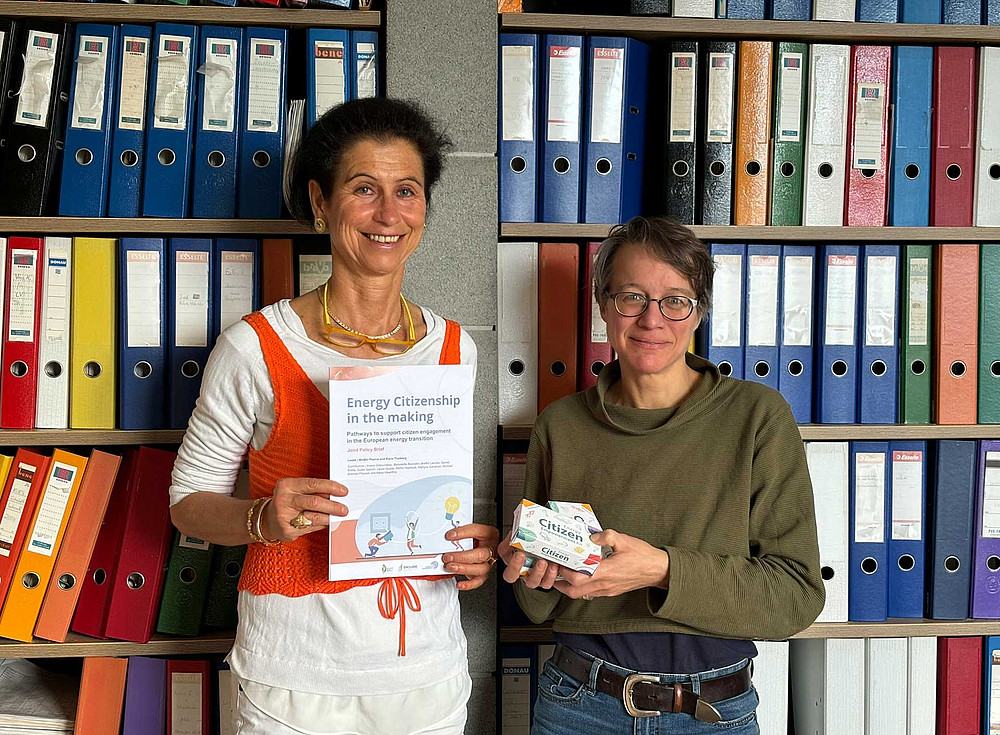
Brigitta Lurger (left) and Katja Corocran

Brigitta Lurger (left) and Katja Corocran want to support renewable energy communities and break down legal and socio-psychological barriers. Photo: University of Graz/Schweiger

Residents of an apartment building have jointly installed a photovoltaic system on the roof. They now receive cheap electricity and are independent of large corporations. And they are also helping to protect the climate. If only everything were that simple. In fact, the road for renewable energy communities is rocky. Scientists at the University of Graz explain how obstacles can be overcome.

The Austrian coordination office lists around 300 renewable energy communities. There could be many more, say legal scholar Brigitta Lurger and social psychologist Katja Corcoran.
As part of the EU Horizon 2020 project "EC² - Energy Citizenship and Energy Communities for a Clean Energy Transition", the two researchers have developed proposals on how legal, socio-psychological and economic barriers can be broken down. Together with other scientists from seven European countries, they want to support the transition to a sustainable energy supply. They confirm: "The energy crisis has fueled momentum and significantly increased interest."

Rethinking the law

In the energy transition driven by EU policy, there is a shift in responsibilities, so to speak. Lurger: "Because the individual should now think about the common good." However, the very complex legal framework conditions, some of which are enshrined in public law, do not take sufficient account of the associated burdens. For example, there are stumbling blocks when installing PV systems on multi-party buildings, as the consent of all residents or the landlord may be required.
Amendments are also needed to the Electricity Industry and Organization Act, for example to ensure that communities can feed into electricity grids and become independent of the dominant operator groups.

One-stop store

The two scientists believe that local authorities in particular have a role to play: "They should play a more active role in coordination, advice and also in municipal housing construction." This is because clear, low-threshold information is extremely important due to the complexity of the subject matter. "So that we don't just reach people who are already interested in the topic."
Lurger and Corcoran speak of a one-stop store where all the threads come together at municipal level and legal, technical and critical issues are resolved. Furthermore, the promotion of social networking among the new energy community members and the exchange of experience among experienced participants from older energy communities and newcomers is important.
The project team also recommends an entertaining approach and has developed a card game for this purpose. This is intended to raise questions and get people talking.

Eliminating inequalities

Joining forces also brings economic benefits. Brigitta Lurger: "Not everyone can afford a purchase on their own, which increases social differences." A community compensates for this because both installation and electricity are cheaper.
Katja Corcoran mentions a positive side effect: "The community spirit motivates people in an often anonymous neighborhood to get involved and make a difference." But: "Especially in times of crisis, when there is a lot of financial and psychological stress, bureaucratic processes need to be made all the simpler."

Research is anchored in the Smart Regulation profile area.

created by Andreas Schweiger

Related news

Chemical Christmas show at the University of Graz: An explosive evening at the Schauspielh

At the beginning of December, the University of Graz transformed the theater into a laboratory: as part of “Chemical Life,” teacher training students staged a chemical Christmas show for Styrian school classes—complete with ethanol rockets, nitrogen snow, and glowing effects. An evening designed to inspire interest in studying chemistry.

Train by train: Koralm railway accelerates exchange between the Universities

Lectures at the University of Klagenfurt in the morning, seminars at the University of Graz in the afternoon: Austria's longest tunnel and a journey time of around 45 minutes make it easy. The Koralm railway increases the speed of networking between the two university locations. The collaboration builds on existing cooperation - for example in the areas of teacher training, Slavic studies and as employers, the universities are well coordinated.

On the trail of the Big Bang: University of Graz receives 1.5 million euros for doctoral programmes

The Austrian Science Fund FWF has selected the Doctoral Programme in Theoretical Particle Physics at the University of Graz for funding from the Doc.funds. Six young scientists will be funded for 3.5 years. They will gain fundamentally new insights into the origins of the world.

From trans women and knee prostheses: sports science prizes awarded

Walking better with a prosthesis, successfully getting rid of excess weight, training more effectively, more fairness for trans people in sport: these were the topics addressed by the students at the University of Graz who were awarded the sports science prizes for their Master's theses on 3 December 2025.

Begin of page section:
Additional information:

University of Graz
Universitaetsplatz 3
8010 Graz
Austria
  • Contact
  • Web Editors
  • Moodle
  • UNIGRAZonline
  • Imprint
  • Data Protection Declaration
  • Accessibility Declaration
Weatherstation
Uni Graz

End of this page section. Go to overview of page sections

End of this page section. Go to overview of page sections

Begin of page section:

End of this page section. Go to overview of page sections