Begin of page section:
Page sections:

  • Go to contents (Accesskey 1)
  • Go to position marker (Accesskey 2)
  • Go to main navigation (Accesskey 3)
  • Go to sub navigation (Accesskey 4)
  • Go to additional information (Accesskey 5)
  • Go to page settings (user/language) (Accesskey 8)
  • Go to search (Accesskey 9)

End of this page section. Go to overview of page sections

Begin of page section:
Page settings:

English en
Deutsch de
Search
Login

End of this page section. Go to overview of page sections

Begin of page section:
Search:

Search for details about Uni Graz
Close

End of this page section. Go to overview of page sections


Search

Begin of page section:
Main navigation:

Page navigation:

  • University

    University
    • About the University
    • Organisation
    • Faculties
    • Library
    • Working at University of Graz
    • Campus
    Developing solutions for the world of tomorrow - that is our mission. Our students and our researchers take on the great challenges of society and carry the knowledge out.
  • Research Profile

    Research Profile
    • Our Expertise
    • Research Questions
    • Research Portal
    • Promoting Research
    • Research Transfer
    • Ethics in Research
    Scientific excellence and the courage to break new ground. Research at the University of Graz creates the foundations for making the future worth living.
  • Studies

    Studies
    • Prospective Students
    • Students
  • Community

    Community
    • International
    • Location
    • Research and Business
    • Alumni
    The University of Graz is a hub for international research and brings together scientists and business experts. Moreover, it fosters the exchange and cooperation in study and teaching.
  • Spotlight
Topics
  • Our digital Advent calendar
  • Sustainable University
  • Researchers answer
  • Work for us
Close menu

End of this page section. Go to overview of page sections

Begin of page section:
You are here:

University of Graz News Freut euch!

End of this page section. Go to overview of page sections

Tuesday, 14 May 2019

Freut euch!

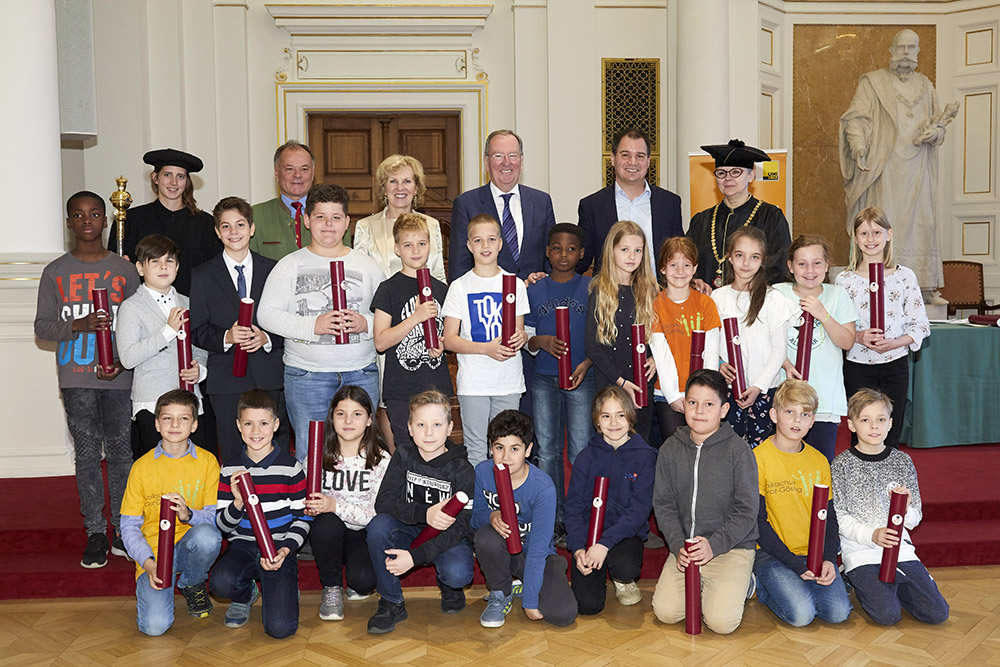
Die Ehrengäste VR Dworczak, Schickhofer, Schwindsackl, Horn und Piffl-Percevic (hinterste Reihe v.r.) mit TeilnehmerInnen der KinderUniGraz bei deren Sponsion. Foto: Melbinger. ©Foto Peter Melbinger/UNI Graz

Die Ehrengäste VR Dworczak, Schickhofer, Schwindsackl, Horn und Piffl-Percevic (hinterste Reihe v.r.) mit TeilnehmerInnen der KinderUniGraz bei deren Sponsion. Foto: Melbinger.

Über 100 TeilnehmerInnen feierten Sponsion der KinderUniGraz

Über 100 Kindern von vier Grazer Pflichtschulen nahmen am Montag, 13. Mai 2019, bei der Sponsionsfeier der KinderUniGraz ihre wohlverdienten Abschlussurkunden entgegen. Vizerektorin Renate Dworczak überreichte die Urkunden an die jungen TeilnehmerInnen in der Aula der Universität Graz.
Die Ehrengäste Landeshauptmannstellvertreter Michael Schickhofer, Ernest Schwindsackl, Mitglied des Bundesrats, Gemeinderat Peter Piffl-Percevic sowie Christa Horn, Schulqualitätsmanagerin der Bildungsdirektion für Steiermark, gratulierten den AbsolventInnen der KinderUniGraz ebenfalls und ermutigten sie, neugierig zu bleiben und die Zukunft aktiv mitzugestalten.

Die KinderUniGraz ist ein Kooperationsprojekt aller Grazer Universitäten, Fachhochschulen und Pädagogischen Hochschulen mit dem Ziel, Kinder schon früh für Wissenschaft, Forschung und Kunst zu begeistern. Bei der KinderUniGraz besuchen die SchülerInnen kindgerechte Vorlesungen und Workshops von WissenschafterInnen und Lehrenden der Universitäten, Fachhochschulen und Pädagogischen Hochschulen, die mit einem Stempel im „Studierendenausweis“ belohnt werden. Wurden genügend Stempel gesammelt, hat man sich die Urkunde zum Bachelor oder Master der KinderUniGraz wirklich verdient. Pro Jahr nehmen mehr als 3.000 KinderUniGraz-Studierende zwischen 6 und 19 Jahren teil.

Unterstützt wird das Projekt seitens der Stadt Graz aus der Ing. Friedrich Schmiedl-Stiftung sowie vom Bildungsministerium und vom Land Steiermark.


created by Lena Franke & Gerhild Leljak

Related news

Fair distribution: Researchers determine just greenhouse gas budgets for all EU regions

Ten years ago, on 12 December 2015, the Paris Climate Agreement was signed at the UN Climate Conference. In order to limit global warming to well below two degrees, only a certain amount of CO2 may be emitted worldwide. While the focus was originally on national emission targets, more than 200 subnational regions and almost 300 cities have now adopted their own targets. But how many emissions are they fairly entitled to? Researchers at the University of Graz have now developed transparent criteria for fair distribution at the subnational level for the first time and determined corresponding greenhouse gas budgets for all European regions. The paper was published today in the scientific journal Nature Communications.

Chemical Christmas show at the University of Graz: An explosive evening at the Schauspielh

At the beginning of December, the University of Graz transformed the theater into a laboratory: as part of “Chemical Life,” teacher training students staged a chemical Christmas show for Styrian school classes—complete with ethanol rockets, nitrogen snow, and glowing effects. An evening designed to inspire interest in studying chemistry.

Train by train: Koralm railway accelerates exchange between the Universities

Lectures at the University of Klagenfurt in the morning, seminars at the University of Graz in the afternoon: Austria's longest tunnel and a journey time of around 45 minutes make it easy. The Koralm railway increases the speed of networking between the two university locations. The collaboration builds on existing cooperation - for example in the areas of teacher training, Slavic studies and as employers, the universities are well coordinated.

On the trail of the Big Bang: University of Graz receives 1.5 million euros for doctoral programmes

The Austrian Science Fund FWF has selected the Doctoral Programme in Theoretical Particle Physics at the University of Graz for funding from the Doc.funds. Six young scientists will be funded for 3.5 years. They will gain fundamentally new insights into the origins of the world.

Begin of page section:
Additional information:

University of Graz
Universitaetsplatz 3
8010 Graz
Austria
  • Contact
  • Web Editors
  • Moodle
  • UNIGRAZonline
  • Imprint
  • Data Protection Declaration
  • Accessibility Declaration
Weatherstation
Uni Graz

End of this page section. Go to overview of page sections

End of this page section. Go to overview of page sections

Begin of page section:

End of this page section. Go to overview of page sections