Begin of page section:
Page sections:

  • Go to contents (Accesskey 1)
  • Go to position marker (Accesskey 2)
  • Go to main navigation (Accesskey 3)
  • Go to sub navigation (Accesskey 4)
  • Go to additional information (Accesskey 5)
  • Go to page settings (user/language) (Accesskey 8)
  • Go to search (Accesskey 9)

End of this page section. Go to overview of page sections

Begin of page section:
Page settings:

English en
Deutsch de
Search
Login

End of this page section. Go to overview of page sections

Begin of page section:
Search:

Search for details about Uni Graz
Close

End of this page section. Go to overview of page sections


Search

Begin of page section:
Main navigation:

Page navigation:

  • University

    University
    • About the University
    • Organisation
    • Faculties
    • Library
    • Working at University of Graz
    • Campus
    Developing solutions for the world of tomorrow - that is our mission. Our students and our researchers take on the great challenges of society and carry the knowledge out.
  • Research Profile

    Research Profile
    • Our Expertise
    • Research Questions
    • Research Portal
    • Promoting Research
    • Research Transfer
    • Ethics in Research
    Scientific excellence and the courage to break new ground. Research at the University of Graz creates the foundations for making the future worth living.
  • Studies

    Studies
    • Prospective Students
    • Students
  • Community

    Community
    • International
    • Location
    • Research and Business
    • Alumni
    The University of Graz is a hub for international research and brings together scientists and business experts. Moreover, it fosters the exchange and cooperation in study and teaching.
  • Spotlight
Topics
  • Our digital Advent calendar
  • Sustainable University
  • Researchers answer
  • Work for us
Close menu

End of this page section. Go to overview of page sections

Begin of page section:
You are here:

University of Graz News Fettspeicherung hemmen

End of this page section. Go to overview of page sections

Tuesday, 24 May 2016

Fettspeicherung hemmen

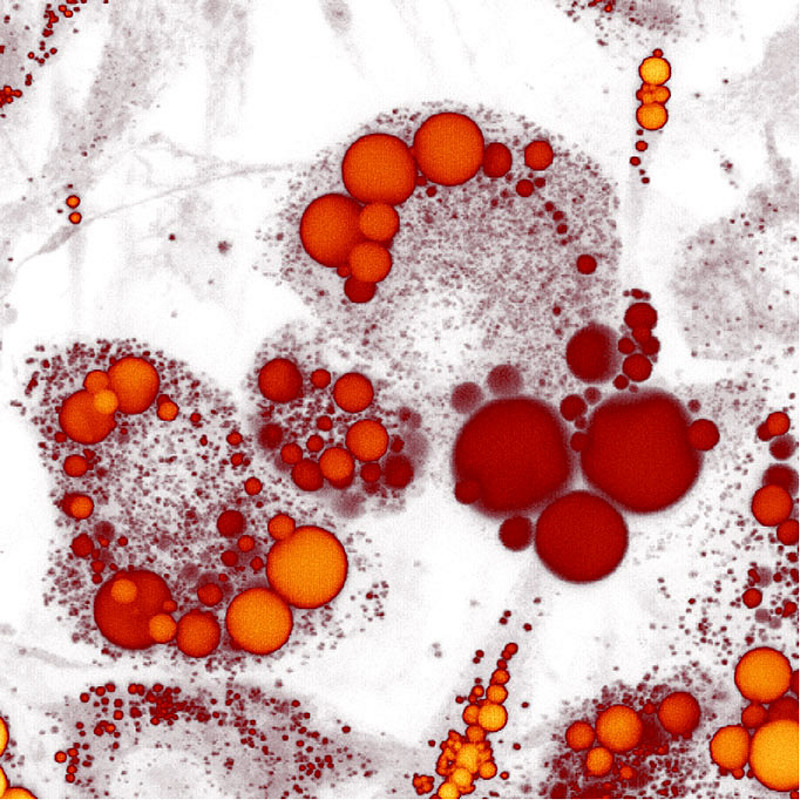
Säugetierzellen mit Fettansammlungen. Foto: Uni Graz/Wolinski, IMB

Säugetierzellen mit Fettansammlungen. Foto: Uni Graz/Wolinski, IMB

Internationales Forschungsteam mit Beteiligung der Uni Graz entdeckte neue Molekülklasse, die das Enzym DGAT1 ausschaltet

Fettstoffwechselerkrankungen wie Adipositas stehen mit verschiedenen Erkrankungen des Menschen im Zusammenhang. Erhöhte Fettwerte werden als besondere Risikofaktoren etwa für Herz-Kreislauf-Erkrankungen gesehen. Die Möglichkeit, in den Fettstoffwechsel und vor allem auch auf die Speicherung von Fetten im Körpergewebe Einfluss zu nehmen, stellen damit Ansatzpunkte für die Behandlung zahlreicher Erkrankungen dar.
Eine internationale Forschungsgruppe aus den USA, Österreich und Deutschland identifizierte eine neue Klasse von pharmakologisch aktiven Substanzen, die ein wichtiges Enzym im Fettstoffwechsel hemmt. Von der Karl-Franzens-Universität Graz war das Team um Assoz. Prof. Dr. Achim Lass und Dr. Thomas Eichmann am Institut für Molekulare Biowissenschaften beteiligt. Für ihre Studien haben die ForscherInnen in einem Massentest mehr als 300.000 verschiedene Substanzen untersucht. Die Ergebnisse veröffentlichten sie in der Zeitschrift EBioMedicine.

Das internationale Team um Juniorprofessor Dr. Mathias Beller von der Heinrich-Heine-Universität hat in einer groß angelegten Studie eine Vielzahl von Molekülen hinsichtlich ihres Einflusses auf die Fettspeicherung untersucht. Unter über 300.000 Substanzen fanden sie mehrere Hundert potente Molekülstrukturen, die die Fettspeicherung in Zellen verhindern. Von drei näher untersuchten Strukturklassen stellte sich weiter heraus, dass eine dieser Strukturen das für die Fettspeicherung zentrale Enzym Diacylglycerol-Acyltransferase-1 (DGAT1) ausschaltet.

Die Untersuchungen geschahen in Form eines Ultrahochdurchsatz-Screenings am National Institute of Health in Washington zunächst an Fruchtfliegenzellen. Für das Testen der Substanzbibliothek nutzte man eine Roboterstraße, die es erlaubt, Zellexperimente im kleinsten Maßstab durchzuführen. Dazu werden sogenannte 1536-well Platten verwendet: Kunststoffplatten mit 1536 winzigen Vertiefungen, an deren Boden jeweils einige Fruchtfliegenzellen liegen. In jede dieser Vertiefungen wird eine andere Substanz geträufelt, jeweils nur winzige Mengen. Mit automatisierten optischen Verfahren wurden ermittelt, wie viel Fett die Zellen in jeder einzelnen Vertiefung gespeichert hatten. Die verwendete Substanzbibliothek deckte eine große Bandbreite chemischer Strukturen und biologischer Aktivitäten ab. Von den meisten Strukturen ist der Wirkmechanismus allerdings noch unbekannt.

Die vielversprechendsten Substanzen aus diesem Screening wurden in Zusammenarbeit mit der Forschungsgruppe um Achim Lass und Thomas Eichmann von der Uni Graz an verschiedenen Säugetier-Zellen in vitro getestet. Dabei haben die WissenschafterInnen entdeckt, dass die Strukturen auch in höheren Organismen aktiv sind. Für eine dieser Verbindungen konnte der Wirkmechanismus, nämlich die Inhibierung des fettaufbauenden Enzyms DGAT1, entschlüsselt werden.

Publikation
K. Tschapalda, Y. Zhang, L. Liu, K. Golovnina, T. Schlemper, T. Eichmann, M. Lal-Nag, U. Sreenivasan, J. McLenithan, S. Ziegler, C. Sztalryd, A. Lass, D. Auld, B. Oliver, H. Waldmann, Z. Li, M. Shen, M. Boxer, M. Beller, „ A class of diacylglycerol acyltransferase 1 inhibitors identified by a combination of phenotypic high-throughput screening, genomics, and genetics “, EBioMedicine, EBIOM567  
DOI: 10.1016/j.ebiom.2016.04.014

created by Arne Claussen & Gudrun Pichler

Related news

Semester abroad without barriers: University of Graz wins award for promoting inclusion

The University of Graz has been awarded the Internationalization Award for its new inclusion initiative. Students with fewer opportunities now also receive financial support for their semester abroad outside Europe.

Fair distribution: Researchers determine just greenhouse gas budgets for all EU regions

Ten years ago, on 12 December 2015, the Paris Climate Agreement was signed at the UN Climate Conference. In order to limit global warming to well below two degrees, only a certain amount of CO2 may be emitted worldwide. While the focus was originally on national emission targets, more than 200 subnational regions and almost 300 cities have now adopted their own targets. But how many emissions are they fairly entitled to? Researchers at the University of Graz have now developed transparent criteria for fair distribution at the subnational level for the first time and determined corresponding greenhouse gas budgets for all European regions. The paper was published today in the scientific journal Nature Communications.

Chemical Christmas show at the University of Graz: An explosive evening at the Schauspielh

At the beginning of December, the University of Graz transformed the theater into a laboratory: as part of “Chemical Life,” teacher training students staged a chemical Christmas show for Styrian school classes—complete with ethanol rockets, nitrogen snow, and glowing effects. An evening designed to inspire interest in studying chemistry.

Train by train: Koralm railway accelerates exchange between the Universities

Lectures at the University of Klagenfurt in the morning, seminars at the University of Graz in the afternoon: Austria's longest tunnel and a journey time of around 45 minutes make it easy. The Koralm railway increases the speed of networking between the two university locations. The collaboration builds on existing cooperation - for example in the areas of teacher training, Slavic studies and as employers, the universities are well coordinated.

Begin of page section:
Additional information:

University of Graz
Universitaetsplatz 3
8010 Graz
Austria
  • Contact
  • Web Editors
  • Moodle
  • UNIGRAZonline
  • Imprint
  • Data Protection Declaration
  • Accessibility Declaration
Weatherstation
Uni Graz

End of this page section. Go to overview of page sections

End of this page section. Go to overview of page sections

Begin of page section:

End of this page section. Go to overview of page sections