Begin of page section:
Page sections:

  • Go to contents (Accesskey 1)
  • Go to position marker (Accesskey 2)
  • Go to main navigation (Accesskey 3)
  • Go to sub navigation (Accesskey 4)
  • Go to additional information (Accesskey 5)
  • Go to page settings (user/language) (Accesskey 8)
  • Go to search (Accesskey 9)

End of this page section. Go to overview of page sections

Begin of page section:
Page settings:

English en
Deutsch de
Search
Login

End of this page section. Go to overview of page sections

Begin of page section:
Search:

Search for details about Uni Graz
Close

End of this page section. Go to overview of page sections


Search

Begin of page section:
Main navigation:

Page navigation:

  • University

    University
    • About the University
    • Organisation
    • Faculties
    • Library
    • Working at University of Graz
    • Campus
    Developing solutions for the world of tomorrow - that is our mission. Our students and our researchers take on the great challenges of society and carry the knowledge out.
  • Research Profile

    Research Profile
    • Our Expertise
    • Research Questions
    • Research Portal
    • Promoting Research
    • Research Transfer
    • Ethics in Research
    • Commission for Scientific Integrity
    Scientific excellence and the courage to break new ground. Research at the University of Graz creates the foundations for making the future worth living.
  • Studies

    Studies
    • Prospective Students
    • Students
  • Community

    Community
    • International
    • Location
    • Research and Business
    • Alumni
    The University of Graz is a hub for international research and brings together scientists and business experts. Moreover, it fosters the exchange and cooperation in study and teaching.
  • Spotlight
Topics
  • Sustainable University
  • Researchers answer
  • Work for us
Close menu

End of this page section. Go to overview of page sections

Begin of page section:
You are here:

University of Graz News Fallschirm für Drohnen

End of this page section. Go to overview of page sections

Thursday, 27 October 2016

Fallschirm für Drohnen
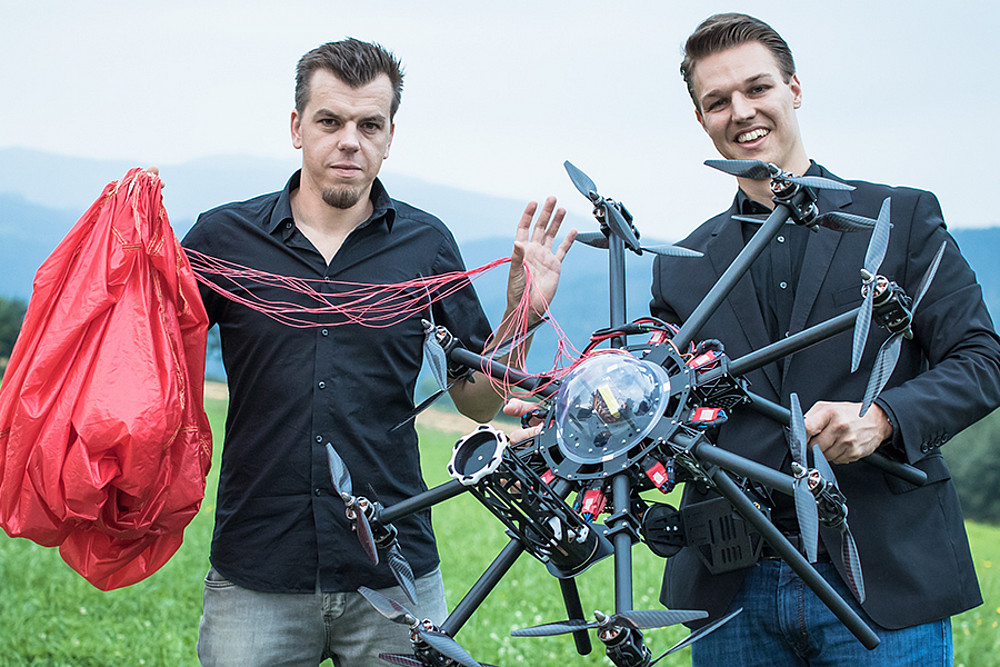
Markus Manninger (links) und Andreas Ploier entwickelten ein innovatives Rettungssytem für Drohnen. Foto: dronerescue.at

Markus Manninger (links) und Andreas Ploier entwickelten ein innovatives Rettungssytem für Drohnen. Foto: dronerescue.at

Grazer Studenten entwickeln Rettungssystem für Fluggeräte

Sie liefern spektakuläre Bilder und sollen künftig sogar Pakete zustellen. Drohnen werden in naher Zukunft immer häufiger über unseren Köpfen kreisen. Umso notwendiger werden effektive Absturzsicherungen. Zwei Studenten der Karl-Franzens-Universität und der Technischen Universität Graz – Markus Manninger und Andreas Ploier – haben dafür eine innovative Lösung entwickelt: Einen Fallschirm, der sich im Notfall automatisch öffnet. Das unbemannte Fluggerät sinkt langsam zu Boden, damit wird das Risiko für Material sowie Menschen deutlich minimiert. Der Erfindergeist der beiden Grazer wurde kürzlich von der europäischen Weltraumagentur ESA ausgezeichnet.

Es sind bis zu 35 Kilogramm, die wie der buchstäbliche Stein vom Himmel fallen können. Kostspielige Technik im Wert von 50.000 Euro und mehr zerschellt am Boden, Menschen sind enormer Gefährdung ausgesetzt. Die Wucht eines Aufpralls demonstrierte ein Zwischenfall beim Slalomklassiker in Madonna di Campiglio im vergangenen Dezember. Eine Drohne stürzte ungebremst knapp hinter Skistar Marcel Hirscher auf die Piste.
Die Erfindung von Markus Manninger und Andreas Ploier könnte in Fällen wie diesen das Schlimmste verhindern. Die beiden Grazer haben ein Rettungssystem entwickelt, das auf gängigen Drohnen angebracht werden kann. „Sensoren messen das Flugverhalten. Ist dieses plötzlich außer der Norm, kommt das Fluggerät zum Beispiel ins Trudeln, wird automatisch der Fallschirm hinausgeschleudert und geöffnet“, schildert Manninger, der Telematik an der TU Graz studiert.
„Unser System unterscheidet sich von bekannten Varianten, bei denen der Fallschirm nur manuell und damit stark zeitverzögert – und lediglich in Sichtweite – ausgelöst wird“, ergänzt Andreas Ploier, der als Student der Betriebswirtschaft an der Uni Graz vor allem für die unternehmerische Seite des Projekts zuständig ist.

Die zwei Studenten werden als Start-up vom akademischen Gründungszentrum Science Park Graz unterstützt. Derzeit wird das zum Patent angemeldete Produkt intensiv getestet, auch die hinter der Technik liegenden Algorithmen werden nachgeschärft. Die Jungunternehmer planen eine Firmengründung und sind auf der Suche nach InvestorInnnen und KooperationspartnerInnen.
Die Idee konnte kürzlich sogar den Österreich-Sieg der European Satellite Navigation Competion der ESA erringen.

>> Projektseite auf Sciencepark

created by Andreas Schweiger

Related news

Studying at the University of Graz: How to enrol

Ready for a new chapter in your life with the start of your studies at the University of Graz in the winter semester 2026/27? Here you will find information on deadlines, admission procedures, registration, and everything else you need to successfully start your studies in the fall.

Interpreting data: Why studies sometimes get it wrong

Hilmar Brohmer and Ziva Korda from the Institute of Psychology, together with 500 international colleagues, have re-evaluated a hundred scientific publications and have often come to different conclusions.

Crystal-clear: AI method revolutionises solar observation

The Sun makes life on Earth possible. However, its magnetic fields can also cause massive disruption. This makes it all the more important to gain a better understanding of the processes taking place on our nearest star. A research team from the University of Graz and the High Altitude Observatory in Boulder (USA) has succeeded in doing just that. The astrophysicists have developed an AI-supported method that makes even the smallest structures on the Sun visible. The scientists are convinced that this will bring about a lasting change in solar observation and that the new method can be used for the planned European Solar Telescope.

Long Night of Research: How many languages are there in the world?

From a linguistic perspective, there are worlds of difference between Bern, Berlin and Vienna. A dialect impersonator will demonstrate live just how varied German can sound. How many languages are there in the world? What are their distinctive features? Which of these are spoken in Austria? These and other questions will be answered during the Long Night of Research at the University of Graz: on Friday, 24 April 2025, from 5 pm to 11 pm, in the University Library. Visitors can immerse themselves in the diversity of languages without travelling far by taking part in a quiz at the station.

Begin of page section:
Additional information:

University of Graz
Universitaetsplatz 3
8010 Graz
Austria
  • Contact
  • Web Editors
  • Moodle
  • UNIGRAZonline
  • Imprint
  • Data Protection Declaration
  • Accessibility Declaration
Weatherstation
Uni Graz

End of this page section. Go to overview of page sections

End of this page section. Go to overview of page sections

Begin of page section:

End of this page section. Go to overview of page sections