Begin of page section:
Page sections:

  • Go to contents (Accesskey 1)
  • Go to position marker (Accesskey 2)
  • Go to main navigation (Accesskey 3)
  • Go to sub navigation (Accesskey 4)
  • Go to additional information (Accesskey 5)
  • Go to page settings (user/language) (Accesskey 8)
  • Go to search (Accesskey 9)

End of this page section. Go to overview of page sections

Begin of page section:
Page settings:

English en
Deutsch de
Search
Login

End of this page section. Go to overview of page sections

Begin of page section:
Search:

Search for details about Uni Graz
Close

End of this page section. Go to overview of page sections


Search

Begin of page section:
Main navigation:

Page navigation:

  • University

    University
    • About the University
    • Organisation
    • Faculties
    • Library
    • Working at University of Graz
    • Campus
    Developing solutions for the world of tomorrow - that is our mission. Our students and our researchers take on the great challenges of society and carry the knowledge out.
  • Research Profile

    Research Profile
    • Our Expertise
    • Research Questions
    • Research Portal
    • Promoting Research
    • Research Transfer
    • Ethics in Research
    • Commission for Scientific Integrity
    Scientific excellence and the courage to break new ground. Research at the University of Graz creates the foundations for making the future worth living.
  • Studies

    Studies
    • Prospective Students
    • Students
    • Registration for Study Programme (Winter semester 2026/27)
    • Welcome Weeks for First Year Students
  • Community

    Community
    • International
    • Location
    • Research and Business
    • Alumni
    The University of Graz is a hub for international research and brings together scientists and business experts. Moreover, it fosters the exchange and cooperation in study and teaching.
Topics
  • Sustainable University
  • Researchers answer
  • Work for us
Close menu

End of this page section. Go to overview of page sections

Begin of page section:
You are here:

University of Graz News Europe - Canada

End of this page section. Go to overview of page sections

Monday, 10 December 2012

Europe - Canada

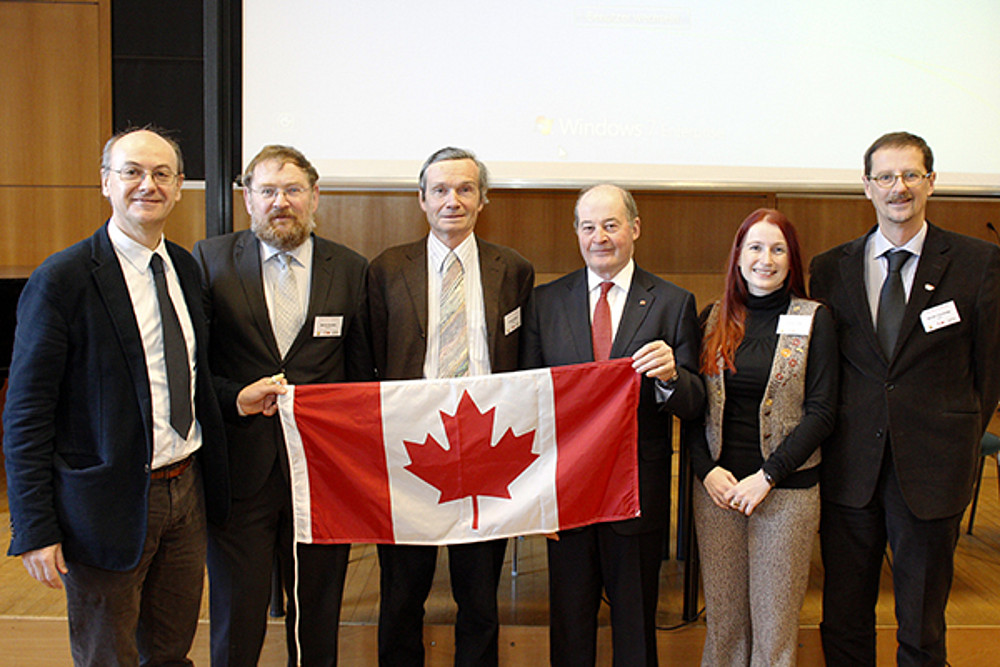
Klaus-Dieter Ertler (Uni Graz), Martin Kuester (Universität Marburg), Patrick Imbert, Alex McNiven, Botschaftrat, Botschaft von Kanada in Wien, Yvonne Völkl und Martin Löschnigg (Uni Graz). (v.l.)

Klaus-Dieter Ertler (Uni Graz), Martin Kuester (Universität Marburg), Patrick Imbert, Alex McNiven, Botschaftrat, Botschaft von Kanada in Wien, Yvonne Völkl und Martin Löschnigg (Uni Graz). (v.l.)

Tagung des Zentrums für Kanada-Studien an der Uni Graz

Zwischen 6. und 8. Dezember 2012 veranstaltete das Zentrum für Kanada-Studien der Universität Graz eine Kanada-Tagung mit dem Rahmenthema „Europe-Canada / Canada-Europe: Transcultural Perspectives / Perspectives transculturelles“. Es trafen sich renommierte KanadistInnen sowie NachwuchsforscherInnen aus Kanada, Deutschland, Italien, Polen, Rumänien, Serbien, Slowenien, Tschechien und Österreich, um ihre neuesten Ergebnisse vorzustellen.


Die englisch- und französischsprachige Tagung wartete mit zwei Hauptrednern auf: Martin Kuester, Professor an der Phillips-Universität Marburg und Präsident der Gesellschaft für Kanada-Studien im deutschsprachigen Raum (GKS), sprach in seinem Vortrag über die Zukunft der Kanada-Studien, nachdem das kanadische Subventionsprogram „Understanding Canada“ im Frühjahr 2012 dem Sparstift der kanadischen Regierung zum Opfer gefallen war. Der französische Vortrag stammte von Patrick Imbert, Professor an der Universität von Ottawa und Präsident der Academy of the Arts and Humanities innerhalb der Royal Society of Canada. Imbert adressierte in seinem Vortrag die Produktionen frankophoner Minoritäten außerhalb Quebecs. Die weiteren 22 Vorträge betrachteten die wechselseitigen Einflüsse zwischen Europa und Kanada und die daraus resultierenden Transformationsprozesse innerhalb der Literatur- und Kulturwissenschaften.


Unter den Tagungsgästen befanden sich der Botschaftsrat der Regierung von Kanada in Wien, Alex McNiven, sowie zahlreiche Studierende der Karl-Franzens-Universität Graz, Studierende aus Ungarn und weitere Kanada-Interessierte.


Das Zentrum für Kanada-Studien bietet eine interdisziplinäre Plattform für den Austausch wissenschaftlicher Kontakte. Es bündelt alle wissenschaftlichen Aktivitäten in Graz, die auf Kanada Bezug nehmen oder unter kanadischer Mitwirkung entstehen, und setzt seinen Schwerpunkt auf die Zusammenarbeit mit südosteuropäischen Universitäten.
created by Yvonne Völkl & Konstantinos Tzivanopoulos

Related news

What is ‘Dr AI’ supposed to decide, Giovanni Rubeis?

Analysing X-rays, documenting diagnoses, searching through databases: artificial intelligence is already providing significant support with administrative and routine tasks in the healthcare sector. To what extent should it be involved in clinical matters – that is, in treatment recommendations or treatment decisions? How do we prevent built-in biases that could be detrimental to certain individuals?

Commissioned by NATO: University of Graz tests high-tech textiles

As part of an international project, antimicrobial and fire-resistant fabrics with UV protection are being developed in Zagreb. Pharmacists from the University of Graz are ensuring that these fabrics are skin-friendly.

The Arctic up close: ORF special feature on the University of Graz’s research station in S

Students from the University of Graz are spending two weeks conducting research at the Univerisity of Graz research station at the Sermilik Fjord in Greenland, which has been operational for three years. They are measuring glacial runoff, tracking ice melt in real time and installing weather stations. ORF is following the expedition and will be reporting on the special feature ‘Arctic Adventure’ across its various channels from 20 July.

Medicine for ants: Caffeine prolongs the life of infected insects

Black coffee stimulates us and acts against bacteria. So, can caffeine also be good for insects? Yes, confirm biologists of the University of Graz. When ants suffer from a fungal disease, they consume more caffeine and remain active for longer.

Begin of page section:
Additional information:

University of Graz
Universitaetsplatz 3
8010 Graz
Austria
  • Contact
  • Web Editors
  • Moodle
  • UNIGRAZonline
  • Imprint
  • Data Protection Declaration
  • Accessibility Declaration
Weatherstation
Uni Graz

End of this page section. Go to overview of page sections

End of this page section. Go to overview of page sections

Begin of page section:

End of this page section. Go to overview of page sections